Showing posts with label Washington. Show all posts

Saturday, July 5, 2025

PBS Terra exclaims 'Wait...The Worst Possible US Disaster Just Got EVEN WORSE?!?'

The 4th of July is over and my blog has already passed its monthly page view goal, so it's time to write about topics worth sharing in August. Fortunately, PBS Terra's most recent video fits the bill, Wait...The Worst Possible US Disaster Just Got EVEN WORSE?!? (Cascadia Megaquake).

The Big One is coming and it could be far worse than anyone imagined.

The Cascadia Subduction Zone, just off the Pacific Northwest coast, is building toward a massive earthquake and tsunami. But new research reveals an even more terrifying possibility: widespread toxic spills, infrastructure collapse, wildfires, and deadly gas plumes. All triggered by a single seismic event.

In this episode of Weathered, we dig into the science behind the Cascadia Megaquake, why the Pacific Northwest is especially vulnerable, and how climate change could make it worse. We explore what you can do to stay safe and why your community might be your best line of defense.
This video is the latest in a series that began with PBS examines the risks from a major earthquake in the Pacific Northwest and continued with PBS Terra explains 'Here's EXACTLY What to Do When the Next Megaquake Hits: Cascadia Subduction Zone', PBS Terra asks 'What's the ONE THING You Can Do To Survive a Tsunami?', and PBS Terra explains 'How Scientists Solved the Mystery of a 300-Year-Old Megaquake'. It's also inspired a multi-year conversation between Infidel753, who lives in the Pacific Northwest, and myself that's played out in the comments, which then gets recycled in the next post in the series. This post is no exception. Here's the exchange from January.
Infidel753: The Portland metro area has two million people and Seattle is even bigger. Even if 125,000 people were killed on the Oregon coast and a similar number on the Washington coast, I would still expect the death toll from structural collapses and fire in Portland and Seattle to be much larger.

Me: I looked up estimates of deaths, injuries, and homelessness from a magnitude 9 earthquake in the Pacific Northwest and found these from Surviving Cascadia, themselves quoted from Oregon's Cascadia Rising Exercise document (PDF).

Coastal fatalities (Oregon): 4,800 (4,500 from tsumami, 300 from the earthquake itself)
I-5 corridor fatalities (Oregon): 400 (all from earthquake)
Coastal injuries (Oregon): 6,500 (5,000 from earthquake, 1,500 from tsunami)
I-5 corridor injuries (Oregon): 9,000 (all from earthquake)
Homelessness/needing shelter (Oregon): 520,000 (500,000 earthquake, 20,000 tsunami)
Coastal fatalities (Washington): 9,100 (9,000 from tsunami, 100 from earthquake)
I-5 corridor fatalities (Washington): 300-1,600 (300 earthquake, 0-1,300 tsunami)
Coastal injuries (Washington): 5,000 (2,000 earthquake, 3,000 tsunami)
I-5 corridor injuries (Washington): 7,400 (7,000 earthquake, 400 tsunami)
Homelessness/needing shelter (Washington): 415,000 (370,000 earthquake, 45,000 tsunami)

According to these estimates, more people will die from the earthquake along the I-5 corridor than along the coasts in both Oregon and Washington, but far more will die from the tsunami along the coasts alone (13,500) than the total that will die from the shaking throughout both states (1,100). So, no, the official estimates do not support your expectation that "the death toll from structural collapses and fire in Portland and Seattle to be much larger" than tsunami deaths on the Oregon and Washington coasts.

Infidel753: Very interesting links, thank you. I need to think further about this.

Me: Thanks for linking to the sources of these statistics and the blog as a whole in Link round-up for 18 January 2025. I'm glad to have informed you and your readers.
The statistics quoted are from a 2016 document, but the casualty numbers are higher than in the video, 43,800 total deaths and injuries in the document compared to "over 30,000 casualties" (total deaths and injuries) cited by Tina Dura of Virginia Tech. Surviving Cascadia also cites a 2022 study by Patrick Massey for FEMA that projects 1,100 earthquake-related fatalities, 13,000 tsunami-related fatalities, and 24,000 injured. The death count is substantially the same, but the number of injuries is less than the 27,900 predicted in the 2016 estimate, altough the 2022 report was for a February earthquake and tsunami. Casualties could be higher during the peak of tourist season. Cascadia Rising didn't list a dollar amount, but I can believe the video's estimate of $81 billion dollars of damage.

On the other hand, Luke Hanst of Portland State University added up to 2,500 deaths from toxic gas exposure resulting from burning fuel and chemical storage tanks and hundreds of thousands of people affected, adding tens of thousands of injuries. Even adding the 2,500 deaths to the 400 from the earthquake listed above for Oregon's I-5 corridor would not push it above the 4,800 deaths expected along Oregon's coast, but it does make the risk more even as well as much higher along the interior.

The video added two items of scientific interest, the effects of liquefaction and climate change. I make a big deal of the former when I lecture about earthquakes, especially the 1964 Alaska Good Friday earthquake. I might show this video to my geology students just to reinforce the point. Climate change will make the subsidence along the coast, which the video in January's post showed happening in 1700, even worse.

Finally, this isn't the first time Maiya May has described pro-social behavior in the aftermath of disaster. That might have been in PBS Terra's 'Weathered' asks 'Do You Need a Gun to Survive the Next Disaster?'
For what it's worth, I've seen similar, if not the same, findings about lower crime rates and increased cooperation after natural disasters and wrote about them five years ago in Seeker/DNews is optimistic about how people would behave during the apocalypse. As I wrote then, "that's good news, even if it might not be good entertainment."
Still good news.

That concludes the latest installment in this series. Stay tuned for the first Sunday entertainment feature of July. Awards shows!

Monday, May 19, 2025

Local news remembers Mount St. Helens eruption 45 years later

Yesterday was the 45th anniversary of the eruption of Mount St. Helens, and the news departments of television stations in the Pacific Northwest observed the occasion by compiling clips from their archives into special reports. I begin with KING 5 Seattle's Mount St. Helens Eruption: 45 Years Later.

A look back at the eruption of Mount St. Helens on May 18, 1980
KATU News in Portland produced its own special report, Past. Present. Future | Mount St. Helens 45th Anniversary.

May 18, 1980, is a day that forever impacted the Pacific Northwest.

After weeks of rumbling, Mount St. Helens unleashed a deadly and explosive eruption that would go down as the most destructive in U.S. history and changed the way we look at volcanoes in the Cascades.

This year marks the 45th anniversary of that monumental event.

Watch as we look back in time through the eyes of the people who lived through the eruption. Past. Present. Future. The 45th anniversary of Mount St. Helens.
I close with Mount St. Helens: Eyewitness to History, a KGW+ Special from KGW News in Portland.

On May 18, 1980, Mount St. Helens erupted with a force that reshaped the Northwest and stunned the world. In this KGW+ special, anchor Christine Pitawanich takes viewers through the days leading up to the eruption, featuring rare archival reports, first-hand accounts from journalists and radio volunteers, and powerful footage of the moment disaster struck. With voices from those who witnessed the destruction — and those who didn't survive — it's a moving look at one of the most significant natural disasters in U.S. history, and how it changed science, policy, and lives forever.
While I'm not teaching geology this summer, I am scheduled to teach three sections of it this fall, two sections next winter, and one section next summer, if it's not canceled for low enrollment. These local documentaries both updated me on the status of Mount St. Helens and will provide opportunities for extra credit to my future students. Welcome to blogging as professional development.

Since I'm in the middle of a series on the News & Doc Emmy Awards, I'm wondering if any of these will earn nominations for regional coverage at next year's ceremony. My readers and I will find out next year. In the meantime, stay tuned for World Bee Day tomorrow.

Monday, January 6, 2025

PBS Terra explains 'How Scientists Solved the Mystery of a 300-Year-Old Megaquake'

I closed PBS Terra explains 'The AMOC Might Be WAY More Unstable Than We Thought...Here's Why' with a preview of coming attractions.
I'm not the only one recycling a subject; PBS Terra's previous video is the latest in a series that began with PBS examines the risks from a major earthquake in the Pacific Northwest and continued with PBS Terra explains 'Here's EXACTLY What to Do When the Next Megaquake Hits: Cascadia Subduction Zone' and PBS Terra asks 'What's the ONE THING You Can Do To Survive a Tsunami?' I will almost certainly cover that in a future entry...Stay tuned.
Without any further ado, here is that video from PBS Terra explaining How Scientists Solved the Mystery of a 300-Year-Old Megaquake.

The 1700 Cascadia earthquake and tsunami was a massive natural disaster that reshaped the Pacific Northwest. Through tree rings, soil layers, and international collaboration, scientists have pieced together the exact timing of the event. As the region braces for another quake, can we prepare in time? Find out how new models and tsunami evacuation towers are helping coastal communities face the threat.
This video shows that it took the efforts of people in multiple disciplines, geology, biology, and history, to decipher the evidence and connect it all together into a coherent reconstruction of the event in 1700. It also shows, like the previous episodes, how people are preparing for the next event. One of those preparations are escape towers. As I wrote last year, "my first instinct if I can't get away from the shore would be to climb up, so I'm relieved to see people building vertical escape structures. Now to build more than three in the U.S." If they're all as well-stocked as the Shoalwater Tribe's, then the people should be in good shape to survive the tsunami.

Follow over the jump for the comments from last year's post.

Saturday, June 22, 2024

PBS Terra on redwoods and moss for World Rainforest Day

Happy World Rainforest Day! Today is the first time I'm celebrating the environmental holiday with a dedicated post during an even-numbered year — progress!

As I have the past two times I observed World Rainforest Day, I'm blogging about the temperate rainforest of the Pacific Northwest, particularly the Coast Redwood forest of California, beginning with PBS Terra explaining Redwoods Shouldn't Be So Tall. Here's Why They Are.

Beyond its iconic height, the Redwood Forest is sacred to the Yurok Tribe and a scientific frontier for the study of vast biodiversity that exists nowhere else on Earth. This episode of Untold Earth explores the varied relationship between The Redwoods, their forest ecosystems, and the humans who live and work among them. Asking, at every turn, what makes these trees epically singular in nature?
This is a sequel of sorts to the PBS Terra video I embedded in last year's post. Like that video, I've shown it to my students. Welcome to blogging as professional development.

Going from the tallest plants in the temperate rainforest to the smallest, I'm sharing PBS Terra telling its viewers You Aren’t Paying Enough Attention to Moss.

Mosses were among the first land plants to evolve out of the ocean roughly 450 million years ago. It grows everywhere, from the world’s harshest landscapes to cracks in the sidewalk. This episode of Untold Earth gets up close and personal with the mosses of the Hoh Rainforest to understand their vital role in this ecosystem and potential to offer a glimpse into our planet’s future.
If I haven't already shown this video to my students, I should and probably will, as I will lecture on mosses on Monday. Again, welcome to blogging as professional development.

Before I leave today, National Day Calendar has updated its photo once again.

June 22 is World Rainforest Day to raise awareness and encourage everyone to set some time aside to join the fight to protect rainforests. Join us today as we encouraging action to protect them.
That's both the message for today and a wrap for today's environmental holiday post. Stay tuned for the final consecutive holiday entry, a double celebration of Souther on Detroit-Style Pizza Day. Wombats eating pizza instead of ice cream!

Tuesday, March 12, 2024

Marching music for primaries in Georgia, Mississippi, and Washington plus Democrats Abroad

I closed Four years of the COVID-19 pandemic by telling my readers "Stay tuned for this year's edition of Marching music for the Washington, Mississippi, Democrats Abroad, and Georgia primaries." I'm going in alphabetical order by state, which happens to be by poll closing time east to west, followed by a non-North American drum corps and Rose Parade band to represent Democrats Abroad. I kick off the music to watch and listen while waiting for results with with Spirit of Atlanta | #DCI2021 | "Bottle Tree" from Drum Corps International (DCI).

Spirit of Atlanta of Atlanta, Georgia, performs a segment from the corps' #DCI2021 production, "Bottle Tree," during the DCI Celebration events hosted August 12-14 at Lucas Oil Stadium in Indianapolis.
DCI hasn't uploaded any more recent shows, so I'm following up with Spirit of Atlanta – "Up Down and All Around" | DCI Finals 2023 from Pageantry Innovations, which at least isn't a bootleg of the FloMarching video, so it will stay up.

Enjoy Spirit of Atlanta's 2023 production, “Up Down and All Around” from the perspective of their synthesizer performer & audio engineer.
Much like Vic Firth Marching, a drum stick maker whose videos I've embedded as part of this series, Pageantry Innovations is an instrument and equipment maker, in this case the carts for the synthesizers and soundboard. That makes this advertising, but I'm O.K. with that.

Georgia also has an all-age corps, Atlanta CV. Watch Atlanta CV Drum & Bugle Corps 2018 Show Clip By Box5TV, an official clip from Drum Corps Associates.

Provided by Box5TV, enjoy this show clip of the 2018 AtlantaCV from DCA World Championships!
Follow over the jump for the rest of the drum corps and marching bands representing Georgia, Mississippi, Washington, and Democrats Abroad.

Wednesday, January 31, 2024

PBS Terra asks 'What's the ONE THING You Can Do To Survive a Tsunami?'

Weathered on PBS Terra returns to the topic of PBS examines the risks from a major earthquake in the Pacific Northwest and PBS Terra explains 'Here's EXACTLY What to Do When the Next Megaquake Hits: Cascadia Subduction Zone' with What's the ONE THING You Can Do To Survive a Tsunami? Cascadia Subduction Zone.

While tsunamis happen all over the world, really big ones are rare. But, they can be truly devastating. And what’s more, the West Coast of North America is overdue for a subduction zone earthquake and tsunami that has the potential to be the biggest disaster the U.S. has ever seen. So, what is the single most important factor determining whether or not YOU survive a tsunami? Watch this episode to find out.
I begin my reaction by recycling the conversation Infidel753 and I and in the comments to PBS Terra explains 'Here's EXACTLY What to Do When the Next Megaquake Hits: Cascadia Subduction Zone'.
Infidel753: Living in Portland, I worry about this a lot. I may actually move, if I can ever afford to. At least the apartment complex I live in is one of those "stick buildings", so it probably wouldn't collapse, but the disruption to water, sewage, transport, and everything else is likely to be horrific, and not quickly fixed.

Me: I can relate. Although they're down the list, earthquakes are one of the things I don't miss about California now that I live in Michigan. As I wrote last year: "the prospect of this quake has dissuaded my wife and me from moving to the Pacific Northwest when I retire." It might make you move out when you retire.
My wife and I just talked about this last week and it reinforced our decision not to move to Seattle or Portland, as lovely as those cities seem in Grey's Anatomy or Grimm — and that's even with the fairy tale monsters in the latter!

As for the answer to the question in the title, it's reaction time and my first instinct if I can't get away from the shore would be to climb up, so I'm relieved to see people building vertical escape structures. Now to build more than three in the U.S.

This concludes January's blogging. Stay tuned for February. Leap year month!

Sunday, June 18, 2023

The 'Mother of Father's Day' plus 2022 was a great year for 'Star Wars' names

Happy Father's Day! For today's celebration, I'm revisiting the themes of two previous observances, beginning with the history of Father's Day, which I last examined in 2020, from History of Father's Day: Founded in Spokane by KREM 2 News.

Father's Day originated in Spokane in 1910. Here's more about the woman behind it and how it became a national holiday.
Thank you, Sonora Louise Smart Dodd, for thinking of Father's Day and doing the work to make it a national holiday.

Follow over the jump for a follow-up to the Star Wars part of Kylo passes Anakin while Arya and Khaleesi fall in popularity, baby names from entertainment for the Father's Day weekend, which qualifies this entry as the Sunday entertainment feature.

Wednesday, October 19, 2022

PBS Terra explains 'Here's EXACTLY What to Do When the Next Megaquake Hits: Cascadia Subduction Zone'

PBS Terra's Weathered series just uploaded a sequel to the video I embedded in PBS examines the risks from a major earthquake in the Pacific Northwest, Here's EXACTLY What to Do When the Next Megaquake Hits: Cascadia Subduction Zone.

Subduction zone earthquakes are the largest and most destructive on earth. In 2004 a 9.1 megaquake hit Sumatra off the coast of Indonesia, unleashing a massive tsunami and killing 227,898 people. And in 2011, the Tohoku earthquake struck Japan, killing around 20,000 and triggering the infamous Fukushima nuclear disaster. In the Pacific northwest lurks the Cascadia Subduction Zone, which has been dormant for centuries and is overdue for its next “big one.”

In this episode we’re going to tell you what experts think is the best way to survive this inevitable disaster.
I was trained to drop, cover, and hold growing up in Los Angeles and I even tell my students about one time I did that when the Whittier Narrows Earthquake hit. The earthquake shook me awake in bed and I jumped out bed, past an office chair, and under the oak desk that my father had left me when he gave me his home office for my bedroom. I stayed there until the shaking stopped, at which point I got up, got a muffin out of the refrigerator, poured myself a glass of orange juice, and ate breakfast outside until the power came on again. Then I went into the house and watched the news to see what had happened. That's where I stayed, as I certainly wasn't going to work on building L.A.'s subway right after an earthquake. I was sure it would be closed for inspection, and it was.

That was one story I tell my students. Another is the previous PBS Terra video I embedded last year. I don't know if I have time to show this one as well and I'm not sure I should replace last year's video with this one. Stay tuned to see if I do. In the meantime, welcome to blogging as professional development.

Saturday, August 21, 2021

'Murder hornets' return for World Honey Bee Day

Happy World Honey Bee Day! As i did last year, I'm observing today by sharing the latest news about a potential major thread to honeybees, "murder hornets" or as the are more properly called, Asian Giant Hornets. I begin with Washington state reports first murder hornet sighting of 2021 from Good Morning America.

State officials released a photo of the dangerous insect attacking a wasp nest, asking residents to keep an eye out and report any sightings to the Washington State Department of Agriculture.
As noted in the comments, it's oddly appropriate that Good Morning America reported this story on Friday the 13th. It certainly was an unlucky day for honeybees in the Pacific Northwest.

Help is on its way, as Reuters reported yesterday Washington researchers hunt down 'murder hornets'.

The first Asian giant hornet nest of the year has been found in Washington state, and plans are being developed to eradicate it, likely next week, the state's agriculture department said.
The report shows the team from the Washington state Department of Agriculture eradicating a nest of Giant Asian Hornets on Food Day last year, so they have experience. That's a good thing. As I wrote on World Honey Bee Day last year, "For the sake of the bees, I hope Chris Looney and the people who work with him at the Washington state Department of Agriculture succeed in preventing 'murder hornets' from becoming established. Bees have enough problems."

Before I leave, I'm sharing this comment exchange I had in IF THE COVID DOOMSAYERS ARE RIGHT, EXPECT A LOT MORE INFECTIONS -- AND MAYBE A GOP WAVE ELECTIONat No More Mister Nice Blog.

Regular commenter Cleto Safari di Moderna posted a link to The Daily Beast's story about the return of "murder hornets" and asked "I wonder if the 'Killer Bees' would resist the 'Murder Hornets' more effectively than other honeybees?" I couldn't resist answering his question.
Take it from this zoologist, the answer is no. Africanized bees might put up a more aggressive defense of their colony than non-Africanized bees, but it won't be enough as their stings won't be any better at penetrating the Asian Giant Hornet's exoskeleton than any other honeybee. Japanese honeybees know better; they cook the hornets instead.
Watch Hornets from Hell by National Geographic to see that in action.

Japanese giant hornets pack a venomous sting so strong it can dissolve human tissue. But when a hornet scout enters a beehive, watch as the bees turn the tables on their enemy — and literally bake the predator to death!
As Cleto Safari di Moderna responded to my answer, "Mmm...hornet teriyaki..."

Tuesday, July 6, 2021

PBS examines the risks from a major earthquake in the Pacific Northwest

I foreshadowed today's topic in the footnote to Drought, fire, and mudslides in California, a story I tell my students.
All that is before I lecture about earthquakes, which really freak my students out. I have a video from PBS NOVA to share about that risk, too. Stay tuned.
Without any further ado, I present that video, The Pacific Northwest is due for a Major Earthquake.

An 8.0-magnitude-plus earthquake hasn't rumbled beneath the Pacific Northwest since the 1700s. Now, the region is due for the next "big one" and a subsequent tsunami. Coastal Indigenous communities could be severely affected. (Already, the Shoalwater Bay Tribe is constructing a tsunami tower to give their residents a better shot at survival in the face of this kind of natural disaster.)

Clues from the past—paired with modern-day science—can help us better understand why this area is at risk and how to best mitigate an earthquake and tsunami's effects.
Note the use of "contiguous United States." That excludes Alaska's Good Friday Earthquake of 1964, which had a magnitude of 9.2. That will probably remain the most powerful earthquake to stike the United States as a whole for the foreseeable future. Also, strictly speaking, the area affected by the 1700 earthquake wasn't part of the United States yet or territories of any colonial power, which is why I mention both the New Madrid earthquakes of 1811-1812 and the San Francisco earthquake of 1906 to my students as the largest temblors to strike the Lower 48. Still, I might add this quake to my lecture. If I did, I would more likely show PBS Terra asking Will the Cascadia Earthquake be the Worst Disaster North America’s Ever Seen?

The Cascadia Subduction Zone is a sleeping monster lurking just off the Northwest coast of the United States. It extends 600 miles between Northern California and Vancouver B.C. and experiences a massive megathrust earthquake every 250 years on average. The last one happened 321 years ago and scientists say there is a 30% chance we’ll see another in the next 50 years. It’s expected to rival the 9.0 quake that shook Japan for 6 minutes, which was the most destructive natural disaster in human history. It unleashed a tsunami that reached 100 feet in some areas, caused an estimated $360 billion in damages and claimed some 16,000 lives.

If this sounds ominous, that’s because it is. As catastrophic as the Tohoku quake was, Japan is light years ahead of the United States when it comes to earthquake preparedness. This grim reality has many experts very worried. And in this episode of Weathered we spoke with some of them about what we can expect when the “Big One” does hit, the kinds of work that need to be done to make our communities more resilient, and what you can do to keep yourself and your loved ones safe.
In addition to showing the destruction from the Fukushima earthquake and tsunami for comparison, PBS Terra's video depicts the kind of damage the projected quake would inflict on the Pacific Northwest, which will impress my students. It also explains what can be done to prepare for the quake. Maybe that will scare my students less. Just the same, the prospect of this quake has dissuaded my wife and me from moving to the Pacific Northwest when I retire. So has the area no longer being immune to extreme heat.

I'm not done with natural disasters this week. NOAA predicted another active Atlantic hurricane season with "13 to 20 named storms (winds of 39 mph or higher), of which 6 to 10 could become hurricanes (winds of 74 mph or higher), including 3 to 5 major hurricanes (category 3, 4 or 5; with winds of 111 mph or higher)." So far, that's coming true with the fifth named storm and first hurricane, Elsa, which Accuweather forecasts will make landfall north of Tampa, Florida tomorrow morning before moving up the Atlantic coast of the U.S. and Canada the rest of the week. That will cause a lot of damage and news coverage, which I plan on reporting here. Stay tuned.

Tuesday, March 10, 2020

Marching music for the Michigan, Washington, Mississippi, and Democrats Abroad primaries


Once again, it's time to share some marching music for my readers to watch and listen while they are waiting for the results from six states, Michigan, Washington, Missouri, Mississippi, Idaho, and North Dakota, plus Democrats Abroad.  Two of these states, Michigan and Washington, have competitive drum corps.  In addition, Democrats Abroad allows me to feature a corps outside of the United States other than the Canadian corps I feature for Canada Day.  Finally, one of my favorite HBCU bands is from Mississippi, Jackson State University.  May my readers enjoy all of them as much as they did the corps I included in A drum corps Super Tuesday 2020, which is one of the 20 most popular entries of the ninth year of this blog.

I begin with the corps from my adopted home state of Michigan, which happens to be both the most populous state having an election today and the first one to vote, Legends from Kalamazoo.  It's also the highest placing of the two corps, coming in 21st last year.  Without any further ado, watch Legends playing their 2019 program, Siren, at Semifinals.


Normally, I'd embed the most recent show clip from Drum Corps International's YouTube channel, but that is from 2014.  Not only is it not as good a competitive performance as last year's show, but it was a French-themed show, which I'd rather save for Bastille Day.  After all, I'm an environmentalist.  Not only do I recycle, I conserve my resources.

Next, two clips of Washington state's top corps, the Seattle Cascades.  First, the most recent official show excerpt from DCI's channel, 2019 Seattle Cascades | Off the Grid.


Seattle, WA | 25th Place | 73.275

Now, the most recent full show upload from the Seattle Cascades' official channel, Seattle Cascades - Set Free (Full Show), the corps' 2017 program.

Repertoire
• One Thousand Airplanes on the Roof by Philip Glass
• Labyrinth by Philip Glass
• Scenes of Memory by Philip Glass
• Fly to Paradise by Eric Whitacre
• Symphony #10, movement 2 by Dmitri Shostakovich
• Bird Set Free by Sia

Set Free opens with "1000 Airplanes on the Roof".  As does the poem, we begin with the free bird having power and “naming the sky his own” while acting on inborn impulses to fly and float on the sky.

The show continues forward, as does Angelou’s work, with a more ominous tone in "Labrynth", as the caged bird experiences darkness, pain, and fear. Reduced to an unnatural and lesser version of itself than the free bird, the caged bird cannot fly yet retains the desire to be free and to find self-expression. Here various performers are trapped by the caged and “open their throats to sing.”

The program takes an adventurous turn with "Scenes of Memory" as we return to the escapades of the free bird. Ultimately the thoughts of freedom are oppressed and eventually trapped at the end of the production.

As the program continues with "Fly to Paradise", we again experience the idea of longing for freedom.  The final production is a juxtaposition of two oppositional pieces of music ("Symphony 10, mvt. II" by Shostakovich and "Bird Set Free" by Sia) that each have a message of their own; one being that of oppression and the other of freedom. The show ultimately concludes with one idea winning out over the other.
Follow over the jump for the rest of the videos.

Sunday, November 3, 2019

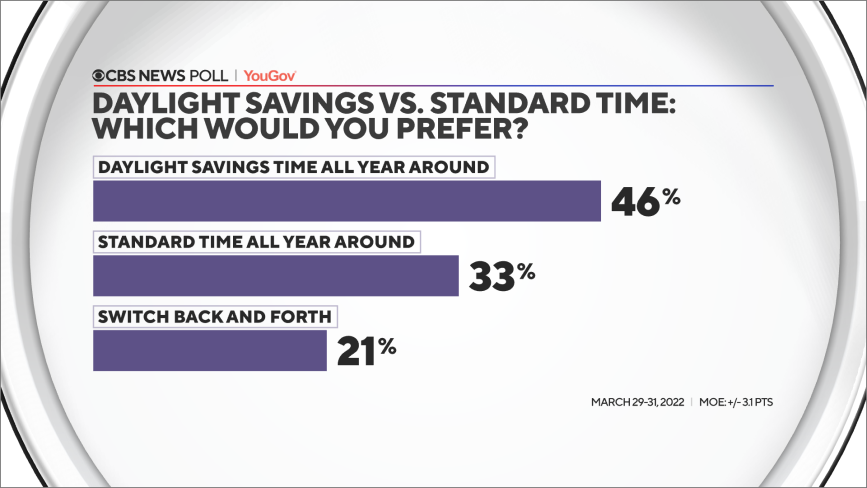
Majority of Americans want to stop changing their clocks twice a year


I closed Fall back for the end of Daylight Saving Time even though it affects health and increases traffic accidents by writing "Americans are getting tired of switching back and forth between Standard Time and Daylight Saving Time, having decided Daylight Saving Time sucks."  WMTW-TV in Portland, Maine reported the depth of that dislike in Majority of Americans want to do away with daylight saving time.

A new poll finds a majority of Americans want to get rid of daylight saving time all together.
70% of Americans are tired of switching the clocks back and forth, while only 30% want to keep doing it.  Americans don't agree yet on which time to stay on, Standard or Daylight Saving.  However, that hasn't stopped states from trying to please their residents by stopping the back-and-forth.  Unfortunately, it literally requires an act of Congress to finish the job.  Follow over the jump for reports about three states that have voted to stop the twice-annual changeover and five more that are considering doing so.

Sunday, March 10, 2019

Many states considering bills ending or keeping Daylight Saving Time permanently


Last year I told my readers to spring ahead for Daylight Saving Time even if you hate it.  It turned out that a lot of my readers dislike changing their clocks back and forth, making Daylight Saving Time (sucks) one of the themes for the most read entries during this blog's seventh year.  They're not alone.  Last fall, I wrote that four states were considering ending or keeping Daylight Saving Time permanently.  One of those states was California, where voters passed a proposition to remain in Daylight Saving Time year-round.  CBS 47/KSEE 24 in Fresno reported the results on its YouTube channel, the text of which I'm quoting here.
In November, California voters passed Proposition 7 by a 60-40 percent margin, paving the way for year-round daylight saving time in the nation's most populated state.

The proposition still needs a change in federal law and a two-thirds vote from the state legislature to go into effect, CBS Sacramento reports. Assembly Bill 7, proposed in December, has not yet been voted on by lawmakers, it has been referred to a committee.

Supporters pointed to a study showing an increased risk of car accidents and heart attacks following the spring change, due to the loss of an hour's sleep.

Opponents of the proposition argued that even if California voters and the legislature approve of year-round daylight saving, the hurdle of getting the federal government to approve is too high, considering the state's tense relationship with Washington.

They also say the switch will cause its own headaches. If California goes to year-round daylight saving, the sun wouldn't rise until 8 a.m. during some winter months, forcing children to walk to school or buses in darkness and likely leading to an increase in car and pedestrian accidents.
California isn't the only state that wishes to remain in Daylight Saving Time.  I also wrote about Florida's Sunshine Protection Act, which requires Congressional action to be implemented.  That hasn't happened yet, so Fox 4 in Naples/Ft. Myers reported Florida legislators push to make daylight savings time year-round.


CBS Miami has a better description.
A group of Florida lawmakers are tired of the Sunshine state springing forward and falling back every year. Senators Marco Rubio, Rick Scott and Representative Vern Buchanan have introduced legislation that would make Daylight Saving Time permanent, not only in Florida, but also across the country.
I normally don't support Republican-sponsored legislation, but in this case, I'm on Rubio's side.  After all, even a stuck clock is right twice a day, pun fully intended.

Those are the states that have taken a vote of one kind or another to stop changing clocks twice a year.  According to the National Conference of State Legislatures, twenty-six other states are considering joining them, either by staying on standard time year-round or changing to Daylight Saving Time year-round.  Follow over the jump for news clips and quotes from articles about those states.