A blog about societal, cultural, and civilizational collapse, and how to stave it off or survive it. Named after the legendary character "Crazy Eddie" in Larry Niven and Jerry Pournelle's "The Mote in God's Eye." Expect news and views about culture, politics, economics, technology, and science fiction.
I shared this at my DreamWidth, where I wrote "If the National Forest Service had been hiding in the bunker, the National Park Service might have been snotty to it." I know, I worked for the National Park Service.
The “big beautiful bill” is actually the ugliest piece of anti-environmental legislation and deepest cut to Medicaid in our nation’s history. Time to call our senators!
It's too late for the "Big Brutal Bill," but it's not too late to affect theshutdown. I couldn't avoid the subject entirely!
Hurricane season in the Atlantic Ocean starts June 1 with NOAA forecasting six to ten storms that will earn names on the list of hurricanes this year. CNN meteorologist Allison Chinchar reports, and CNN’s Victor Blackwell speaks with former FEMA administrator Deanne Criswell about the state of hurricane preparedness.
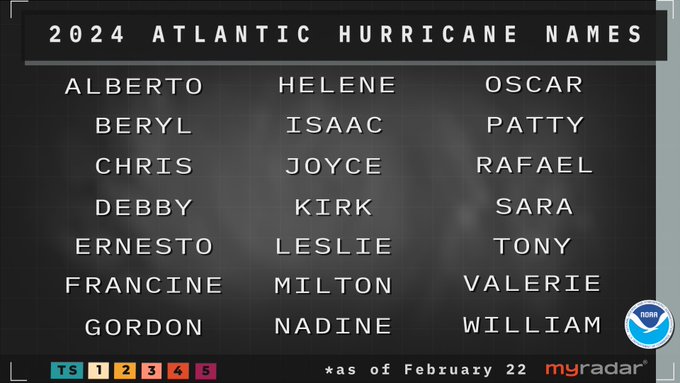
First, the charts, beginning with the list of storm names.
The new storm name is Dexter, replacing Dorian. I expect to see Dexter memes when it develops, especially if becomes a threat to the mainland U.S. Serial killer vibes!
Now for the numbers.
Most of the forecast range is above average, which the next chart shows as a 60% chance of an above average season.
Stay tuned to see if I resume my coverage of the News & Doc Emmy Awards, or if I post tonight's monologues instead. It depends on whether the comedians return tonight and if I feel up to a long awards nominations post.
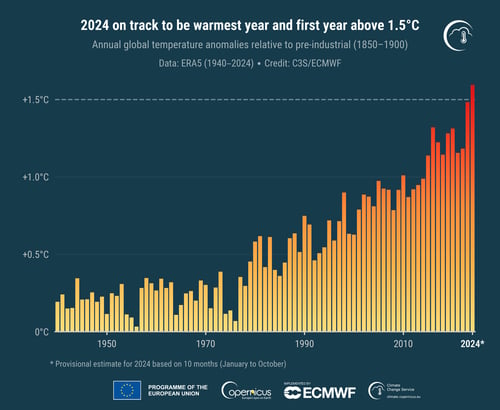
In 2024, billions of people across the world faced climatic conditions that broke record after record: logging ever more highs for heat, floods, storms, fire and drought. As the year drew to a close, the conclusion was both blatant and bleak: 2024 was the hottest year since records began, according to European climate scientists. Story by Alice Brogat, Axelle Simon and Eliza Herbert.
1. Chasing Ice opens with a montage of natural disasters. Name three of them.
The three that come to mind are floods, fires, and droughts. All of those, along with dangerous heatwaves and stronger hurricanes and tropical cyclones, appear in this report. For what it's worth, those are also among the possible answers to a question I ask about Treasures of the Earth:Power: "What are the expected effects of global warming? List three examples." Back to Chasing Ice.
2. How many of the past 20 years, as of 2012, were the hottest on record?
As of 2012, 16 were the hottest on record. According to the image below, it looks like it's now 17, as 1998, 2002, and 2003 fall outside the past 20 years, although the past ten years remain the hottest decade on record.
2024 has been a landmark year for climate change, with record-breaking heat and extreme weather events dominating the globe. From the Sahara’s rare floods to the Arctic’s rapid melting, the planet is feeling the heat. But there’s hope too—renewable energy is booming, and conservation efforts are gaining momentum. Join us as we reflect on the highs and lows of a tumultuous year.
Good news that I can share with my students, but not nearly enough to inspire me to post ProfessorFarnsworth. Still, welcome to blogging as professional development.
So far, this season's 18 named storms, including 11 hurricanes and 5 major hurricanes, have borne out NOAA's 'Most Aggressive Hurricane Season Forecast On Record' for 2024, which predicted 17–25 named storms, 8–13 hurricanes, and 4–7 major hurricanes. I might revisit this and other forecasts next month. Stay tuned.
There's been no change since I wrote this, so I think ABC News's report suffices.
It's early enough that I might post an entry about the year's best TV shows today. Stay tuned to see if I do, followed by the overall year in review for New Year's Eve.
In the second of our pre-election series we look at America and... climate change. How could Kamala Harris or Donald Trump shape the global response to the climate crisis?
...
As one of the world’s largest producers of fossil fuels and carbon emissions, the US plays a pivotal role in addressing climate change. The environmental policies of the next president could reshape American industry and the economy, while influencing the global fight against climate change.
Sumi Somaskanda speaks to the BBC’s climate editor Justin Rowlatt and Carl Nasman, who covers US climate issues for the BBC.
Project 2025 is calling for the breaking up of the National Atmospheric and Oceanic Administration (NOAA). Monica Medina, former Assistant Secretary of State for Oceans and International Environmental and Scientific Affairs, joins Morning Joe to discuss as Hurricane Milton is set to hit Florida.
That's damage that's already been done and needs to be repaired. I'd rather not imagine the impact of breaking up NOAA, which paid my salary twice. That would make the consequences of extremeweather and other natural disasters worse.
This year’s presidential election will determine the fate of our democracy and, with it, hard-won environmental and climate gains. Project 2025, the conservative playbook for another Trump term, promises to completely eviscerate climate policy and empower Big Oil. Activist and author Bill McKibben and Monica Medina, a former top climate official at the State Department, DoD, and NOAA, join Ali Velshi to discuss what’s at stake this November. 'Biden has done more to support clean energy by far than any president before,' says McKibben. Trump “won’t just politicize the weather – he will weaponize it,” warns Medina.
Not only did McKibben imagine what a U.S. without NOAA would be like, he compared it to convictedcriminalDonald Trump's response to the pandemic, "if we don't know, then we don't have to talk about it." He also brought up Ron DeSantis forbidding mention of climate change in Florida's official documents, all while the Sunshine State was already facing one of the worst hurricane seasons forecast. So far, that dire prediction is coming true. Speaking of which, Trump weaponizing the weather against his enemies isn't a prediction; it already happened during his time as President.
I have three more MSNBC videos about Project 2025 and climate policy to share, but I have papers to correct and dinner to grill, so I'm saving them for part 9. In the meantime, stay tuned for a highlights post of tonight's Saturday Night Live as the Sunday entertainment feature. Ariana Grande and Stevie Nicks!
The National Oceanic and Atmospheric Administration (NOAA) released its outlook for the 2024 Atlantic Hurricane Season today (May 23, 2024), and it's the most aggressive forecast on record. Our hurricane expert Dr. Rick Knabb breaks it down.
If NOAA, The Weather Company, and Colorado State University (CSU) are correct, then this season will exhaust the primary list of names, which has only happened three times before, 2005, 2020, and 2021. It almost happened last year, when there were 19 named storms, leaving one of my names and my ex-girlfriend's name unused. That means that our names will stay together until 2029, more than 20 years after we broke up. As I wrote in 2022, ironic.
Here are this year's Atlantic storm names. Fortunately, most of them have no special significance to me.
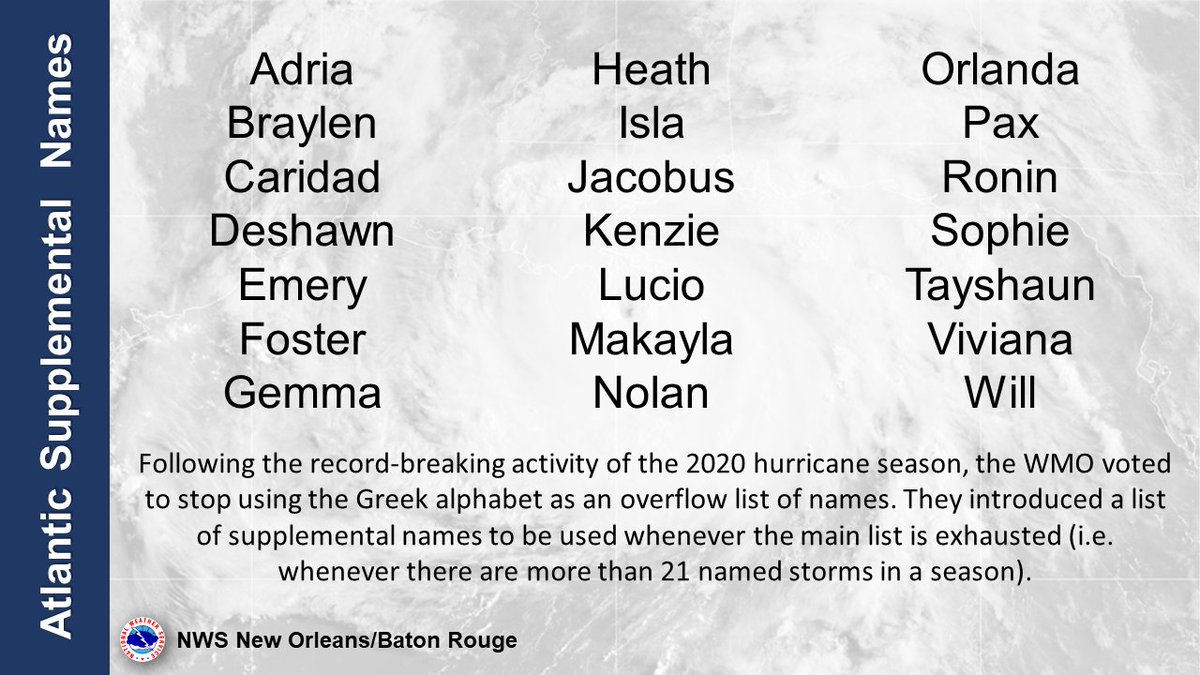
Now the overflow list of storm names.
If the forecast is correct, we're likely to see some from the first column before the year is over.
AccuWeather hurricane experts are concerned that storms could rapidly intensify during the 2024 hurricane season due to high ocean temperatures, low wind shear, and abundant moisture. Hurricane season starts this Saturday, June 1.
Legend has it that if he sees his shadow then winter will continue for another six weeks but if Punxsutawney Phil does not see his shadow spring will come early.
Woody the Woodchuck made her prediction for the season during the Howell Nature Center’s annual Groundhog Day Celebration on Friday, Feb. 2, 2024.
Woody saw her shadow and was scared back into her den. Rep. Elissa Slotkin was on hand with a proclamation from Congress thanking the Howell Nature Center for it's work for the community.
Woody the Woodchuck, Michigan’s official groundhog who resides at the Howell Nature Center, began forecasting the weather in 1999. Since then, those at the center say she’s had a nearly 70% accuracy rate in her predictions.
This is one of the reasons I pay attention to Woody as well as Phil. Another is that her predictions are for Michigan, where I live, which could have entirely different weather than Pennsylvania, so both animals could be right.
Speaking of Phil, MLive had this to say.
Although he has a much longer track record, Punxsutawney Phil, on average, has only gotten his prediction right 30% of the time in the past 10 years, according to the National Oceanic and Atmospheric Administration’s National Centers for Environmental Information.
“It’s nice to be able to rave that we’re better than Punxsutawney,” Tina Bruce, Howell Nature Center CEO, said. “I just think Woody does a much better job for her residents and her state.”
This year, Phil did not see his shadow from his home in Gobbler’s Knob in Punxsutawney, Pennsylvania meaning he thinks spring is coming early.
While the staff at the Howell Nature Center are actually observing Woody's behavior, I suspect the handlers at Gobbler's Knob are checking the long-range forecast instead. Follow over the jump for NOAA's U.S. climate outlook for February 2024.
We’ve all heard that we should keep global climate change under 2 degrees of warming, but did you know that there are many places around the globe that have already surpassed that? Some places around the globe are experiencing extreme warming, while other places have actually seen some cooling. So what’s with all the variation?
In this episode of Weathered, we’ll talk with a couple climate scientists from NOAA to dive deep into the numbers, and we’ll call up a resident of the fastest warming county in the U.S. to see what it's like.
Weathered is a show hosted by weather expert Maiya May and produced by Balance Media that helps explain the most common natural disasters, what causes them, how they’re changing, and what we can do to prepare.
That's a good explanation for the stair-stepping pattern of warming over the past half-century in general and the temperature plateau since 2016 in particular, with 2020 only tying 2016. That's because of relatively weak El Niño years and three strong La Niña years in a row. As the video points out, El Niño is back in 2023, and that means higher temperatures globally and especially in the U.S. Prepare for a hot summer and a mild winter. The first isn't good, while the second will likely elicit a response like the skit in Classified documents leak headlines 'Weekend Update' on 'SNL'.
"It's mid-April here in New York City and the temperature hit 90 degrees this week, a full two months ahead of schedule. And while that may be terrifying on a climate level, the warm weather can only mean one thing. All the freaks, crazies, and weirdos are heading to Central Park." Yes, it is terrifying on a climatechange level, but after even a mild winter, a week of summer temperatures would be considered "good weather" this time of year. Let's see if people still think that should the northeast and midwest suffer from excessive heat waves this summer.
HappyWorldOceansDay! For this year's celebration, I'm pulling a video out of the archives, World Ocean Day (sic) from 2012 by NOAA's National Ocean Service.*
Celebrate World Ocean[s] Day with this video from NOAA's Ocean Today!
While I mentioned NOAA in my first World Oceans Day post nine years ago, I have not done so since. It's about time I featured a video from one of my former employers to observe today's holiday.
With more than 70% of the earth’s surface covered by the ocean, one has to wonder who thought it was a good idea to name it Planet Earth! Explore the wonders of our blue planet in this fact packed one-minute watch.
*NOAA pretty consistently calls today World Ocean Day, something I hadn't noticed until now. Maybe that's why I hadn't featured their videos for today.
With the damage caused by the remains of Hurricane Ida fresh on their minds, some New York City residents are bracing for another active hurricane season. CBS2's Christina Fan and Lonnie Quinn report.
While I think CBS New York did an excellent job of depicting the human impact of Hurricane Ida, I found its explanation of the science behind the storm season prediction a bit lacking compared to ABC 13 Houston's NOAA predicts above average Atlantic hurricane season, releases storm names, which includes the primary list for names for 2022's tropical storms and hurricanes.
Chief Meteorologist Travis Herzog explains NOAA's 2022 hurricane season predictions.
I have a personal interest in this season, as one of my names is on this list, just like it was on the lists for 2010, when it actually was used, but I don't recall noticing it then, and 2016, when it wasn't. I paid more attention when another of my names appeared in the 2005 list, when it was used, as that was the first time there were more storms than names, just like 2020. I paid even more attention in 2011, when that name appeared next to my ex-girlfriend's. We broke up more than 15 years ago, but we're still together as hurricane names and will be until at least 2023. Ironic.
Speaking of named storms, if this season results in 21 named storms, it will be the third consecutive year that all names on the primary list will be used. Yikes! That's enough to make me conclude by being a good environmentalist and recycling what I last wrote in August 2021.
A new report from NOAA shows alarming new predictions for sea level rise. Katy Tur sat down with Michael Mann, Penn State Distinguished Professor & Director of their Earth Systems Science Center, to talk about the report and what can be done to protect the climate.
First, those maps of selected coastlines are horrifying. The one of Florida seems to show more of Tampa Bay being flooded than Miami, which the third video explores. Second, Dr. Mann's comments about melting ice sheets reminds me of "Chasing Ice," which seems to be a successful replacement for An Inconvenient Truth" to show my classes. Third, I agree with both Mann and Katy Tur about the aptness of "Don't Look Up" as a metaphor for the reaction to climate change.
Rising sea levels could impact the world's coasts by 2050, a new study says. CNN meteorologist Tom Sater shows "astonishing" images of what that might look like.
While the maps of flooding MSNBC showed were horrifying in the abstract, the depictions of what sea level rise would look like in major U.S. cities from Climate Central were much more concretely scary. So were the projections of both temperature and sea level rise by the end of the century if climate change continues at its current pace. In its own way, I found the news that Indonesia was moving its capital to escape sea level rise to be the most stunning. It would be as if the U.S. moved its capital from Washington, D.C., to Columbus, Ohio. Brazil already did that 60 years ago, moving its capital from Rio De Janeiro to Brasilia. The Brazilians didn't do that for climate change, but it will work for that, too.
Both MSNBC and CNN described the causes and effects of sea level rise. WFTS-TV, ABC Action News in Tampa, Florida, which I already noted would be one of the more adversely affected areas, examined the adaptation measures needed to cope with sea level rise in Sea level to rise up to a foot by 2050, Interagency report projects.
An interagency sea level rise task force that includes NASA, NOAA, and other federal agencies said Tuesday the ocean height is projected to rise by up to a foot over the next 30 years.
As CNN's Tom Sater pointed out, if trying to prevent climate change is expensive, imagine what the price of having it happen will be.
CNBC's Diana Olick joins Shep Smith to report on the impact climate change could have on America's museums, where priceless American artifacts are housed.
I'm glad the Smithsonian Institution is preparing for climate change, but it would be better if the rest of us did more to reduce our contribution to it.
Scientists with NOAA say that the global temperature in 2021 was not as warm as the last two years. Still - it was one of the top 10 warmest years on record.
That was worth embedding just for the preview image from Climate Central, let alone all the other images of last year's climate and weather from NOAA. If 9News had used ABC15's video description, I'd have placed this video first.
2021 was the 4th warmest year on record for the U.S., according to the National Oceanic and Atmospheric Administration.
ABC10 got very local in the second half of this video, concentrating of the effects of climate change on precipitation. That ties into one of the questions I asked my students about An Inconvenient Truth: "What is the predicted effect of global warming on floods and droughts?" The answer is that it will make both more extreme, exactly what ABC10 showed for its coverage area in its video.
2021 was tied for the sixth warmest year on NASA’s record, stretching more than a century.
But, what is a temperature record?
GISTEMP, NASA’s global temperature analysis, takes in millions of observations from instruments on weather stations, ships and ocean buoys, and Antarctic research stations, to determine how much warmer or cooler Earth is on average from year to year. Stretching back to 1880, NASA’s record shows a clear warming trend.
However, individual weather events and La Niña — a pattern of cooler waters in the Pacific that was responsible for slightly cooling 2021’s average temperature — can affect individual years. Because the record is global, not every place on Earth experienced the sixth warmest year on record. Some places had record-high temperatures, and we saw record droughts, floods and fires around the globe.
So completes 2021 in climate. Stay tuned for the Sunday entertainment feature.
All that is before I lecture about earthquakes, which really freak my students out. I have a video from PBS NOVA to share about that risk, too. Stay tuned.
An 8.0-magnitude-plus earthquake hasn't rumbled beneath the Pacific Northwest since the 1700s. Now, the region is due for the next "big one" and a subsequent tsunami. Coastal Indigenous communities could be severely affected. (Already, the Shoalwater Bay Tribe is constructing a tsunami tower to give their residents a better shot at survival in the face of this kind of natural disaster.)
Clues from the past—paired with modern-day science—can help us better understand why this area is at risk and how to best mitigate an earthquake and tsunami's effects.
Note the use of "contiguous United States." That excludes Alaska's Good Friday Earthquake of 1964, which had a magnitude of 9.2. That will probably remain the most powerful earthquake to stike the United States as a whole for the foreseeable future. Also, strictly speaking, the area affected by the 1700 earthquake wasn't part of the United States yet or territories of any colonial power, which is why I mention both the New Madrid earthquakes of 1811-1812 and the San Francisco earthquake of 1906 to my students as the largest temblors to strike the Lower 48. Still, I might add this quake to my lecture. If I did, I would more likely show PBS Terra asking Will the Cascadia Earthquake be the Worst Disaster North America’s Ever Seen?
The Cascadia Subduction Zone is a sleeping monster lurking just off the Northwest coast of the United States. It extends 600 miles between Northern California and Vancouver B.C. and experiences a massive megathrust earthquake every 250 years on average. The last one happened 321 years ago and scientists say there is a 30% chance we’ll see another in the next 50 years. It’s expected to rival the 9.0 quake that shook Japan for 6 minutes, which was the most destructive natural disaster in human history. It unleashed a tsunami that reached 100 feet in some areas, caused an estimated $360 billion in damages and claimed some 16,000 lives.
If this sounds ominous, that’s because it is. As catastrophic as the Tohoku quake was, Japan is light years ahead of the United States when it comes to earthquake preparedness. This grim reality has many experts very worried. And in this episode of Weathered we spoke with some of them about what we can expect when the “Big One” does hit, the kinds of work that need to be done to make our communities more resilient, and what you can do to keep yourself and your loved ones safe.
In addition to showing the destruction from the Fukushimaearthquake and tsunami for comparison, PBS Terra's video depicts the kind of damage the projected quake would inflict on the Pacific Northwest, which will impress my students. It also explains what can be done to prepare for the quake. Maybe that will scare my students less. Just the same, the prospect of this quake has dissuaded my wife and me from moving to the Pacific Northwest when I retire. So has the area no longer being immune to extreme heat.
I'm not done with natural disasters this week. NOAA predicted another active Atlantic hurricane season with "13 to 20 named storms (winds of 39 mph or higher), of which 6 to 10 could become hurricanes (winds of 74 mph or higher), including 3 to 5 major hurricanes (category 3, 4 or 5; with winds of 111 mph or higher)." So far, that's coming true with the fifth named storm and first hurricane, Elsa, which Accuweather forecasts will make landfall north of Tampa, Florida tomorrow morning before moving up the Atlantic coast of the U.S. and Canada the rest of the week. That will cause a lot of damage and news coverage, which I plan on reporting here. Stay tuned.
Here are some of the rainfall reports we have received over the last 24 hours (most are a 24-hr total). You can see all of our local storm reports here: https://t.co/3SpEJRgSzUpic.twitter.com/W5bTBkTNZN
Wow! I expect more reports of flooding through the weekend. The silver lining is that the heavy and repeared rains should end the mild to moderate drought in SE Michigan.
Authorities in Kalamazoo want residents to pay attention to the water levels around area rivers and creeks as rain, heavy at times, will continue this weekend.
Be careful what you wish for; you might get it, even if it's rain to break a drought.
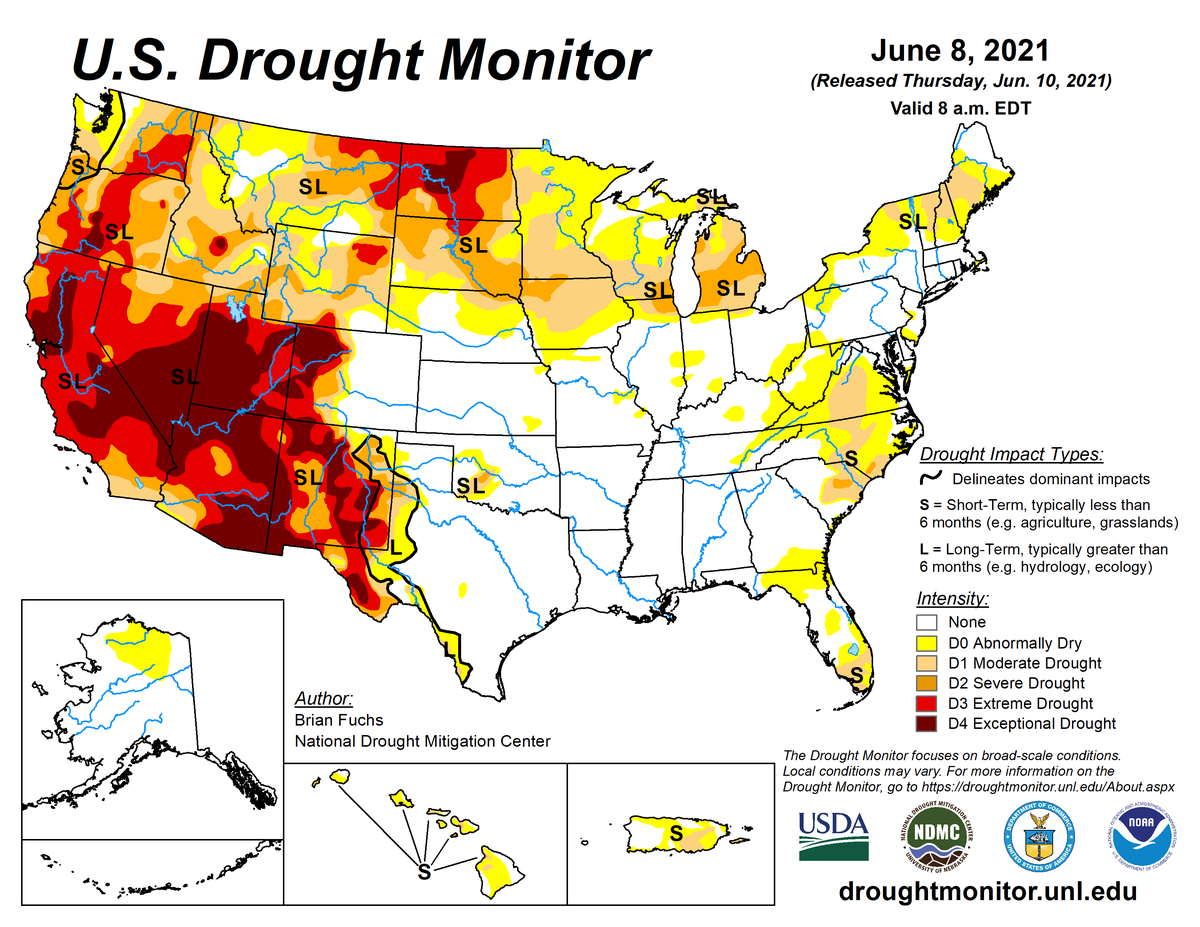
As CBS News' Mola Lenghi reports, drought conditions in the Western U.S. are historic and point to what could be a catastrophic wildfire season. CBS News meteorologist and climate specialist Jeff Berardelli then joins CBSN's Elaine Quijano with more.
While this video started off as a weather story about this week's heat wave, Jeff Berardelli put it in context as a climate story that carries all kinds of risk. In addition to appreciating the connection, I think this video from CBS News has the best preview image for this entry. I am not above arranging the videos for my posts on that criterion. (ETA: That didn't work, so I added the image from NOAA.)
The drought in the Western U.S. has been building for years, if not decades. Follow over the jump for that story as well as an update on the situation.
Protecting plants and wildlife for the present, and for the future; on Endangered Species Day, Secretary Haaland encourages everyone to think about the role they can play in saving animal and plant species from endangerment, and extinction.
Secretary Haaland and the Department of the Interior oversee one of the agencies responsible for enforcement of the Endangered Species Act (ESA), the United States Fish and Wildlife Service (USFWS), which put out Endangered Species Act Overview last week, explaining the history and content of the 48-year-old legislation it helps enforce.
This brief video explains the various sections of the Endangered Species Act of 1973. Greater detail is provided for some of the more relevant sections.
NOAA Fisheries manages more than 165 marine species listed as threatened or endangered under the Endangered Species Act. The goal is to help these species recover to the point where they can be taken off the endangered species list. That’s why, in 2015, we created the Species in the Spotlight initiative. It’s a way for us to focus our time, energy, and resources on these at-risk species and bring greater attention to their plight. Our goal is to focus our recovery actions and motivate partners and community members to work with us on these actions to turn this situation around. For each species, we have developed action plans that outline short-term efforts to stop their decline and prevent their extinction.
Each of these species is an important part of the habitat, the ecosystem, and the world we all share. Bringing them back will make our world richer and more balanced. Through the continued dedication of NOAA and its partners, we can all help these species recover.
While USFWS explained the theory, NOAA Fisheries described the practice. I have to say that I found watching and listening to the practice more interesting. I wonder what my readers think.
A new report from the NOAA finds that despite global shutdowns, greenhouse gas levels in 2020 surged. In fact, levels of carbon dioxide are at the highest they've been in 3.6 million years. CBS News meteorologist and climate specialist Jeff Berardelli joins CBSN to explain.
Jeff Berardelli and anchor Lana Zak concentrated more on the rate of increasing greenhouse gas concentrations and temperatures, the consequences of the higher temperatures, and what humans can do to keep temperatures from rising more than two degrees Celsius above pre-industrial levels than they did on the effects of the pandemic-drivenrecession or the implications of the subtitle of the report, "Carbon dioxide levels are now higher than at anytime in the past 3.6 million years." Follow over the jump for the first half of the NOAA press release with my commentary on those two subjects.
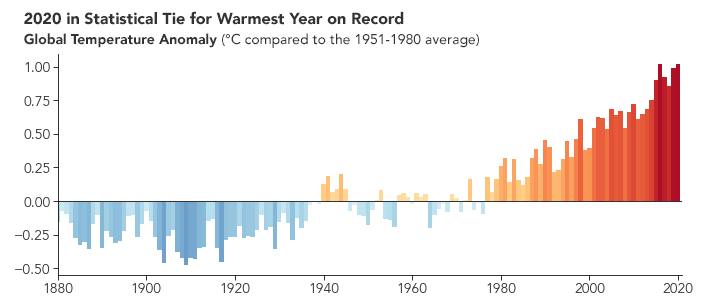
Globally, 2020 was the hottest year on record, effectively tying 2016, the previous record. Overall, Earth’s average temperature has risen more than 2 degrees Fahrenheit since the 1880s. Temperatures are increasing due to human activities, specifically emissions of greenhouse gases, like carbon dioxide and methane.
Earth’s global average surface temperature in 2020 tied with 2016 as the warmest year on record, according to an analysis by NASA.
Continuing the planet’s long-term warming trend, the year’s globally averaged temperature was 1.84 degrees Fahrenheit (1.02 degrees Celsius) warmer than the baseline 1951-1980 mean, according to scientists at NASA’s Goddard Institute for Space Studies (GISS) in New York. 2020 edged out 2016 by a very small amount, within the margin of error of the analysis, making the years effectively tied for the warmest year on record.
“The last seven years have been the warmest seven years on record, typifying the ongoing and dramatic warming trend,” said GISS Director Gavin Schmidt. “Whether one year is a record or not is not really that important – the important things are long-term trends. With these trends, and as the human impact on the climate increases, we have to expect that records will continue to be broken.”
The bar chart below shows this year in the context of the past 140 years in the modern temperature record. The values represent surface temperatures averaged over the entire globe for the year.
That's a graphic I'm going to have to add to my PowerPoint on climate to show to my students.
The NASA Earth Observatory press release continued.
Tracking global temperature trends provides a critical indicator of the impact of human activities—specifically, greenhouse gas emissions—on our planet. Earth’s average temperature has risen more than 1.2 degrees Celsius (2 degrees Fahrenheit) since the late 19th century.
A separate, independent analysis by the National Oceanic and Atmospheric Administration (NOAA) concluded that 2020 was the second-warmest year in their record, behind 2016. NOAA scientists use much of the same raw temperature data in their analysis, but have a different baseline period (1901-2000) and methodology. They noted that 2020 was the 44th consecutive year with global land and ocean temperatures above the 20th-century average.
Scientists from Europe’s Copernicus program also have 2020 tying 2016 as the warmest year on record, while the UK Met Office ranked 2020 as the second-warmest.
Based on all these analyses, declaring 2020 a statistical tie with 2016 looks like a safe conclusion to me.
NASA Earth Observatory's press release included one more graphic I want to share.
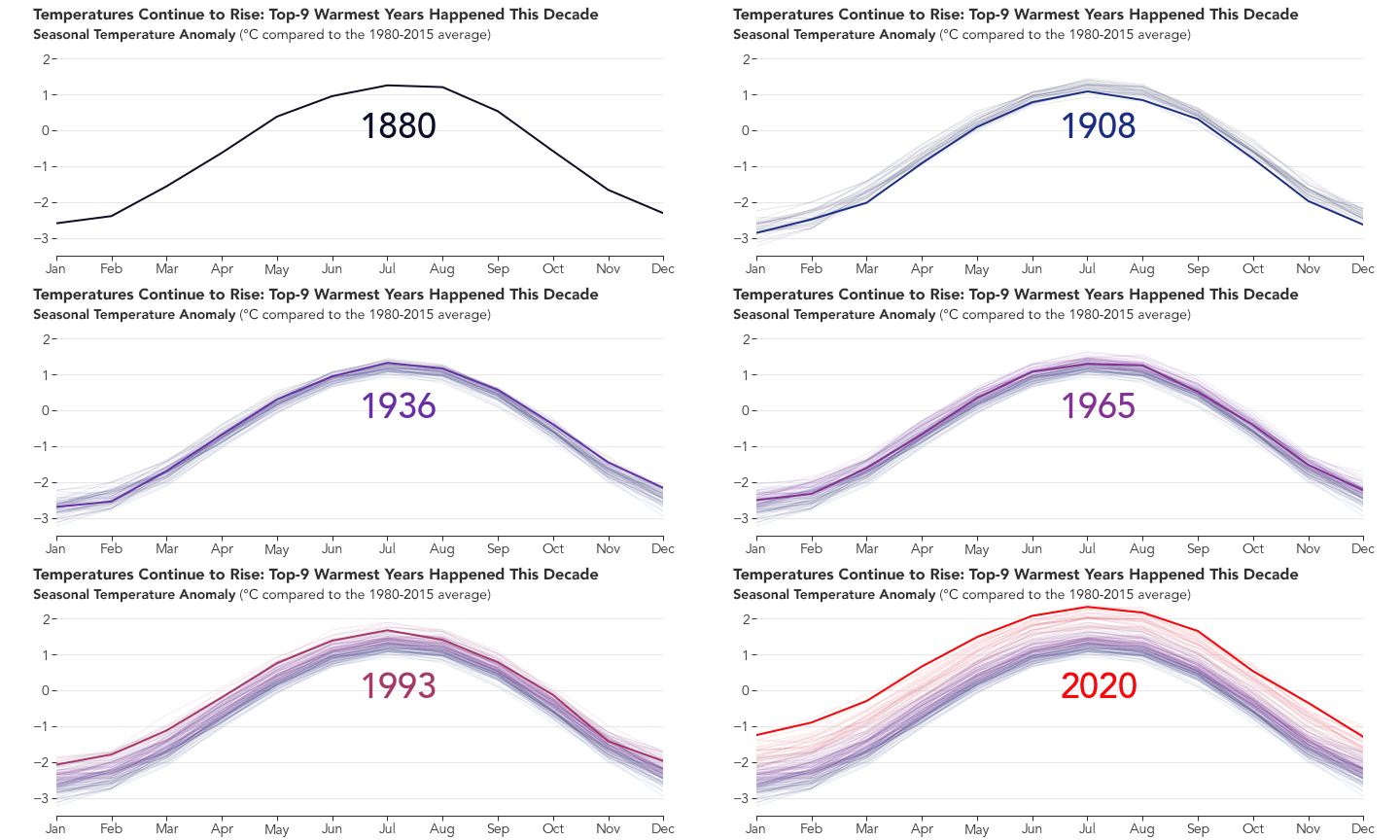
The animation below shows the seasonal cycle in global temperature anomalies for every month since 1880. Each line shows how much the global monthly temperature was above or below the global mean of 1980–2015. These seasonal anomalies are drawn from the Modern-Era Retrospective analysis for Research and Applications, version 2 (MERRA-2), a model run by NASA’s Global Modeling and Assimilation Office.
Talk about a picture being worth 1000 words! That clearly shows how much warming has taken place over the past 140 years!
I have one last excerpt to share.
While the long-term trend of warming continues, a variety of events and factors contribute to any particular year’s average temperature. The largest source of year-to-year variability in global temperatures typically comes from the El Nino-Southern Oscillation (ENSO), a naturally occurring cycle of heat exchange between the ocean and atmosphere. While the year ended in a La Niña (cool) phase of ENSO, it started in a slightly positive (warm) phase, which marginally increased the average overall temperature. The cooling from the negative phase is expected to have greater influence on 2021.
“The previous record warm year, 2016, received a significant boost from a strong El Niño,” Schmidt said. “The lack of a similar assist from El Niño this year is evidence that the background climate continues to warm due to greenhouse gases.”
Yikes!
Follow over the jump for what 2020's record warmth meant for last year's weather plus the footnote showing Thunberg's tweet.
With only three days remaining in the year about to end, it's time I take care of some business I promised I would get to in Colbert, Corden, and Fallon run down 2020.
November 30th marks the official end of hurricane season. Though activity past this date is still possible (and 2020 has thrown plenty of curveballs...), let's go ahead and recap this record-breaking, catastrophic, please-let-it-be-over season.
Fortunately, the 2020 Atlantic hurricane season actually did end by the official completion date. For once, 2020 did not have an additional unpleasant surprise, unlike 2005, when Tropical Storm Zeta formed on December 30, 2005.
The record-breaking Atlantic hurricane season may have been my top climate and weather story of 2020, but there were plenty of others, such as this year's westernwildfires. Weather Nation covered those and more in its Top 10 Weather Events of 2020.
Meteorologist Joe Astolfi takes a look back at the Top 10 Weather Events of 2020.
In addition to the hurricanes and fires, floods, drought, tornadoes, a nor'easter, and a derecho all made the top ten.
NBC News’ Simone Boyce takes look back at this year’s most important climate-related events.
It's been such a long and eventful year that I had to be reminded that it started off with wildfires in Australia. Those ended up being only a foretaste of what was to come.
That's it for the year about to end's climate and weather. Stay tuned for two more retrospectives of 2020.
2018 was the fourth hottest year in the modern record, part of a decades-long trend of warming. The record dates back to 1880, when it became possible to collect consistent, reliable temperatures around the planet. NASA and NOAA work together to track the temperatures, part of ongoing research into our warming planet.
The past five years have been the warmest years since records began in the late 1800s, according to NASA and NOAA. The global temperature in 2018 was the fourth-hottest on record, scientists announced Wednesday. Only 2016 (warmest), 2015 (2nd-warmest) and 2017 (3rd-warmest) were hotter than 2018. Overall, the past five years have been the five warmest years since records began in the late 1800s, according to a report released Wednesday.
“2018 is yet again an extremely warm year on top of a long-term global warming trend,” according to NASA's Gavin Schmidt, the director of the agency's Goddard Institute of Space Studies.
Specifically, NASA said global temperatures in 2018 were 1.5 degrees Fahrenheit above the average from 1951 to 1980.
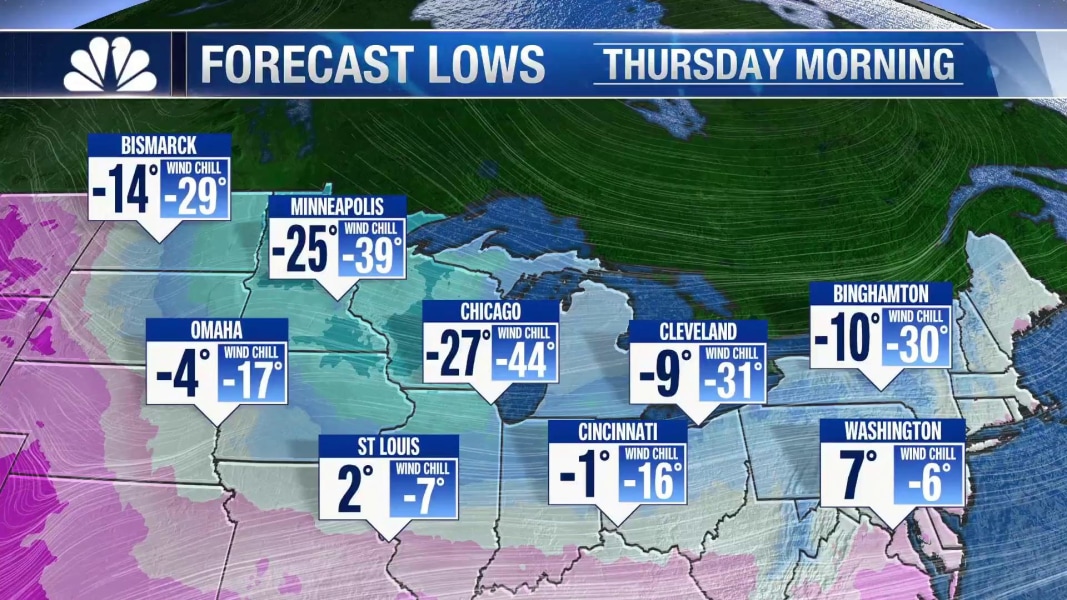
Temperatures in the Midwest are nearing all-time record lows as a powerful polar vortex drives a deep freeze across the eastern half of the United States. The bitter cold will bring below-zero temperatures to a quarter of the continental USA. In fact, it is predicted that Chicago will be colder than Antar[c]tica, Siberia, and Mount Everest.
Extreme cold, big snowstorms - and even unwelcome invasions from the polar vortex - will continue to hit the U.S., even as humans continue to warm the planet.
As he has several times in the past, President Trump again tweeted about global warming during a cold snap: Late Monday, he tweeted that "in the beautiful Midwest, windchill temperatures are reaching minus 60 degrees, the coldest ever recorded...What the hell is going on with Global Warming? Please come back fast, we need you!"
However, no matter how much humans have warmed the planet, we still didn't kill winter: Trump's own federal agency - the National Oceanic and Atmospheric Administration - corrected the president on Tuesday, noting that "winter storms don't prove that global warming isn't happening."
A dangerous polar vortex is sweeping across the midwest, with some areas experiencing colder temperatures than the Arctic circle or South Pole. CBS News contributing meteorologist Jeff Berardelli joins CBSN to discuss the latest forecast.
Because of climate change, the planet is once again experiencing chills and fever.
For all my readers experiencing the polar vortex, stay warm and remember that milder temperatures are coming soon.