Showing posts sorted by relevance for query ebola. Sort by date Show all posts

Monday, October 6, 2014

Ebola update--Dallas patient worsening, containment, and false alarms


With Sunday over, it's time to follow upon the first Ebola case diagnosed in the U.S.  This time, ABC News leads this entry, just as they led This Week with the story.  Their report, Ebola Scare: Dallas on Edge, included the first images I've seen of the victim.

ABC News' Ryan Owens reports on the effort to contain the first case of Ebola diagnosed on U.S. soil. Dallas Mayor Mike Rawlings weighs in on his city's response.
I'll have more of ABC News' coverage, which I found wide and sensationalistic, over the jump.  For a calmer and narrower perspective, Reuters reported Ebola patient in Dallas struggling to survive, says CDC head, which was the most popular article on their site tonight.
The first person diagnosed with Ebola in the United States was fighting for his life at a Dallas hospital on Sunday and appeared to be receiving none of the experimental medicines for the virus, a top U.S. health official said.

Thomas Eric Duncan became ill after arriving in the Texas city from Liberia two weeks ago, heightening concerns that the worst Ebola epidemic on record could spread from West Africa, where it began in March. The hemorrhagic fever has killed at least 3,400 people out of the nearly 7,500 probable, suspected and confirmed cases.

"The man in Dallas, who is fighting for his life, is the only patient to develop Ebola in the United States," Dr. Thomas Frieden, director of the U.S. Centers for Disease Control and Prevention (CDC), said on CNN's "State of the Union."

In a media briefing with reporters on Sunday, Frieden said he was scheduled to brief President Barack Obama on Monday.
Reuters also captured Frieden on video in CDC: Dallas Ebola patient "taken a turn for the worse."

Dr. Thomas Frieden, director of the CDC, says the first patient diagnosed with Ebola in the U.S. has "taken a turn for the worse."
Follow over the jump for more from ABC News and Reuters plus a local scare reported by WOOD-TV in Grand Rapids and an analysis from The Guardian.

Monday, October 20, 2014

Ebola news from campuses on the campaign trail and Discovery News


I ended Discovery News on high-fructose corn syrup with a half-hearted promise.
That would be after an Ebola update, if I'm up for it.  Stay tuned.  Even I don't know what I'm doing next!
I wasn't up for an Ebola update last week.  Instead of following up on Michigan prepares for Ebola after Dallas patient dies, I posted Happy Canadian Thanksgiving!  It paid off, as that entry got 354 page views in 24 hours.  Today, I don't have the excuse of a holiday to avoid an update, plus I have a fair amount of material.

I begin with Northern Illinois University, which asks Ebola: Should we worry?
NIU professor: Money spent to protect U.S. from Ebola better spent in Africa

So, is there reason for concern in this country? Yes and no, say two NIU biologists and a professor of public health.

"We maybe should worry," says Neil Blackstone, a professor in the NIU Department of Biological Sciences whose field of interest is evolutionary biology.

"We don't yet have a grasp of how it got to West Africa, and the concern is that it's evolving. It's evolving to be a better human parasite than it has been, perhaps less deadly but more transmittable," Blackstone adds. "If it infects 1,000 and kills them all, that's one thing. But if it infects 1 million people and kills 10 percent of them - 100,000 - that's another."

Barrie Bode, chair of the department, similarly urges caution.

“The likelihood that we could see a pandemic here is extremely remote, but vigilance is probably advisable right now. We do have a great deal more resources here and protocols that are in place. We can easily isolate the virus and prevent its spread here,” says Bode, who studies the biology of cancer.

“In these Third World countries, it’s much more difficult because they don’t have the resources,” he adds, “and viruses are notorious for mutating. Because the human-to-human transmission rate has been so high, it gives the virus more opportunity to evolve with each subsequent infection.”

Bode and Blackstone are quick to point out that neither is an expert in infectious disease or Ebola itself. They can offer scientifically literate interpretations of the emerging epidemic, however, and are following the news closely.

Sarah Geiger, assistant professor of public health in the NIU School of Nursing and Health Studies, agrees that the possibility of a widespread Ebola outbreak in the United States remains remote.

Geiger traces some of the anxiety to modern advances in outbreak containment. “Public Health Preparedness as a sub-field has grown substantially in terms of workforce as well as funding dollars since the events of Sept. 11,” she says, “so I think as a nation we’re more aware of the value of preparedness, which can unfortunately also lead to unreasonable fear.”

However, “I do think that parts of Africa will ultimately be devastated by the virus,” Geiger says.
As I wrote in the previous update...
Once again, the message from the authorities is "Don't Panic."  One of these days I should post the cover of Hitchhiker's Guide to the Galaxy in response to these pronouncements.
One of these days has arrived.


Follow over the jump for more Ebola stories.

Monday, September 15, 2014

The Archdruid on Ebola and other epidemic news


I gave a partial update to Third American doctor infected and other Ebola news in No Ebola in Windsor in which I followed up on part of a comment I left to Technological Superstitions at The Archdruid Report.  It's time for the rest of my comment, Greer's response, and more of the week's Ebola news.

I begin with the key sentence of Greer's that prompted my comment.
The Ebola epidemic in West Africa has continued to spread at an exponential rate as hopelessly underfunded attempts to contain it crumple, while the leaders of the world’s industrial nations distract themselves playing geopolitics in blithe disregard of the very real possibility that their inattention may be helping to launch the next great global pandemic.
That gave me my opening.
President Obama actually talked about Ebola on Meet the Press, saying that it could pose a danger to the U.S. and that the country should send troops and resources in.  That might be wiser in the long run than chasing ISIS, AKA The Sith Jihad, around Syria and Iraq, even though that would be a more popular thing to do, as people understand a fight with a human enemy better than an effort to contain The Red Death.  Speaking of which, the same people who observed relationship between food prices and unrest and predicted the onset of the Arab Spring and then the current spate of crises in Ukraine, Syria, and elsewhere, are calling attention to a model of Ebola spread that could turn into a global pandemic by just adding intercontinental transportation into the mix. That's an issue that was pointed out in "The Hot Zone" 20 years ago.  Welcome to the science-fiction future of two decades ago.
Greer's response was more chilling and alamist than usual, which is saying something.
Pinku-sensei, Obama's fairly good at talking. It's doing anything when he's finished with the speech that's his problem. At this point I think a global pandemic that could leave a quarter or more of the world's population dead in five to ten years is a serious possibility.
Yikes!

Greer wasn't alone in his grim assessment.  Rene concluded his comment by stating "as a retired public health professional, [I] do agree with your assessment about the possibilities for an Ebola outbreak."  On that cheery note, here's the story Reuters ran on Friday about the epidemic, which I included in a comment to Overnight News Digest: Science Saturday (Solar storm and aurora).

As Ebola grows out of control, WHO pleads for more health workers
By Kate Kelland and Tom Miles
LONDON/GENEVA Fri Sep 12, 2014 11:20am EDT
The number of new Ebola cases in West Africa is growing faster than authorities can manage them, the World Health Organization (WHO) said on Friday, renewing a call for health workers from around the world to go to the region to help.

As the death toll rose to more than 2,400 people out of 4,784 cases, WHO director general Margaret Chan told a news conference in Geneva the vast nature of the outbreak -- particularly in the three hardest-hit countries of Guinea, Liberia and Sierra Leone -- required a massive emergency response.

Sarah Crowe, a spokeswoman for UNICEF, said the U.N. children's agency was using innovative ways to tackle the epidemic, including telling people to "use whatever means they have, such as plastic bags, to cover themselves if they have to deal with sick members of their family".
The version of the story at Reuters India includes the following bullet points.
* Cuba to send 165 health workers to help in Sierra Leone

* WHO's Chan calls for more international support (Adds Dutch doctors, Piot comment, UNICEF comment)
Follow over the jump for more on the situation from Reuters and Agence France Press.

Wednesday, October 1, 2014

First Ebola case diagnosed in the U.S.


I lot has happened since I wrote Predictions about Ebola coming true, among them that Ebola has arrived in the U.S.  I was greeted at the start of my evening class with that news, which I confirmed once I finished my lecture.  Here's the story from Reuters from last night: Traveler from Liberia is first Ebola patient diagnosed in U.S. By Julie Steenhuysen and Sharon Begley on Tue Sep 30, 2014 11:11pm EDT.
A man who flew from Liberia to Texas has become the first patient infected with the deadly Ebola virus to be diagnosed in the United States, health officials said on Tuesday, a sign the outbreak ravaging West Africa may spread globally.

The patient sought treatment six days after arriving in Texas on Sept. 20, Dr. Thomas Frieden, director of the U.S. Centers for Disease Control and Prevention (CDC), told reporters. He was admitted two days later to an isolation room at Texas Health Presbyterian Hospital in Dallas.

U.S. health officials and lawmakers have been bracing for the eventuality that a patient would arrive on U.S. shores undetected, testing the preparedness of the nation's healthcare system. On Tuesday, Frieden and other health authorities said they were taking every step possible to ensure the virus did not spread widely.

"It is certainly possible someone who had contact with this individual could develop Ebola in the coming weeks," Frieden told a news conference. "I have no doubt we will stop this in its tracks in the United States."
I told my students that not only would the patient be isolated, but those he came in contact with would likely be quarantined.  ABC News shows that to be the case, beginning with EMTs and the ambulance in which they all drove in Health Officials on High Alert After First US Ebola Case.

CDC dispatches a team of disease detectives to Dallas after patient is diagnosed with deadly virus.
The CDC is not playing.

This case has prompted a flurry of follow up stories.  Follow over the jump for the videos that have passed through my YouTube feed during the past eight hours.

Monday, September 8, 2014

Third American doctor infected and other Ebola news


It's Monday, so it's time for more on the Ebola outbreak.  This morning's lead story is Massachusetts doctor infected with Ebola.  Here is the video from CNN.

Dr. Rick Sacra is the third American physician to be diagnosed with Ebola while working in Liberia.
The University of Massachusetts Medical School, where he is a professor, posted Debbie Sacra requests prayers for husband and practical help for Ebola-stricken Liberia by Sandra Gray and Bryan Goodchild on September 04, 2014.

Wife of American doctor infected with Ebola addresses news media at UMass Medical School

In response to the outpouring of concern about her husband, Richard Sacra, MD, who is the third American doctor to be infected with Ebola in Liberia, Debbie Sacra shared a message of gratitude and hope at a press conference held today at UMass Medical School.

Mrs. Sacra’s comments came moments after the announcement from the international Christian mission organization SIM that Dr. Sacra is being transported from Liberia to the Nebraska Medical Center in Omaha, which has a biocontainment patient care unit, for treatment.

“He walked onto the plane and he is in good spirits,” said Mrs. Sacra. She fought back tears while expressing her hopes for his recovery, and thanked the media for bringing attention to the plight of Liberians “who needed a hospital to open” whether for malaria treatment, maternity care or other medical care.
UMass Medical School faculty joined Mrs. Sacra in commenting on the situation in UMMS faculty speak on colleague diagnosed with Ebola.

Dr. Warren Ferguson and Dr. Virginia Van Duyne worked with Dr. Richard Sacra and spoke briefly about their relationship with Dr. Sacra, UMMS Assistant Professor of Family Medicine & Community Health, and his work in Worcester and elsewhere.

Dr. Sacra has spent much of his career working overseas, including nearly two decades in Liberia. He has a faculty appointment at UMMS as an assistant professor of family medicine & community health, as a function of teaching in the medical school’s residency program at the Family Health Center of Worcester when he returns to the U.S. for periodic respite visits.
Dr. Sacra left Liberia to be treated in the U.S.  Reuters reported on his progress in U.S. missionary with Ebola showing signs of improvement, wife says.
The third U.S. medical missionary to become infected with the Ebola virus was showing signs of improvement Saturday at a Nebraska hospital but was still very ill, his wife said.

Dr. Rick Sacra, a 51-year-old Boston physician, arrived Friday at the Nebraska Medical Center in Omaha for treatment after being flown there from Liberia, one of five West African countries affected by an outbreak of the virus.

"Rick is very sick and weak, but slightly improved from when he arrived yesterday," Debbie Sacra said Saturday. "He asked for something to eat and had a little chicken soup," she said.
Here's to a successful recovery, just like the other two U.S. physicians who came back to be treated.

Follow over the jump for other news about the epidemic from the past week, including statements from President Obama and the director of the WHO and the scariest silent video about the epidemic one could possibly watch.

Sunday, August 3, 2014

Ebola outbreak now a top story


In my comment to Bright Were The Halls Then at The Archdruid Report, I mentioned the some of the latest candidates for pandemics in the context of the fall of the Roman Empire.*
As for what caused that decline even in the Eastern Empire, you nailed it when you wrote "epidemics are thus a common feature in the history of declining civilizations."  One of them was Justinian's Plague, which reversed the Eastern Empire's attempt to reconquer what was once the Western Empire.  Today, we have MIRS and Avian Flu, and the latest outbreak of Ebola appears worrisome.
That was two weeks ago.  Tonight, Ebola was the top story in Overnight News Digest: Science Saturday (Ebola outbreak) on Daily Kos.

Susannah Locke of Vox got to explain The deadliest Ebola outbreak in history.
The deadliest Ebola outbreak in recorded history is happening right now. The outbreak is unprecedented both in infection numbers and in geographic scope. And so far, it's been a long battle that doesn't appear to be slowing down.

The Ebola virus has now hit four countries: Sierra Leone, Guinea, Liberia, and Nigeria.

The virus — which starts off with flu-like symptoms and often ends with horrific hemorrhaging — has infected about 1,300 people and killed more than 700 since this winter, according to estimates on July 31 from the World Health Organization.
Follow over the jump for more of the latest stories about Ebola.

Monday, August 25, 2014

Ebola news from The Archdruid, Daily Kos, and campuses on the campaign trail


Greer the Archdruid made this observation in Heading Toward The Sidewalk.
I suspect that most of my readers have been paying at least some attention to the Ebola epidemic now spreading across West Africa. Over the last week, the World Health Organization has revealed that official statistics on the epidemic’s toll are significantly understated, the main nongovernmental organization fighting Ebola has admitted that the situation is out of anyone’s control, and a series of events neatly poised between absurdity and horror—a riot in one of Monrovia’s poorest slums directed at an emergency quarantine facility, in which looters made off with linens and bedding contaminated with the Ebola virus, and quarantined patients vanished into the crowd—may shortly plunge Liberia into scenes of a kind not witnessed since the heyday of the Black Death. The possibility that this outbreak may become a global pandemic, while still small, can no longer be dismissed out of hand.
I couldn't resist responding and promoting one of my entries.
As for the Ebola outbreak becoming a top story, I mentioned in a comment here that it looked concerning weeks ago.  Honestly, Ebola scares me.  I first read about it in "The Hot Zone," the very first chapter of which described the death of an Ebola patient on a plane back to the U.S.  Stephen King described that story as "the scariest thing he'd ever read--and then it got worse."  Fortunately, it's not an immediate threat to people in the developed world.  That's small comfort to the people in west Africa, who are in immediate and growing danger.
That got a direct response from Gwaiharad.
@Pinku-Sensei: I'm not at all surprised that Ebola's become a top news story. After all, Stephen King's right. Ebola is really scary stuff. And media companies thrive on selling fear.
Media companies aren't alone.  Three universities whose press releases I quoted in Overnight News Digest: Science Saturday (Shark Week) and Overnight News Digest: Science Saturday (Bardarbunga eruption) have also been capitalizing on the outbreak, which threatens to become an epidemic, if not a pandemic.  Follow over the jump for them, as well as a frightening diary from Daily Kos.

Saturday, December 27, 2014

Ebola best and worst for 2014


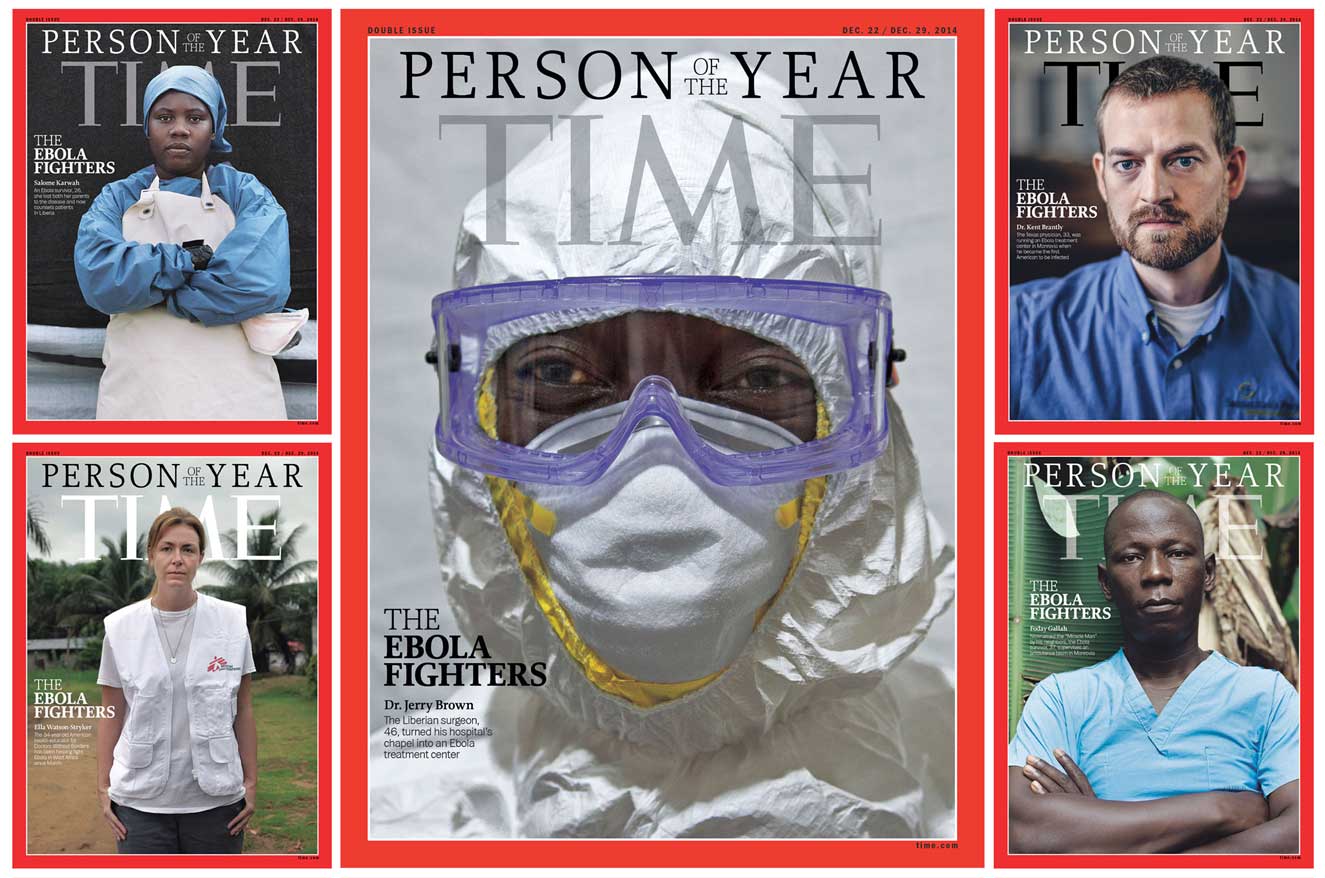
The Ebola epidemic brought on the best and worst in people this year.  The best was recognized by Time Magazine, who designated The Ebola Fighters as "The Person of the Year."
The ones who answered the call
By David von Drehle, with Aryn Baker / Liberia
Dec. 10, 2014

On the outskirts of Monrovia, the capital of Liberia, on grassy land among palm trees and tropical hardwoods, stands a cluster of one-story bungalows painted cheerful yellow with blue trim. This is the campus of Eternal Love Winning Africa, a nondenominational Christian mission, comprising a school, a radio station and a hospital. It was here that Dr. Jerry Brown, the hospital’s medical director, first heard in March that the fearsome Ebola virus had gained a toehold in his country. Patients with the rare and deadly disease were turning up at a clinic in Lofa County—part of the West African borderlands where Liberia meets Guinea and Sierra Leone. “It was then that we really started panicking,” says Brown.

Even in ordinary circumstances, the doctor’s workday was a constant buzz of people seeking answers: Can you help with this diagnosis? Would you have a look at this X-ray? What do you make of this rash? Inevitably, Brown would raise his eyebrows and crease his forehead as if surprised that anyone would think he might know the answer. Just as inevitably, he would have one.

Ebola was different. On this subject, Brown had more questions than answers. He knew the virus was contagious and highly lethal—fatal in up to 90% of cases. But why was it in Liberia? Previous Ebola outbreaks had been primarily in remote Central Africa. Could the disease be contained in the rural north? The membrane between countryside and city in Liberia was highly porous; people flowed into Monrovia in pursuit of jobs or trade and flowed back to their villages, families and friends. “Sooner or later,” Brown remembers thinking, “it might reach us.” And what then? A poor nation still shaky after years of civil war, Liberia—population 4 million-plus—had just a handful of ambulances in operation. How could Liberia possibly deal with Ebola?
It also brought out the worst or, at least, the most mendacity in people.  Follow over the jump for how misinformation about Ebola was recognized as the lie of the year and which person spreading that misinformation was recognized as singled out for doing so.

Monday, September 1, 2014

Second outbreak of Ebola in Congo and other Ebola news


This month's Nablopomo theme is Heal.  I'll get around to posting the usual entry about the theme later.  Right now, I'm going to focus on one aspect of that theme, health and disease, and the number one health story I'm covering in this blog is the Ebola outbreak.

I lead with this story from Reuters, which I first posted here as part of War, Death, and Destruction from Reuters for August 25, 2014.  Hey, I'm an environmentalist, I recycle.

Congo declares Ebola outbreak in northern Equateur province
Reporting by Bienvenu-Marie Bakumanya; Writing by Daniel Flynn; Editing by Robin Pomeroy
KINSHASA Sun Aug 24, 2014 5:02pm EDT
(Reuters) - Democratic Republic of Congo declared an Ebola outbreak in its northern Equateur province on Sunday after two out of eight cases tested came back positive for the deadly virus, Health Minister Felix Kabange Numbi said.

A mysterious disease has killed dozens of people in Equateur in recent weeks but the World Health Organization had said on Thursday it was not Ebola.

"I declare an Ebola epidemic in the region of Djera, in the territory of Boende in the province of Equateur," Kabange Numbi told a news conference.
This is likely a second outbreak, not a spread of the original one.

Follow over the fold for Ebola news from Overnight News Digest: Science Saturday (Blair Mountain and Labor Day).

Thursday, October 9, 2014

Michigan prepares for Ebola after Dallas patient dies


What I feared would happen when I posted the previous Ebola update has occured, the Dallas patient died of the disease.  The reactions to his death have been felt here in Michigan.  WXYZ reports Airports asked to monitor incoming passengers for signs of Ebola


In an earlier video, WXYZ reported that Oakwood Hospital in Romulus could handle up to 50 Ebola cases.  They're serious about this disease and their role in containing.

Ellen Creager of the Detroit Free Press has much the same story in Metro Airport travelers to face new Ebola measures.
The deadly Ebola virus scare will impact every international passenger arriving on international flights into Detroit Metro Airport and other American airports, the government announced Wednesday.

All passengers will closely be observed for signs of illness and given information about Ebola symptoms as they pass through customs and immigration.

In addition, the temperatures of passengers will be taken by CDC officials as they arrive from West Africa into five airports -- New York's JFK, Washington Dulles, Chicago O'Hare, Newark and Atlanta, the White House announced.

The measures to protect the American public took on new urgency Wednesday with the death of Liberian Ebola patient Thomas Eric Duncan in Dallas.
It looks like the inertia of business as usual that I observed in First Ebola case diagnosed in the U.S. has finally given way to appropriate levels of vigilance.

Preparations are also happening on the west side of the state, as WOOD-TV reports in Ebola: Should West Michigan be concerned?

Adam London of the Kent County Health Department says we're not scared about Ebola here in West Michigan, but we are prepared.
Once again, the message from the authorities is "Don't Panic."  One of these days I should post the cover of Hitchhiker's Guide to the Galaxy in response to these pronouncements.  However, London is right to put this outbreak in perspective by comparing it to the flu.  That reminds me, I need to get my flu shot.

Thursday, October 5, 2017

'Body Team 12' and 'Extremis' both nominated for Outstanding Short Documentary plus other science, health, and environment nominees

That's it for the nominees in the categories devoted to science, space, medicine, nature, and the environment.  I'll return tomorrow with the final installment on the nominees, when I plan on collecting all the leftovers in these topics in one place.  Stay tuned.
So I ended Extinction, water, astronomy, and HIV among 2017 Emmy nominees for Outstanding Science, Medical and Environmental Report and so I begin today's entry.  I begin my examination with this passage from Space, Ebola, volcanoes, stroke, and human expansion the topics of Science and Technology Documentary nominees.
I made an observation and a promise yesterday.
There are three programs about Ebola nominated this year.  I could have made an entire post about The Red Death!  Instead, I promise I'll get to all of them before the winners are announced.
I was wrong; there really are four, as all three episodes of HBO's "Ebola Trilogy" were nominated separately.  Added to "Spillover--Zika, Ebola & Beyond" and that makes four.  Here is the trailer for all of the "Ebola Trilogy" from HBO.

A special presentation of three films on one night.  “Ebola: The Doctors’ Story,” “Body Team 12,” and “Orphans of Ebola” premiere March 14 on HBO.
This trailer won't have to serve as the video introduction to all three episodes; “Body Team 12,” which was nominated for an Academy Award, has its own.  “Orphans of Ebola” doesn't seem to have one on YouTube.
Here is the trailer for "Body Team 12."

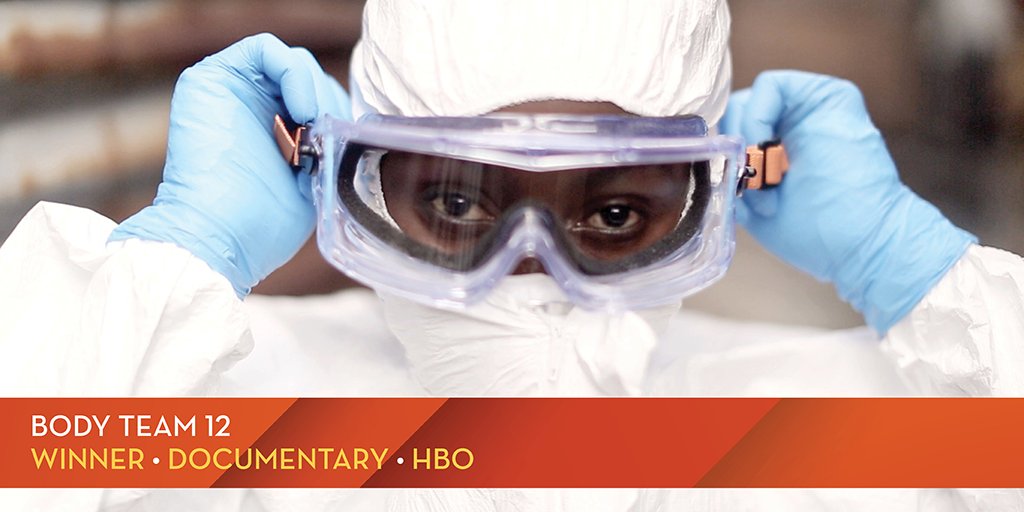
Body Team 12 follows a team of Liberian Red Cross workers tasked with collecting the dead during the height of the Ebola outbreak. The story is told on the ground in Monrovia, Liberia, through the eyes of the only female member of the team, who reveals the lifesaving work of removing bodies from family and loved ones in order to halt transmission of the disease.
Yes, another Oscar nominee for Best Documentary Short Subject is getting another shot at recognition at the News and Documentary Emmy Awards.*  Here, it is nominated for Outstanding Short Documentary and Outstanding Editing: Documentary.  In the latter category, it is competing with the third part of HBO's "Ebola Trilogy," "Orphans of Ebola."  In both categories, "Body Team 12" is also competing against the end-of-life medical documentary "Extremis," another nominee for Best Documentary Short Subject.  Here is its trailer from Netflix.

Witness the wrenching emotions that accompany end-of-life decisions as doctors, patients and families in a hospital ICU face harrowing choices.
This last film makes a point about medicine that it is not purely a science; it is an art as well.  I make that same point to my students every semester.  As for which one I think will win, it depends on the category.  I'd say "Extremis" would have a better shot at both, but I have my doubts either will win Outstanding Short Documentary.   "A Girl in the River: The Price of Forgiveness" is also nominated (and was a former Academy Award nominee), so it offers stiff competition.  For Outstanding Editing: Documentary, the chances for the health documentaries are better.

Follow over the jump for the rest of the nominees in science, health, and the environment.

Monday, September 29, 2014

Predictions about Ebola coming true


It's been two weeks since The Archdruid on Ebola and other epidemic news, so it's time for another update.

First, this video from Discovery News: Everything You Need To Know About Ebola In Under 3 Minutes.

The current Ebola outbreak is the worst in history, and there are a lot of myths about this virus floating around. Julian is here to figure out what is fact, and what is fiction.
Now that the general introduction is out of the way, on September 19, 2014, Arizona State University posted Research predicts possible 6,800 new Ebola cases this month.
New research published in the online journal PLoS Outbreaks predicts new Ebola cases could reach 6,800 in West Africa by the end of the month if new control measures are not enacted.

Arizona State University and Harvard University researchers also discovered through modeling analysis that the rate of rise in cases significantly increased in August in Liberia and Guinea, around the time that a mass quarantine was put in place, indicating that the mass quarantine efforts may have made the outbreak worse than it would have been otherwise.

Deteriorating living and hygiene conditions in some of the quarantined areas sparked riots last month. Sierra Leone began a three day country-wide quarantine today, where all citizens have been asked to stay at home, said Sherry Towers, research professor for the ASU Simon A. Levin Mathematical, Computational and Modeling Sciences Center (MCMSC) in the College of Liberal Arts and Sciences.
Tomorrow is the end of the month, so it's time to see if that prediction is coming true.  In Liberia's top doctor in quarantine after assistant dies of Ebola, Reuters reported the latest.
The latest figures from the World Health Organization show that the death toll from the worst outbreak of Ebola on record has killed at least 3,091 people, out of 6,574 probable, suspected and confirmed cases.
Pretty close, especially since the numbers came out on Saturday.  I'm sure four more days would push the number of cases to and probably past 6,800.

As for the future, another Reuters report passed along these grim projections.
WHO said earlier this week the total number of infections could reach 20,000 by November, months earlier than previously forecast. The U.S. Centers for Disease Control and Prevention (CDC) warned between 550,000 and 1.4 million people might be infected in the region by January if nothing was done.
The Archdruid is right to be concerned about Ebola.  He concluded his response to a comment of mine on Dark Age America: The Senility of the Elites on the topic.
I probably need to do a post here on the likely role of pandemic disease in the transition to the deindustrial dark age. Given that Ebola cases are doubling every twenty days at this point, that may be a more immediately relevant point than most people like to think.
I hope he follows through.  If so, it wouldn't be the first time one of my comments prompted him to explore a topic.  I did it before when I inspired The Archdruid to write about Steampunk.  That's when I wrote the following to him.
On my blog, I've written that interacting with you has been good for my writing.  I'm glad to see that the reverse has been true for you, too.
May that continue to be so.

Monday, September 26, 2016

Emmy winner 'Outbreak' from Frontline on PBS


I wrote that I'd post more about other Emmy News and Documentary winners at the end of Emmy Award winner 'Rise of Animals'.  After giving my readers a rain check at the start of How 'Star Trek' shaped the present and future, it's time to redeem it.

Today, I'm looking at Frontline's "Outbreak," which won the award for Outstanding Coverage of a Current News Story – Long Form, one of seven awards earned by Frontline last week.  It covered the Ebola epidemic of 2014 in west Africa, which I wrote about extensively at the time.  I begin with the trailer.

The vivid, inside story of how the recent Ebola outbreak began and why it wasn’t stopped before it was too late. FRONTLINE's upcoming documentary "Outbreak" exposes tragic missteps in the response to the epidemic.
Follow over the jump for clips from each of the most affected countries, Guinea, Sierra Leone, and Liberia.

Sunday, June 21, 2015

'The Last Ship' returns and other summer TV fare


If my readers have been counting, I promised three times that I would blog about the season premiere of "The Last Ship" tonight.  I'm making good on that promise, which I first made in the footnote to Razzies and Robocop this past February.
My wife and I are watching "The Last Ship." When I heard it was a Michael Bay show, I knew to expect a lot of action and things being blown up. I have not [been] disappointed.
Some Sunday this summer, I'm going to have to write about "The Last Ship," which is an OK post-apocalyptic drama that probably will seem more relevant and urgent after last year's Ebola epidemic.  For example, in a case of life imitating art, one of the Ebola treatments looked very similar to a treatment for the disease in the TV show.  That's not something I expect out of a Michael Bay production.
In the TV show, the ship's doctor transfuses blood from an immune person picked up during the voyage to the ship's crew who were infected in hopes of transferring her immunity to them.  That's what Scientific American described last summer in Blood Transfusions from Survivors Best Way to Fight Ebola.
Treating Ebola patients with blood transfusions from survivors of the disease should be the immediate priority among all the experimental therapies under consideration for this outbreak, World Health Organization (WHO) experts said Friday after reviewing the status of all the potential experimental therapies and vaccines. “We agreed that whole-blood therapies and convalescent serum may be used to treat Ebola virus disease and that all efforts must be invested into helping affected countries use them safely,” Marie-Paule Kieny, assistant director general for health systems and innovation at WHO told reporters. “This is something that would be ready near term.” None of the considered Ebola regimes have yet been adequately tested in humans.

Because survivors of an Ebola infection would typically have produced effective antibodies against the virus (otherwise they wouldn't have survived), transfusions of their blood into a newly infected individual may help that person survive the often fatal disease. Such blood preparations, drawn from volunteers, could be ready before the end of 2014, according to preliminary WHO estimates put out earlier this week. “We have to change the sense that there is no hope in this situation to a realistic hope,” Kieny said during a press conference Friday. She has called for other countries to help affected west African nations to build their capacity to safely do the blood drawing and preparation for what needs to be reinfused into the patients.
A Google search found that this treatment had been proposed back in 1999.  In that case, it looks less like a case of life imitating art, which it would seem to the uninformed, and more an example of a scriptwriter doing his or her homework.  Given how many examples TV Tropes lists of the show's various kinds of artistic license, I'm pleasantly surprised.  Here's to the show providing more victories of sense over sensation, although given that Michael Bay prefers sensation, I'm only guardedly optimistic.  Given the two trailers below, that's probably the right expectation to have.


When a global pandemic wipes out eighty percent of the planet's population, the crew of a lone naval destroyer must find a way to pull humanity from the brink of extinction.
Follow over the jump for more on this show and the rest of this summer's post-apocalyptic TV offerings, including the surprising addition of "Wayward Pines" to the genre.

Friday, September 12, 2014

No Ebola in Windsor


In my comment to Technological Superstitions at The Archdruid Report, I passed along this bit of news.
Ebola may already be spreading through travel. There is a patient exhibiting Ebola-like symptoms in a hospital in Windsor, Ontario, Canada, right across the river from Detroit.  That's very close to home, literally.
I learned about it from this WXYZ news report: Ebola scare in Windsor.


I should have kept following that story, as the information was out-of-date before I posted it over at Greer's blog.  The headline of WXYZ's follow-up says it all: Officials say Windsor, Ontario patient does not have Ebola.  Whew.

Just the same, local hospitals are preparing, as WOOD-TV in Grand Rapids reports in Spectrum Health preps for unlikely Ebola.

The deadly Ebola epidemic is a long way from Grand Rapids, but the city's largest hospital is prepared for the unlikely event that it does.
I'm glad the hospital is prepared.  Just the same, I hope, its staff never has to actually treat the disease.  That will mean that the epidemic has reached Michigan.

Tuesday, October 3, 2017

Space, Ebola, volcanoes, stroke, and human expansion the topics of Science and Technology Documentary nominees


"Stay tuned for Science and Technology Documentary nominees tomorrow" was my closing for 'Sonic Sea,' a triple nominee, and its competitors.  It's tomorrow, so it's time to examine the competitors in this category.

In alphabetical order, the first nominee is "A Year in Space" from PBS.

On March 27, 2015, astronaut Scott Kelly began a historic year in space. Follow Scott and his identical twin Mark Kelly as the two-part program tells the story of what it takes, mentally and physically, to spend a year in space.
I blogged about Scott and Mark Kelly's twin experiment in Twins on Earth and Space.  That was three years ago.  It's about time I followed up!

Speaking of following up, Time Magazine, which co-produced this documentary, announced that a "second installment, Beyond a Year in Space, will air this fall on PBS.  Here's to it being nominated for an Emmy next year.  If so, I'm looking forward to blogging about it.

Follow over the jump for the other four nominees.

Monday, May 11, 2015

Liberia declared Ebola-free


It's been more than four months since I posted Ebola best and worst for 2014, which was the last time I gave any kind of update on the Ebola epidemic.  That's too long, and the entries where I mentioned it in passing don't count.  Fortunately, I have good news to report: Liberia declared Ebola-free, but outbreak continues over border.

Liberia vows to be vigilant to keep Ebola-free as country goes 42 days without a new case after a year-long epidemic that killed over 4,700 people. Nathan Frandino reports.
The Reuters article accompanying this video continues with the death toll.
However, celebrations were muted by thoughts for the dead and medical charity Medecins Sans Frontieres (MSF) urged vigilance until the worst outbreak of the disease ever recorded was also extinguished in neighboring Guinea and Sierra Leone.

A total of 11,005 people have died from Ebola in the three West African neighbors since the outbreak began in December 2013, according to the WHO.
ODN joined Reuters in reporting this welcome development.


Don't believe the "42 weeks" part; that's an error.  It's 42 days.

When the epidemic is declared over in all three countries, I'll post Professor Farnsworth.  Until then, it looks like the rest of the world may have dodged a bullet.

Monday, December 8, 2014

Social media tracking Ebola and fighting air pollution


I promised something more serious to follow Marching band momentsOvernight News Digest: Science Saturday (Orion test mission) did the work for me, providing me three stories on a common theme, the use of social media in research, activism, and education.

First, Carolyn Shapiro of the University of Vermont describes The Social Contagion of Fear: Clark Analyzes Ebola Discussions on Twitter.
As the Ebola epidemic expanded overseas and reached U.S. shores in late September, concern – and misinformation – flew across social media networks.

Twitter lit up with references to “virus” and “death” and descriptions of “scary” and “terrifying.” Some less-worried tweets mentioned “cure” and even “jokes.”

These words became building blocks for Eric Clark’s latest “social contagion” study. A mathematician and doctoral candidate working in the University of Vermont Department of Surgery, Clark is finding ways to use data-processing power and social media to take the public’s temperature on health issues and current events. He works under the mentorship of Assistant Professor of Surgery Christopher Jones, Ph.D., director of the Global Health Economics Unit in the Center for Clinical and Translational Science.
As I wrote in Ebola news from campuses on the campaign trail and Discovery News, the message from the authorities remains "Don't Panic."  Now that there are no longer cases in the U.S., people have stopped freaking out--for now.*

Follow over the jump for two more uses of social media.

Thursday, October 12, 2017

'Body Team 12' wins Outstanding Short Documentary and Outstanding Editing: Documentary


I concluded 'The End of AIDS?' wins Outstanding Science, Medical and Environmental Report with "Next up, Ebola and 'Body Team 12.'"  From one pandemic to the next.

Katty Kay presented both awards.  First, she announced the winner for Outstanding Editing: Documentary.


I found the story about how the film had plenty of time to be edited because its director/producer was in Ebola quarantine darkly funny, just like the audience.

Next, Kay presented the statue for Outstanding Short Documentary.


I guess there was only one clip of each nominee to show.

I'm pleasantly surprised that "Body Team 12" won.  I thought "A Girl in the River: The Price of Forgiveness" would be the more likely victor with "Extremis" the next most likely winner.  That written, I think it fully deserved both honors.

Before I finish, I'm sharing this interview from the Today Show, Olivia Wilde Talks Ebola-Focused Film ‘Body Team 12’, that includes more clips from the documentary.

Olivia Wilde, David Darg, and Bryn Mooser join TODAY to talk about producing “Body Team 12,” a new documentary about the impact of the Ebola virus in Liberia.
Congratulations to all involved in documenting the work to stop Ebola.  "Body Team 12" can now join Emmy winner 'Outbreak' from Frontline on PBS as worthy examinations of the disease I call "The Red Death."

I'll continue my series on the News and Documentary Emmy winners after I celebrate Friday the 13th.  Stay tuned!

Tuesday, August 26, 2014

War, Death, and Destruction from Reuters for August 25, 2014


I titled last night's news summary on Daily Kos Overnight News Digest: Death, Disaster, Good news for business, and the Emmys.  I already passed along the Emmy Awards update from Reuters and even that couldn't escape the specter of Death with the Robin Williams tribute, so it's time for the death and destruction.

First, stories about three of the four topics that Kunstler wrote about in this week's missive of DOOM, Chill Winds, Ukraine, ISIS, and Israel-Gaza.

Slim chance of progress as Russian and Ukrainian leaders meet
By Alexei Anishchuk
MINSK Mon Aug 25, 2014 5:16pm EDT
(Reuters) - Divided by mistrust and mutual recriminations, the Russian and Ukrainian leaders will hold rare talks on Tuesday that offer only a slim hope of progress towards ending five months of separatist war in Ukraine.

Since Vladimir Putin and Petro Poroshenko last met on June 6 in France, Ukraine has turned the tide of the conflict and largely encircled pro-Russian rebels holding out in two cities in the east of the former Soviet republic.

But the diplomatic crisis has only deepened, especially since the downing of a Malaysian airliner over rebel-held territory last month with the loss of 298 lives.
This was the most read story on Reuters last night.  My Ukrainian and Russian readers can make of it what they will.  And, yes, I have lots of readers from both countries.  Ukraine and Russia are top two non-U.S. sources of readers for the blog this month, and Russia is the largest foreign portion of the audience in the history of the blog; Ukraine is in eighth, and will pass France for seventh at current rates in a few months.

Follow over the jump for the stories about war, death, and destruction from Iraq, Gaza, Congo, and elsewhere that made headlines last night.