Showing posts sorted by date for query twinkies. Sort by relevance Show all posts

Thursday, November 20, 2025

Company Man asks 'The Decline of Chi-Chi's...What Happened?'

Today's evergreen educational post is Company Man asking The Decline of Chi-Chi's...What Happened?

In 2004, the chain of Mexican restaurants closed all of its locations. This video explores the history of the brand while identifying some of the main reasons behind its decline.
Here's Company Man Mike's list.


I begin with competition. When my ex-wife, son, and I moved to Ann Arbor in 1989, Chi-Chi's was the only chain Mexican restaurant in town.*  I found it adequate, but not excellent. I had higher standards having grown up in Los Angeles. Other Californians I encountered who moved to Michigan were also disappointed by the lack of the ethnic cuisines they left behind, a story I recounted in Impaling Vlad, or With friends like this, Kunstler hardly needs enemies.
For years, when I ran into another person who had moved to Michigan, I asked them, "So, do you miss Mexican food?" and they invariably answered, "Yes! Do you know where any is around here?" They also missed cheap Cantonese food, too. I was always happy to steer them to the nearest good examples of both.

Within the past decade, Chinese takeout places run by immigrants from the mainland have sprung up all over southeast Michigan, to the point where two of the three small towns on the outskirts of Irish Hills each have one and the next small town I moved to had one as well. Also, Mexican food has become common enough and people have developed enough of a taste for it that the local blues joint that served ribs has become a Mexican restaurant. I no longer run into Californians who can't find the food of home; it's now all around them. I personally consider this to be an improvement.
I still do, but it probably helped doom Chi-Chi's, which I mourned briefly when it closed down, but didn't really miss. There are much better options for Mexican food in Michigan today.

I didn't know the rest of Chi-Chi's story except for the addition of El Torito to the company. That was my favorite chain of Mexican restaurants in southern California, and I was hoping Chi-Chi's would incorporate some of what I liked about them. It didn't happen. That was disappointing, but at least El Torito still exists.

By the way, Company Man Mike mentioned that both Chi-Chi's and El Torito were owned by Foodmaker, which owned Jack-In-The-Box, a story I recounted in Business Insider examines the rise, fall, and return of Twinkies.
Business Insider's video also lists Purina as a former owner of Hostess's parent company from 1984 to 1995. That means I have a distant connection to Hostess, as my first job for a large employer was as cook and cashier for Jack In The Box from 1977 to 1979, which Purina owned from 1968 to 1985. My fellow employees and I joked that we worked for Purina People Chow. Our manager told us to never say that in front of the customers. We didn't.
At least Purina no longer owned Foodmaker by the time it acquired Chi-Chi's, so Chi-Chi's never did serve "Purina people chow."

That's a wrap for today's Retail-Apocalypse-adjacent story. Stay tuned for World Television Day. I have a Storied video to share.

*ETA: There was and still is a locally owned Mexican restaurant in town, Tios, but I never went there.

Friday, May 6, 2022

Star Wars drinks and music for Revenge of the Sixth on Flashback Friday

Beware the Revenge of the Sixth, the dark side of Star Wars Day! For this year's celebration, I'm combining the drinks and music themes of 2018 and 2020 with the retrospective theme of 2021.

I begin with a review of fictional drinks from the Star Wars franchise by Star Wars: Top 10 – Alcoholic Beverages by Inside Star Wars.

Sometimes, especially in a galaxy far, far away, you've just got to loosen up. And what better way to do so than drinking yourself into oblivion! I'm noel from TheCancrizans, and here are the top 10 alcoholic beverages in Star Wars.
Now for the music from the Dark Side, The Mandalorian: Moff Gideon Theme | EPIC IMPERIAL VERSION by Samuel Kim Music.

The Mandalorian Theme by Ludwig Göransson
Star Wars Theme by John Williams
Arranged and Orchestrated by Samuel Kim.
Also "Long Live the Empire" by Ludwig Göransson.

That's it for the fan celebration of Star Wars. Follow over the jump for retrospective about the blog's year on Pinterest.

Friday, April 15, 2022

CNBC explains 'How Companies Like Amazon, Nike and FedEx Avoid Taxes' for Tax Day on Flashback Friday

"Happy" Tax Day, at least for my readers in the U.S.!* I'm observing the day by sharing CNBC's How Companies Like Amazon, Nike and FedEx Avoid Taxes.

At least 55 of the largest corporations in America paid no federal corporate income taxes on their 2020 profits, according to the Institute on Taxation and Economic Policy. Some of these companies include big names FedEx, Nike, HP and Salesforce, and it's costing the U.S. government billions of dollars. Those 55 corporations would have paid a collective total of $8.5 billion. Instead, they received $3.5 billion in tax rebates, collectively draining $12 billion from the U.S. government. These estimates don't include corporations that paid only some but not all of these taxes, like Netflix and Amazon.

Watch the video above to learn about how the most profitable companies in the country maneuver the complicated tax system to avoid federal corporate income taxes, different forms of tax expenditures and what policy solutions may bridge the gap.
Watching this just reinforced my opinion that the 2017 tax bill was a bad idea and reminded me that John Oliver covered this four years ago. Some things haven't changed and those that have might have changed for the worse. Sigh.

Follow over the jump for a brief retrospective about top posts from the eleventh year of Crazy Eddie's Motie News covering economic issues.

Saturday, July 3, 2021

Business Insider examines the rise, fall, and return of Twinkies

Writing Business Insider explains 'why the world's most popular banana may go extinct', "remind[ed] me that I promised to share a Business Insider video about the rise, fall, and return of Twinkies three months ago but haven't done so yet...Saturday looks open..." That's today, so watch The Rise And Fall Of Twinkies.

Hostess Twinkies rose to icon status in the mid-1900s, becoming a mainstay in lunchboxes across America. But a heavy debt load and two bankruptcies almost killed Twinkies. In 2012, Twinkies left shelves for good... Until two guys, Andy and Dean, came up with a plan to save the iconic brand.
As I first wrote nine years ago, "Twinkies and the other Hostess products are still valuable and someone will make them" and this video tells how and why. It also dispels urban legends about the Twinkie, particularly the one about it lasting indefinitely. It didn't; the reformulated one lasts longer.

Business Insider's video also lists Purina as a former owner of Hostess's parent company from 1984 to 1995. That means I have a distant connection to Hostess, as my first job for a large employer was as cook and cashier for Jack In The Box from 1977 to 1979, which Purina owned from 1968 to 1985. My fellow employees and I joked that we worked for Purina People Chow. Our manager told us to never say that in front of the customers. We didn't.

That I'm revisiting the subject shows that I've made my peace with Americans' screwed-up priorities and no longer think this is as silly a story as I did when I first wrote about it. Americans crave their comfort food as much as they need their entertainment, which I take more seriously now than when I started writing this blog ten years ago. I just wish both were healthier and distracted less from issues like sustainability.  May Americans be as passionate about sustainability and democracy as they are about Twinkies.


That's it for this Retail-Apocalypse-adjacent story of manufacturing returning from bankruptcy. Stay tuned for a celebration of July 4th.

Friday, July 2, 2021

Reactions to the U.S. Government report on UAPs for World UFO Day


Today is the second of two World UFO Days. Why two? National Day Calendar explains.
World UFO Day commemorates two separate dates. The first, on June 24th, recognizes the first widely reported UFO sighting on this same day in 1947 by aviator Kenneth Arnold. On July 2nd, the date commemorates the incident that took place in Roswell, New Mexico, in the same year.
I can see why two different UFO Days; both are important in the early history of the phenomenon and should be recognized. National Day Calendars singled out today's observance by writing "The creators of the July 2nd event launched it to raise awareness of UFO sightings and remove speculation from them." That makes me feel better about postponing my observance from June 24 to today, which I based on reports that the House Intelligence Committee's report on Unidentified Aerial Phenomena (UAPs) would come out later that week. It did, as CNET reported in The Pentagon UFO report explained on June 26.

Are they aliens? Spy planes? What *are* those unidentified aerial phenomena we've been seeing lately? We break down the report commissioned by Congress to get to the bottom of UAPs and the people who report them.
CNET not only presented a good summary of the findings, but also an excellent timeline of how and why this reported ended up being produced. For some reason, I'm not surprised it started off with Marco Rubio adding the request to a budget bill. His doing so adds to the ambivalence I feel about the subject.
On the one hand, I feel the same about addressing the official interest in UFOs as I do about "Fauci's emails and...the Wuhan lab-leak hypothesis, two narratives that I want to give as little attention to as possible." On the other, I have described this blog as having a "science fiction slant" on its Facebook page, so writing about the topic is on brand.
I hope this is a case of a stuck clock still being right twice a day, just as Senator Rubio is on Daylight Saving Time. On the other hand, it might end up being like his positions on gun control and Cuba, which I disagree with. Only time will tell, although the kind of supporters the report has makes me wonder and worry.

Follow over the jump for more news reactions to the report.

Tuesday, June 29, 2021

Business Insider explains 'why the world's most popular banana may go extinct'

It's been eight years since I first wrote "the dessert bananas people eat are threatened by fungus because of the unintended effects of growing monocultures of clones," so when I saw Why The World’s Most Popular Banana May Go Extinct | Big Business, I was saddened and alarmed, but not particularly surprised. Watch to see how the banana crisis has progressed since I last blogged about it in 2014, before Tropical Race 4 of Panama Disease had reached South America in 2019.

Bananas are facing a pandemic, too. Almost all of the bananas exported globally are just one variety called the Cavendish. And the Cavendish is vulnerable to a fungus called Panama Disease, which is ravaging banana farms across the globe. If it's not stopped, the Cavendish may go extinct. We visited a farm in Colombia infected with Panama Disease and a lab in the Netherlands studying the fungus to see if biosecurity and breeding can save the $25 billion banana industry.
I make the point that growing monocultures of clones is a bad idea every semester and this video shows why. Worse yet, the video and I both describe that it happened before and all growers did was replace the variety grown, which illustrates another point I make, that people don't learn and repeat their mistakes. At least this time, growers in Columbia are implementing measures that will slow the spread of the disease, which might give them more time to find a solution other than the genetically modified Cavendish that I think works well from a scientific and technological perspective, but is unpalatable socially and politically. Sigh. People have to accept the solution for it to really work.

Watching this reminds me that I promised to share a Business Insider video about the rise, fall, and return of Twinkies three months ago but haven't done so yet. I'll get to that after observing Asteroid Day tomorrow, Canada Day Thursday, and World UFO Day on Friday. Saturday looks open before I celebrate July 4th on Sunday. Stay tuned.

Friday, March 19, 2021

CNBC asks 'Why Is Short Selling Legal?'

Short selling and the social media efforts to thwart it provided me a lot of material this year, alternating between silly and serious beginning with Noah, Colbert, Kimmel, and Corden explain GameStop, a funny tale of the stock market and Retail Apocalypse, then CNBC, The Economist, CBS This Morning, and Retail Archaeology explain GameStop, a serious tale of the stock market and Retail Apocalypse, and most recently Samantha Bee, Trevor Noah, and Legal Eagle have more funny things to say about GameStop, a tale of the stock market and Retail Apocalypse.* It's time for a serious examination of the topic as CNBC asks Why Is Short Selling Legal?

When a stock rises, all of its investors turn a profit, right? That’s not the case for short-sellers, who look for profit by betting against the success of a company or the market. The recent events surrounding Tesla, Reddit, Robinhood and Gamestop’s short squeeze have put short selling under the limelight. So how did the practice of betting against the U.S. market become such a common, legal practice? Watch the video to find out.

The recent events surrounding meme stocks and GameStop’s short squeeze have put short selling, one of the oldest practices in the stock market, directly under the limelight.
The video made three points in favor of short selling. First, it is one major way to make money off a declining market. Second, it provides liquidity, the ability to turn stocks into cash, during a declining market. Third, it's a way of "discovering price," what the true value of a company is in the face of fraud, mismanagement, and hype. I won't dispute any of that, but I will add the following quote from the video's description.
“I think the main reason people dislike short selling is that something just feels bad about profiting from someone else’s failures,” said Sasha Indarte, an assistant professor of finance at the University of Pennsylvania’s Wharton School. “Short sellers gain when someone else loses. It’s like if you took out an insurance policy against your neighbor’s home and your neighbor’s home was destroyed.”
That pretty much sums it up. Just don't confuse buying the insurance policy with setting the fire, although it would look like a motive.

I shouldn't be surprised that CNBC reported support for short selling as well as the moral case against it. As I quoted TVTropes 10 years ago, "CNBC is watched by people who think they own the country," so it will take the side of the markets. I expressed a more detailed complaint about CNBC two years ago.
While the channel is more entertaining than its competition (I'm looking at you, Bloomberg), it has a perma-bull attitude — it's always a good time to buy stocks, according to CNBC. My wife and I don't believe that, as we got out of the stock market about six months ago. We don't care that the values recovered; it was too stressful going down.
We have since returned to the stock market. During the past two years, we have developed a better tolerance for uncertainty. I suppose living through a pandemic did that for us, a silver lining to the storm clouds the past year has brought us.

Stay tuned for tomorrow's post about the Vernal Equinox, which will be the final entry of the tenth year of this blog. After that, it will be Nowruz, the blog's tenth birthday, and the beginning of my eleventh year of blogging here.

*I have a somewhat funny video about GameStop from Business Insider to post next week along with another one about Twinkies to continue the alternation between silly and serious. Consider this footnote to be a preview of coming attractions.

Friday, March 5, 2021

CNBC explains why U.S. malls are disappearing, plus Forever 21 and Brooks Brothers saved for now, tales of the Retail Apocalypse and pandemic

Last Black Friday/Buy Nothing Day, I shared a CNBC Television video reporting that one-third of malls present in 2012 were already gone in 2020 with 25% more to close in the next 3-5 years. Yesterday, CNBC's main channel expanded on that statistic in a video explaining Why U.S. Malls Are Disappearing.

Shopping malls in the U.S. were already in decline before the Covid-19 pandemic as consumers shifted away from traditional brick-and-mortar stores to e-commerce. The outbreak has only exacerbated the challenges at malls as social distancing has placed restrictions on stores, movie theaters and restaurants. So what will become of malls in America after the pandemic ends?

Shopping malls across the U.S. have been reeling as restaurant and retail tenants struggle to keep their doors open.

Data compiled by Coresight Research shows about a quarter of U.S. malls could close over the next three to five years, accelerating a trend that began before the pandemic.
...
Malls are a big tax driver for the communities they serve and employ lots of people locally. Watch the video above to find out more about the struggles U.S. malls face and what could become of them after the pandemic ends.
Before examining the decline of malls more closely, CNBC reviewed the history of malls, including the role of architect Victor Gruen in designing the long-closed Northland Mall in Southfield, Michigan, and the Southdale Shopping Center in Edina, Minnesota, and how they fit in the history of suburbia, a topic I covered in Wired on dead malls, a tale of the Retail Apocalypse two years ago. It then followed up on two stories I left hanging, the bankruptcies of Forever 21 and Brooks Brothers. Mall owners like Simon Properties and Brookfield Properties bought parts of both of them, rescuing both chains from bankruptcy, just as they did for JCPenney. Korea Now has the first story in Korean fast-fashion brand Forever 21 finds new owner in 4 months after filing for bankruptcy.

Korea’s fast-fashion emporium, Forever 21 has found a new owner in just four months after it filed for bankruptcy. The retail brand is to sell most of its business for $81 million to a consortium made up of mall operators Simon Property Group, Brookfield Property Partners and brand management firm Authentic Brands Group. Watch this video, for more information.
That's good news for Forever 21 and its new owners, the mall operators, even as it's bad news for the environment and factory workers.

The Wall Street Journal, whose The Rise and Fall of Brooks Brothers concluded with Simon Properties and Authentic Brands buying Brooks Brothers, has the second story.

Brooks Brothers -- the self-proclaimed oldest clothier in the U.S. -- filed for bankruptcy in July. Analysts say the suit dealer wasn’t able to keep up with modern men who often wanted styles that were cheaper and more functional.
That was fast. However, I shouldn't be surprised. As I first observed about Twinkies, some products and brands are too valuable to let go extinct and someone will save them. Looks like JCPenney, Forever 21, and Brooks Brothers are among them.

Returning to the CNBC video, it will be worth watching which solutions mall owners and the communities around the mall pursue once the pandemic ends. Stay tuned.

Friday, November 29, 2019

The death and rebirth of Toys R Us, a tale of the Retail Apocalypse for Black Friday/Buy Nothing Day


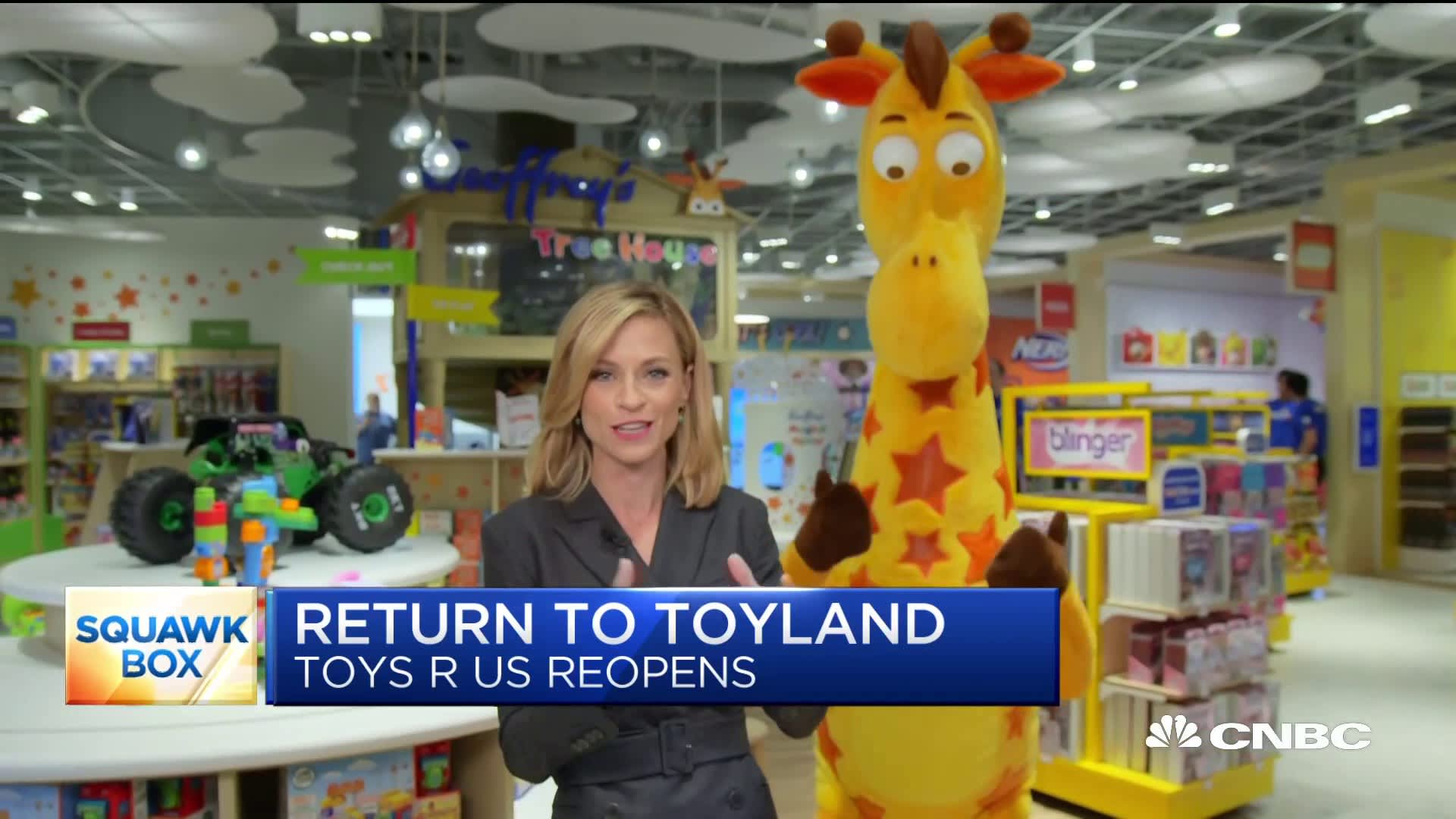
Happy Black Friday/Buy Nothing Day!  Last year, I covered the Retail Apocalypse by focusing on Macy's and Bon-Ton.  This year, I continue with the tradition by re-examining the death and rebirth of Toys R Us, one of the first two chains I followed in covering the decline of brick-and-mortar retailers.  I begin with Wall Street Journal's How Toys 'R' Us Went Bankrupt, which concludes with the chains rebirth under new ownership.

For decades, Toys "R" Us was not only one of the top toy retailers in the United States, it was one of the top retailers period. Until it suddenly wasn’t. Toys “R” filed for bankruptcy in 2017 and liquidated six months later. This is the story of how Toys "R" Us went bankrupt.
The part about the private equity firm that secured their loans to Toys R Us's intellectual property, including Geoffrey the Giraffe, was a new facet of the story to me.  It ties into what I wrote in June about the revival of the name.
Toys R Us is like TwinkiesThe products are too valuable and someone will make them.
Companies will do so even if it involves killing off the original company and stripping the carcass.  To paraphrase Steve Martin, capitalism is not pretty.

Follow over the jump for two videos about the opening of the first Toys R Us store under Tru Kids, the new ownership.

Friday, June 28, 2019

The return of Toys R Us, a tale of the Retail Apocalypse


It's rare that I get to share good news about the Retail Apocalypse, but I have some this week.  CBS Los Angeles reported earlier this week that Toys 'R' Us Is Making A Comeback, 2 New Stores Opening This Year.

The beloved toy store that closed all of its U.S. stores last year has plans to re-open in 2019.
Bloomberg Markets and Finance has more in Toys 'R' Us Plans to Make a Christmas Comeback.

Maybe American kids will only have to live through one Christmas without Toys “R” Us. About a year after shuttering U.S. operations, the remnant of the defunct toy chain is set to return this holiday season by opening about a half dozen U.S. stores and an e-commerce site, according to people familiar with the matter. Bloomberg's Matt Townsend reports on "Bloomberg Markets: What'd You Miss?"
Matt Townsend doesn't seem very optimistic.  Still, I should have seen it coming.  Toys R Us is like TwinkiesThe products are too valuable and someone will make them.  Not only was that true of Twinkies and Toys R Us, it's apparently true for RadioShack.  The dead, they rise again!

Wednesday, March 13, 2019

Bright Sun Films on the death and possible rebirth of RadioShack, a tale of the Retail Apocalypse


I promised to revisit Radio Shack at the end of Charlotte Russe liquidating, a tale of the Retail Apocalypse and again at the end of Tesla makes a U-turn on closing stores while Musk defends tweet before judge, a tale of the Retail Apocalypse, when I wrote "tomorrow."  Well, that's today, so I present Bright Sun Films Abandoned - RadioShack.

After over 80 years in business and the worlds largest electronic store retailer, today I explore how this billion dollar company which revolutionized the electronic store market, eventually came tumbling down into its eventual bankruptcy in the same vein as Circuit City. Let's take a look at the history of RadioShack.
That is a more complete history than the one from Company Man.  That stopped in 2017 just as the chain closed up shop, literally.  Bright Sun Films shows that, just like Twinkies, the name lives on under new ownership; it's too valuable to die.

That's it for this installment of Tales of the Retail Apocalypse.  Stay tuned for a series of holiday entries, as tomorrow is Pi Day, Friday is the Ides of March, Sunday is St. Patrick's Day, next Wednesday is both Purim and the Vernal Equinox, next Thursday is Nowruz and the birthday of both Twitter and this blog, and next Friday is World Water Day.  There will be little time for DOOM other than this Friday.  Beware The Ides of March!

Monday, March 11, 2019

Charlotte Russe liquidating, a tale of the Retail Apocalypse


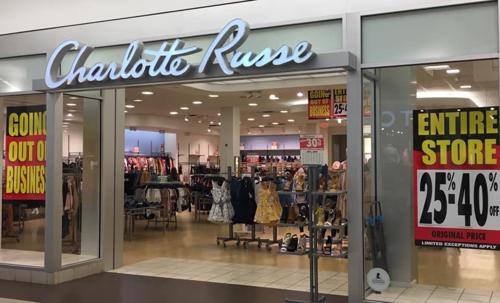
First Payless ShoeSource and then Gymboree are closing all their U.S. stores and selling off assets.  Now, Charlotte Russe is doing the same.  Watch Money Matters 3/7: Charlotte Russe is closing all of its stores from CBS 46 in Atlanta.


CNN has the details in Charlotte Russe will liquidate and close all of its stores.
Charlotte Russe will close all of its stores over the next two months. The women's clothing company joins a growing group of retailers that couldn't survive bankruptcy.

The company didn't want to shut down. It filed for bankruptcy protection a month ago and announced plans to close only 94 of its 512 stores nationwide. The goal was to use the bankruptcy process to shed debts and sell to a buyer who would keep it in business.

But those hopes fell apart this week when liquidator SB360 Capital Partners won the auction in bankruptcy court for Charlotte Russe's $160 million worth of inventory, and other assets. The plan to shut down was approved Wednesday by the bankruptcy court in Delaware.

SB360, which describes itself as "one of the oldest, most experienced companies in the country conducting store closing and going out of business sales," announced Charlotte Russe would start going out of business sales at all stores as of Thursday. The company will accept gift cards through March 21, and it will close all of its stores by of the end of April.
USA Today also quoted the press release.
“We are partnering with SB360 Capital to liquidate the remaining inventory in a manner which maximizes the return to our creditors," the fashion retailer said in a statement to USA TODAY. "In addition, we remain in ongoing negotiations to sell the (intellectual property) to a buyer who has expressed interest in a continued brick and mortar presence.”
In other words, just like Twinkies, the name will live on under new ownership; it's too valuable to die.

CNN has more on the fallout for employees.
Charlotte Russe had 8,700 employees at the time of the filing, all but 1,400 of whom were part-time workers. It had stores in every US state except Alaska at the time of its bankruptcy filing. It also owned 10 children's clothing stores under the Peek brand, which it acquired in 2016.
Meanwhile, $559,000 in bonuses will be paid to executives, but rank-and-file employees will likely not receive severance, which is typical in bankruptcies.

The chain's demise has been coming for a while, as I first mentioned the Charlotte Russe bankruptcy in Sears and KMart avoid liquidation, a tale of the Retail Apocalypse.  I then wrote in Gymboree closing 805 stores and selling off Janie and Jack, a tale of the Retail Apocalypse, "as the next installment of Tales of the Retail Apocalypse, I expect it will be Charlotte Russe."  Instead, it turned out to be about Tesla joining the Retail Apocalypse by closing its showrooms, but I repeated that the next installment would still be about Charlotte Russe.  I made good on that promise.

In the entry about Tesla, I also wrote "It also looks like 2019 will see even more stores close than last year," so I expect to write more about the Retail Apocalypse.  An entry about Dollar General or The Gap will have to wait until after I revisit Radio Shack, as Bright Sun Films just uploaded an episode about the defunct chain.  Stay tuned.

Thursday, July 9, 2015

Monthly Meta for June 2015


June 2015 was the fourth consecutive month with more than 13,000 page views.  Before this streak began, the blog had reached 13,000+ page views in a month only three times.  It was also the most page views during June in the history of the blog.  I'm impressed with those statistics, but they weren't my readership goals for last month; these were.
June 2014 saw 11,998 page views, so the minimum goal is for 400 page views per day for a total of 12,000.  The medium goal is 12,400 to finish a day ahead and 12,600 for a five percent increase, each of which will require 413.33 and 420 page views per day respectively.  I'm trying to do that while posting no more than 43 entries during the month.  So far, I'm meeting all these goals.  Wish me luck on doing so for the rest of the month.
I succeeded in meeting all these goals.  The blog earned 13,114 page views, an increase of 9.3% over June 2014, well over my high goal for the month.  It did so from only 38 entries, five below the maximum I set for last month.  These numbers translate into rates of 437.1 page views per day and 345.1 page views per post.  The first is slightly higher than May's 443.61 page views per day, while the second is slightly lower than the same month's 352.62 page views per entry.  I'll take that, as I'm more interested in page views per day, which tell me that readership is still higher than last year.

While I don't make goals for comments, as any efforts I make to prompt more are less effective and predictable than what I can do to increase page views, last month was another good one for people responding to my posts at my blog.  Readers left 36 comments last month, the highest since February 2014 with 42 comments.  This is also the most per month so far this year.  I'd be pleasantly surprised if I could do that again this month, but I have no expectations.  Just the same, I'll celebrate this occasion  by awarding an honorable mention for most commented on entry to "Monthly meta for May 2015," which had 4 comments, enough to tie for second place.  However, it only got 85 page views.  In terms of comments per page view, it would have come in first!

The rest of the most commented on posts also made it into one or both of the ten most read lists for June, so I'll pass out those awards later.  Right now, I'm recognizing the most liked entry of the past month.  "'The Last Ship' returns and other summer TV fare" earned 22 pluses on Google Plus--all this with only 82 page views.  The post earned its "likes" though my sharing it in "The Last Ship" community on Google Plus, where the community members voted it up again and again.  That's one enthusiastic group of fans!  It's possible this may be the most "liked" entry on Google Plus in the history of the blog.

Follow over the jump for the top fourteen, which consists of the top ten for the month as of 11:59 PM EDT on June 30th plus three that had been on the list and the tenth most read entry actually posted during June, as well as my goals for July.

Saturday, June 20, 2015

The full meme about cougars and Twinkies includes bacon

Two years ago, I posted A macro about Twinkies and cougars.  In the process of finding a new source for the image, I discovered the one I used was only half of the meme.  Here's all of it with a better punch line and a proposal for action.


I'm not sure this counts as the "something more serious" I mused about attempting today in Professor Farnsworth and Grumpy Cat agree about yesterday, but it will have to do.  Stay tuned for entries about the summer solstice, Fathers Day, and "The Last Ship" for the Sunday entertainment feature.

Thursday, July 18, 2013

A macro about Twinkies and cougars

It looks like I'm not done with Twinkies yet.  I posted the link to The long-awaited return of Twinkies on a Facebook group and got the following macro in response.


That's a good illustration of Americans' screwed up priorities.  There's just one issue I have with the contrast.  It turns out that the eastern subspecies of the cougar has probably been extinct for decades.  It took until 2011 for that fact to be recognized officially.  That written, the point stands.  Even I, the environmentalist and avid newshound, hadn't heard of the event until now.

Tuesday, July 16, 2013

The long-awaited return of Twinkies


As I wrote in Twinkies return!
Americans have made good on their screwed up priorities and saved the Twinkie.
Americans who would rather save Twinkies than save the planet can buy their favorite snack food again.  ABC News has the story in Twinkies Return to Store Shelves With a Vengeance.

Walmart has exclusive preview of the return of an iconic American cake.
I should have guessed that Wal-Mart would get them first.  As for how the new owner has managed to extend Twinkies shelf life, WCPO has the answer in Twinkies to be frozen? Fans say no way.

John Matarese reports on a big change to Twinkies that has some fans quite upset.
With this report, I hope I can finally put this silly story to bed and move on to something that is actually important instead of merely symbolic.

Tuesday, June 11, 2013

Twinkies return!


Americans have made good on their screwed up priorities and saved the Twinkie.  WIBW in Emporia, Kansas, has the story.

Emporia Hostess Plant Reopens, Twinkies Back Late Summer
A company that once laid off roughly 500 employees in Emporia has new life. The city's Hostess plant opened its doors again.

After the damaging blow of Hostess Brands closing its doors last November, the city is now celebrating at that same building.

The Twinkie is back!

The Hostess plant in Emporia is re-launching its baking production, and more than 300 people in the Emporia area will call Hostess, LLC. their employer.
...
And the final Hostess good news of the whole event - you will be able to snag a box of Twinkies in late summer.
Until then, you can make your own vegan creme-filled snack cakes using the recipe at Girly Girl Army.  Those would probably be healthier for you and return you to your roots as a cook, if you ever were one.

Sunday, January 13, 2013

Wild fires of 2012 from Accuweather

What subject would most logically follow droughtWildfires

Thousands of acres were burned in 2012 due to wildfires. While they are not uncommon, it was an impressive year of blazes. Valerie Smock has more.
I mentioned last year's drought-caused blazes at least twice.  None of those stories were local.  Instead, last year's local fire story happened in an abandoned bakery.  Good thing it was vacant.
Fortunately, ... the operations moved elsewhere, so all the people who wanted bumpy cakes could still get one.
And they still can, unlike Twinkies, for the time being, as I saw some Bumpy Cakes on sale yesterday.


Stay tuned for videos about last summer's derecho and two hurricanes.

Sunday, December 2, 2012

Closing tabs: Following up on Twinkies and the Wixom plant

Time to do what I did on my LiveJournal for more than a year--write about tabs and windows that I'd had open for a while so that I could close them and move on.  Today's installment involves Detroit Free Press articles and a WXYZ video about two topics, one I've blogged about here recently and another that I blogged about at LiveJournal three years ago.

First up, a link to an Associated Press article, so no quoting, that confirms what I've been saying since January; Twinkies and the other Hostess products are still valuable and someone will make them.

Bidders for Hostess virtually assure survival of Twinkies

The good news is that there are 110 bidders.  The bad news is that the incompetent executives who ran the company into the ground will be eligible for $1.8 million in bonuses if they meet their liquidation goals.  Meanwhile, the 18,000 workers will still lose their jobs.  Ugh, vultures.

Second, here's what I wrote about the Wixom Ford plant three years ago.

Detroit Free Press: 'Green is the new gold' in Michigan
BY RON DZWONKOWSKI and BARBARA ARRIGO
FREE PRESS STAFF WRITERS
In its heyday a generation ago, the Ford Motor Co. assembly plant at the Wixom Road exit off I-96 employed 5,000 people. About two years after it shut down, the 320-acre site is coming back to life as the home of several government-subsidized manufacturers of alternative-energy products, such as solar panels and the batteries to store the sun power that such panels capture.

That doesn't mean 5,000 people will ever be working there again. But 3,000 is within the realm of possibility if the alternative-energy center grows as projected over the next several years. More important, though, the developments at Wixom and other projects now sprouting up around the state signal that Michigan is earnest about becoming a hub of alt-energy and related technology -- a field with a future.

It won't be the next auto industry. But it will be around -- and it's growing. Michigan cannot afford to be left back as global demand grows for energy from sources other than oil, driven by costs, conservation and concern about climate change. China, for example, is aggressively pursuing a plan to get 15% of its electricity from renewable sources, mostly wind, by 2020, and expects to spend $190 billion to do it.
It turns out that didn't quite go as planned, as the Detroit Free Press reports.
Strip mall retail is a much different redevelopment prospect for the site than was envisioned three years ago, when then-Gov. Jennifer Granholm joined Executive Chairman Bill Ford to announce the possibility of a $725-million renewable energy park with as many as 4,300 new jobs.

That project was to be anchored by battery maker Xtreme Power of Austin, Texas, and California solar company Clairvoyant Energy. But those ambitious plans fell apart by spring 2011, when the two companies failed to obtain about $500 million in financing from the U.S. Energy Department.
Yes, you read that right, "strip mall retail."  Instead of using all the property for a green industry, Ford is going to use some of the land for a big box store--more suburban sprawl, anyone?
The automaker's real estate arm is in talks with home improvement retailer Menards to purchase a 45-acre section of property close to I-96 off Wixom Road. The Wixom City Council recently agreed to Ford's request to split that parcel from the 317-acre site, in addition to sectioning off a landfill area at the back of the property.
For what it's worth, while the article points out that this would be the 23rd Menards store in Michigan, it would be the first one in Metro Detroit.  Menards' own store locator shows the nearest locations to be in Toledo, Jackson, Lansing, and Flint (actually Davison, but close enough).  The store will have plenty of competition nearby, as there is already a Home Depot on the other side of the freeway and a Lowes one exit to the west, but I've seen Lowes and Home Depot right next to each other with enough business for both.  As long as business as usual (BUA) continues, this is likely to be a viable proposition.  Let's see how long BUA lasts, as these aren't BUA times.

Demolition has already begun, as this raw WXYZ video shows.


Ford tears down part of shuttered Wixom plant.


Not all hope for a green energy plant is lost, as the Free Press notes.
But a separate, high-tech prospect for the old plant could still be in the works. Last year, Townsend Energy Solutions of Hunt Valley, Md., proposed opening a manufacturing operation at Wixom for, among other things, producing energy-efficiency products for fuel-efficient vehicles. The project was forecast to create 36 jobs in its first year and perhaps 875 jobs over five years.

The Michigan Economic Growth Authority board approved multiple rounds of tax credits for the project: a $6.3-million tax credit and two, $10-million brownfield tax credits. These tax credits are only to be used for industrial purposes -- no retail.
No manufacturing, no tax credits.  That should be enough incentive for a green energy factory to be built, even if it's only on part of the land.

Thursday, November 22, 2012

Food news for Thanksgiving


Continuing with the food theme from yesterday's entry, here is a collection of food news for Thanksgiving. I'll start this linkspam off with this update on Hostess Cakes has gone Galt from Next Media Animation: Hostess Brand Inc., maker of Twinkies, might liquidate.


See, I told you all that the brands and products would survive, even if the parent company disappears.

Follow over the jump for the all the food news I've included in Overnight News Digest since my Food Day news entry last month.