Showing posts with label Smithsonian. Show all posts

Friday, June 4, 2021

Legend and history for National Donut Day 2021


Happy National Donut Day! I skipped celebrating the holiday last year because it was also World Environment Day, but I'm not skipping it today.* I begin this year's observance by recycling my family connection to the donut, which is more legendary than historical.
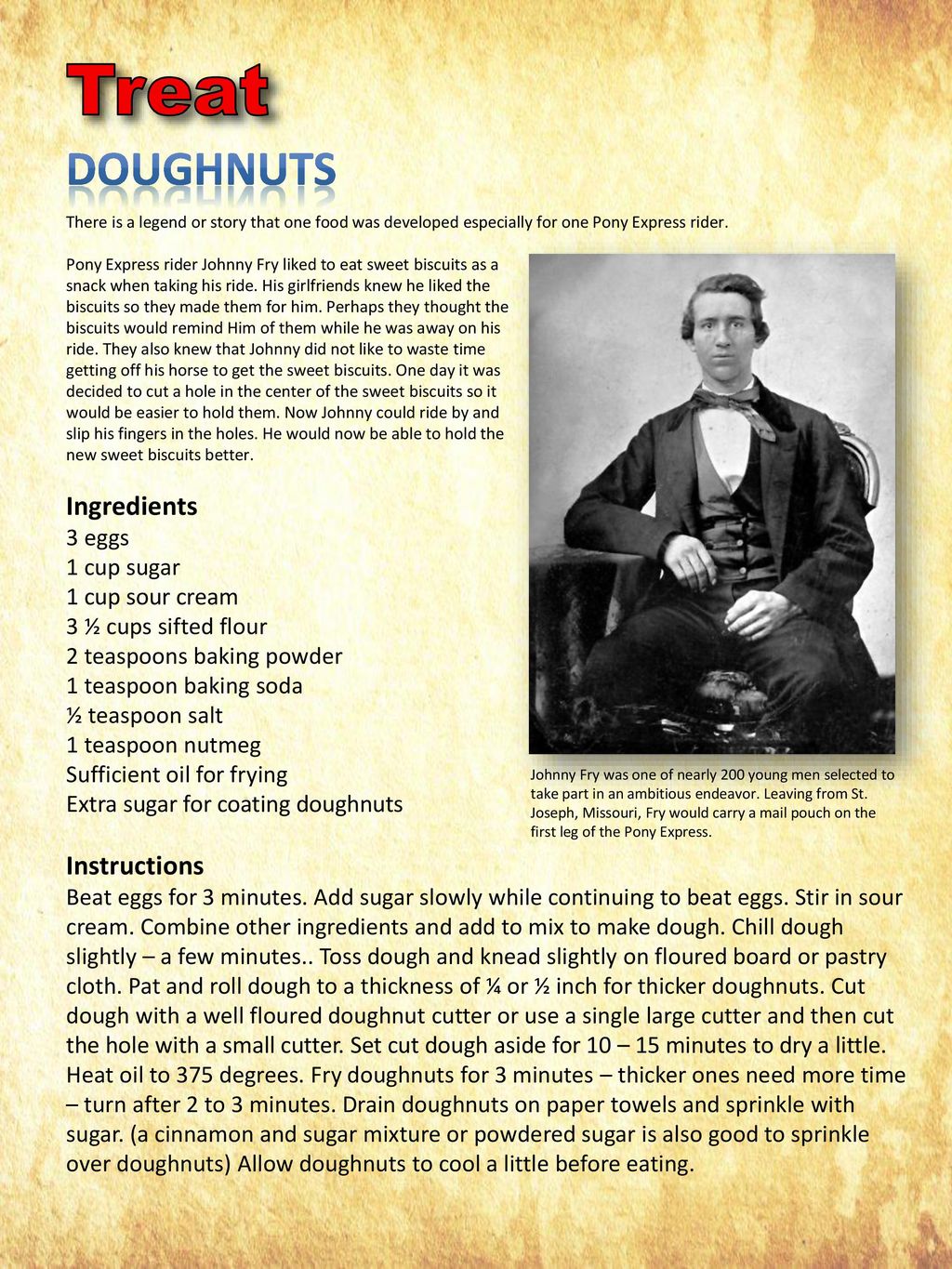
I'm descended from the brother of Johnny Fry, the first Pony Express rider out of St. Joseph, Missouri. He's connected to the origin of donuts.
Fry quickly gained a reputation for never failing to deliver the mail, regardless of weather or danger, and was a fast rider, averaging a speed of 12.5 miles per hour, including all stops. Local lore says that the donut was invented as a cake for Fry to eat while speeding by young girls homes near Troy, Kansas.
This is also family lore. My father told me that the girls would try to give him cakes and cookies, but he rode so fast that when they tried to give them to him, they would just crumble. The solution was a fried cake with a hole in the middle, which he could hook like a ring on a carousel. Thus the donut was invented.

That's a really cool story. Unfortunately, it's not the accepted one. Smithsonian Magazine gives credit to someone else a couple of decades earlier in The history of the doughnut...Johnny Fry and his female admirers are not mentioned at all, not even to debunk the legend. Darn. Just the same, Happy National Donut Day!
That's a legend about the creation of the donut. Now for some actual history about National Donut Day from its creators, the Salvation Army.

“Today is my favorite day of the year because it’s National Donut Day. The Salvation Army has a connection with the donut that you might not know about…”
As I wrote two years ago, "That's right, the Salvation Army created this holiday, not the donut shops, although they are quite content to tag along." WTOL in Toledo, Ohio exemplified this when the morning show hosts started off talking about the Salvation Army founding the holiday, then describing all the donut chains giving out deals in The morning team celebrates National Donut Day!

Today is National Donut Day, one of the morning team's favorite days!
All of my readers who feel like eating a donut, go right ahead. I'll have to beg off because of my diabetes.

*I'll write about World Environment Day tomorrow, entertainment on Sunday, and probably a pandemic update Monday. I'm in an "I can't be all DOOM all the time" mood and I plan on easing out of it over the weekend.

Tuesday, December 4, 2018

U.S. life expectancy drops for third straight year because of suicides and drug overdoses


In June, I reported that life expectancy was down for a second consecutive year in the U.S. and promised "I'll be sure to report on the final numbers for 2017, which should come out at the end of the year."  Those numbers have been reported, which Time Magazine summarized as U.S. Life Expectancy Dropped For The Third Year In A Row: Drugs & Suicide Are Partly To Blame.

U.S. life expectancy dropped in 2017 for the third consecutive year, as deaths by suicide and drug overdose continue to claim more American lives.
That was the headline.  Smithsonian Magazine provided more details.
As Lenny Bernstein notes for The Washington Post, the three-year drop represents the longest sustained decline in expected lifespan since the tumultuous period of 1915 to 1918. Then, the decrease could be at least partially attributed to World War I and the devastating 1918 influenza pandemic. Now, the drivers are drug overdoses, which claimed 70,237 lives in 2017, and suicides, which numbered more than 47,000 over the same period. Both of these figures rose between 2016 and 2017.

“Life expectancy gives us a snapshot of the Nation’s overall health,” CDC Director Robert R. Redfield said in a statement, “and these sobering statistics are a wakeup call that we are losing too many Americans, too early and too often, to conditions that are preventable.”

According to Ars Technica’s Beth Mole, 2015 marked the first recorded drop in U.S. life expectancy since 1993, with Americans shaving an average of 0.1 years off of their lifespans. The same proved true in 2016 and 2017, Cathleen O’Grady writes in a separate Ars Technica piece, making the latest projection 78.6 years, down 0.3 years from 2015’s 78.8. Broken down by gender, men could expect to live an average of 76.1 years, down from 76.2 in 2016, while women could anticipate living until 81.1, the same age projected in 2016.

Although the country’s aging Baby Boomer population factored into the decline, Mike Stobbe of the Associated Press reports that increased deaths amongst younger and middle-aged individuals (particularly those between 24 and 44) had an outsized effect on calculations.

As Kathryn McHugh of Harvard Medical School tells NPR’s Richard Harris, “We're seeing the drop in life expectancy not because we're hitting a cap [for lifespans of] people in their 80s, [but] because people are dying in their 20s [and] 30s.”

The overall number of deaths across the U.S. totaled 2.8 million, or 69,255 more than in 2016, Erin Durkin notes for The Guardian. Of the top 10 leading causes of death—heart disease, cancer, unintentional injuries (drug overdoses constituted slightly less than half of this category in 2017), chronic lower respiratory disease, stroke, Alzheimer’s, diabetes, influenza and pneumonia, kidney disease, and suicide—only cancer witnessed a decrease in mortality rates. Seven, including suicide and unintentional injuries, experienced increases.
I am not surprised by any of these findings, as I covered rising suicide rates in the context of Anthony Bourdain's and Kate Spade's deaths, influenza in the context of 80,000 Americans killed by the flu last year, and drug overdoses in the contexts of a Pew Research Center survey and the News & Documentary Emmy Awards.  I'm also doing my best to reduce the death rates from cancer and diabetes by being a five-year and counting cancer survivor and treating my diabetes.  As for what others can do about drug overdoses and suicides, WXYZ gives some advice in Ask Dr. Nandi: What's causing U.S. life expectancy to drop for the 3rd year in a row?

For the third year in a row, U.S. life expectancy has dropped.  Experts say the data is “troubling."
All good advice.  I hope people take some of it.  Otherwise, I expect another decline in life expectancy to be reported this year.  When I first wrote about the phenomenon, I said prompted Russian analogies, reflecting the loss of social support accompanying the collapse of the USSR.  That is not a good comparison to make, and I don't like making it about the United States.  Remember, I'm a Crazy Eddie and I'd like to offer some hope in solutions, not doom.

Wednesday, November 29, 2017

Two Utah landscape videos from Smithsonian Channel and MatadorU


I left three comments at Booman Tribune that together form a series on Utah landscapes.  The first was on SPP Vol.639 & Old Time Froggy Bottom Cafe and it's from Smithsonian Channel.

"I have a video for that landscape."

Despite its dry desert landscapes, Utah is a land of endless surprises, and Glen Canyon is one of them, rivaling Arizona's Grand Canyon for sheer majesty.
The second is from Matador University, included in this comment on SPP Vol.640 & Old Time Froggy Botttom Cafe.

"Another video showing Utah's Iconic Landscapes From the Air."

MatadorU alumni and filmmaker Max Seigal shows you a view of Utah that not many have seen before. Take a look at this iconic landscape like never before, in Utah from the Air.
I hope my readers enjoyed the scenery as much as I did.

I included a third video in my comment on SPP Vol.641 & Old Time Froggy Botttom Cafe but it's now unavailable.  I have two reactions, phooey and that didn't take long.

Stay tuned for the final entry of the month tomorrow at 7 P.M. E.S.T.

Wednesday, October 18, 2017

An accident in Oregon for Hagfish Day


Happy Hagfish Day!  Here's the national day's description from National Day Calendar.
Hagfish Day is observed annually on the third Wednesday in October.

Hagfish are considered to be the ugliest of species. The idea behind Hagfish Day is to encourage everyone to look beyond the exterior of the Hagfish and appreciate how highly evolved they are.
In general, O.K., but in detail, no.  I'm sure there are uglier vertebrates.  Also, while hagfish are just as evolved as any other organism on this planet, they are the descendants of the first branch off the vertebrate family tree.  In fact, they branched off so early that they don't even really have vertebrae!  They're the reason why cladists call the group Craniates instead of vertebrates; the most primitive group to have vertebrae are lampreys.  See the phylogenetic diagram below.


However, I did not decide to celebrate Hagfish Day to give a lecture.  Instead, I'm doing so to note that hagfish got in the news this summer.  Watch Sloppy slime eel spill stops traffic from USA Today, which I showed to one of my classes this summer. USA Today took down that video, so here's the National Geographic video instead.


All USA Today could muster was "Talk about a traffic jam!"  National Geographic had a more informative description, if a less interesting video.
A car accident caused thousands of hagfish to spill on the highway, coating the road—and even a car—with slime. Hagfish, also called slime eels, secrete huge amounts of an extremely slippery mucus when stressed. The Oregon Department of Transportation used firehoses and a bulldozer to clear away the goo. The fish were likely destined for Asia, where many countries consider them a delicacy.
That was a fun video to show my students, but I think I might show The Hagfish Is the Slimy Sea Creature of Your Nightmares from the Smithsonian Channel to next year's class, either instead or in addition.

The hagfish is a slime-emitting ocean-dweller that's remained unchanged for 300 million years--and it shows. It has a skull (but no spine), velvet smooth skin, and a terrifying pit of a mouth that’s lined with rows of razor-sharp teeth.
That shows and tells a lot more about the animal itself and not just how it interacts with humans.

By the way, not only did I write yesterday that I'd celebrate Hagfish Day today, but that I'd feature the Emmy Awards that "The Rachel Maddow Show" won for its coverage of the Flint Water Crisis and its interview of Kellyanne Conway.  I've changed my mind.  I plan on posting an entry about an Emmy winner that covered the opiate crisis, but it wasn't one of the ones I listed in 'Body Team 12' and 'Extremis' both nominated for Outstanding Short Documentary plus other science, health, and environment nominees; it was one I missed entirely.  Stay tuned.

Sunday, October 1, 2017

Nature documentary nominees are well photographed at the 2017 News and Documentary Emmy Awards


"It's time to move on to the News and Documentary Emmys, which will be awarded October 5th.  Stay tuned!"  So I finished 'Saturday Night Live' wins big on political satire with nine Emmy Awards.  I'm starting this series by following up on a passage in More nature and science at the Primetime Emmy Awards, which mentioned noted that "Wild New Zealand" was nominated for awards in both the Primetime Emmy Awards and the News and Documentary Emmys, the only show I've found with that distinction.
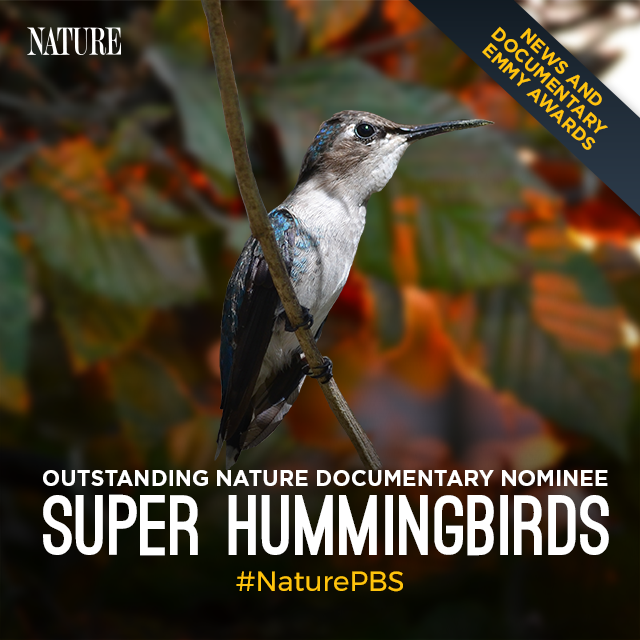
In the News and Documentary Emmys, the show is nominated for Outstanding Cinematography: Documentary along with four other nature shows, "David Attenborough's Light on Earth," "Desert Warriors: Lions of the Namib," "Forces of Nature," and "Nature: Super Hummingbirds."  I watched the last one at my mom's house in Utah immediately after I watched the Nova episode " Treasures of the Earth: Power."  It deserves its nomination.  As for "Wild New Zealand," its nominations prove it was well-narrated and well-photographed.
"Planet Earth II" won't be the only nature documentary recognized for its spectacular cinematography.

Since I've already featured "Wild New Zealand" in an earlier entry and I've praised "Nature: Super Hummingbirds," I'll write about the latter one first (and the first one last).  Here is the preview from PBS.

Hummingbirds are amazing creatures to behold. They are the tiniest of birds, yet possess natural born super powers that enable them to fly backwards, upside-down, and float in mid-air. Their wings beat faster than the eye can see and the speed at which they travel makes people wonder if it was indeed a hummingbird they actually saw. They also are only found in the Americas. These attributes have both intrigued scientists and made it challenging to study the species, but with the latest high-speed cameras and other technologies, Super Hummingbirds reveals new scientific breakthroughs about these magical birds.
In addition to being nominated for Outstanding Cinematography: Documentary, the Nature episode is nominated for Outstanding Nature Documentary.  So is another nominee, CuriosityStream's "David Attenborough's Light on Earth."

Why do animals produce light of their own? For centuries, we could only marvel at the mystery of bioluminescence. Now we can begin to reveal the amazing truth about these living lights. Sir David Attenborough is our guide, as we venture into a world he describes as "utterly unlike our own".
Yes, Sir David narrates nominees in the News and Documentary Emmys as well.  Follow over the jump for the rest of them as well as the remaining nominees in both Outstanding Cinematography: Documentary and Outstanding Nature Documentary.

Thursday, January 5, 2017

Butterflies: Student Sustainability Video Festival 68


I'm concluding this installment of the series with some natural beauty in captivity, Exhibit Highlights Butterfly's Beauty, Diversity, Value to Ecosystem from Voice of America (VOA) News.

As spring makes its slow return to the hemisphere, the Smithsonian Institution's Natural History Museum in Washington, D.C., is marking the occasion with one of its most popular exhibits - the Live Butterfly Pavilion. Now in its fifth year, the Pavilion is a warm, lush enclosure filled with beautiful flowering plants, in which visitors interact with hundreds of live butterflies, representing species from around the world. As VOA's Julie Taboh discovered, it's an exhilarating experience.
I write a lot about bees, but Monarch butterflies are in trouble, too, as I've mentioned once.  Perhaps I should write more about their plight.

The Student Sustainability Video Festival will return in May or August.  Until then, Crazy Eddie's Motie News will resume its regular programming, which will likely be about entertainment awards shows and coping with the election of Donald Trump.  Stay tuned.

Sunday, September 25, 2016

How 'Star Trek' shaped the present and future


When I wrote "I'll have more on the other [News and Documentary Emmy] winners next week, possibly beginning with Sunday's entertainment entry" to end Emmy Award winner 'Rise of Animals', the key word was "possibly."  I'll still do it, but later this week.  Instead, I'm celebrating Star Trek's 50th anniversary one more time with two videos from Smithsonian Channel from its documentary "Building Star Trek."  I begin with a topic I've examined here before, a real-life tricorder in The $10 Million Race to Invent Star Trek's Tricorder.

Fifty years after the show aired, Star Trek’s fictional tricorder is far from becoming a reality. But a $10 million prize from the XPRIZE Foundation is hoping to motivate inventors to create one quickly.
The show influenced more than technology.  Star Trek's Nichelle Nichols on Uhura's Radical Impact depicts its impact on society.

Star Trek’s decision to cast Nichelle Nichols, an African American woman, as major character on the show was an almost unheard-of move in 1968. But for black women all over the country, it redefined the notions of what was possible.
To watch more, click here for the full documentary.  Sorry, embedding disabled by request.

Friday, September 23, 2016

Emmy Award winner 'Rise of Animals'


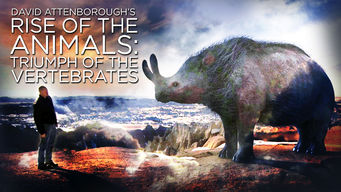
As I mentioned in Al Jazeera America's final Emmy nominations, the News and Documentary Emmy Awards were given out Wednesday night.  Unfortunately, Al Jazeera America didn't win any.  That doesn't mean that I found the awards disappointing.  Quite the contrary, since I've started paying attention, I've found worthwhile shows that I can share with my classes, whether about Snow Monkeys or Your Inner Fish.  This year, the winner that caught my eye was Smithsonian Channel's "Rise of Animals: Triumph of the Vertebrates," which earned Outstanding Nature Programming.  Not only is it excellent informative television, it gives me a chance to write about fossils.

Smithsonian Channel has obligingly loaded several videos from the show to its YouTube channel, begining with Sir David Attenborough answering the question When Did Our Backbones First Appear?

When did vertebrates emerge, asks David Attenborough? An exciting fossil find in China points to a 525-million year old sea-dweller who used its new backbone to swim nimbly away from predators.
I can definitely use this in class.

Follow over the jump for more videos.

Friday, August 5, 2016

Servals: Student Sustainability Video Festival 56


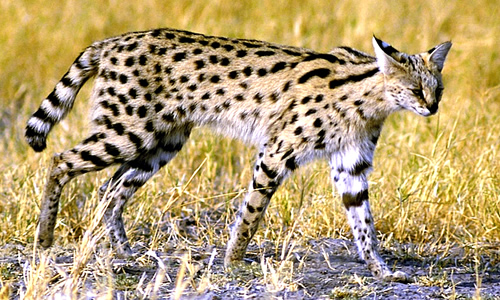
Yesterday's installment was about snow leopards.  Today's is about another big cat (more or less), the serval.  Here's the Smithsonian Channel's Serval Vs. Guinea Fowl.

With the ability to pounce 10 feet in the air, the serval is more than a formidable opponent for this guinea fowl.
The student who presented on servals keeps one as a pet--legally.  Here it is at home.


That wins the cool pet award so far.

Stay tuned for more installments.

Saturday, June 4, 2016

Belated National Donut Day 2016!


Last year, I added another holiday to the list I celebrate here, National Donut Day.  The day was yesterday, and ABC News marked it by posting Nuts for Donuts | International Donut Day 2016.

Of all the made-up national food holidays, National Doughnut Day may be the best. Find out the history behind the tasty treat and don't forget to celebrate by visiting your local donut shop!
At least the video sticks to the history of the holiday itself without going too much into that of the donut, which I have a family connection to.  Time to be a good environmentalist and recycle.
I'm descended from the brother of Johnny Fry, the first Pony Express rider out of St. Joseph, Missouri.  He's connected to the origin of donuts.
Fry quickly gained a reputation for never failing to deliver the mail, regardless of weather or danger, and was a fast rider, averaging a speed of 12.5 miles per hour, including all stops. Local lore says that the donut was invented as a cake for Fry to eat while speeding by young girls homes near Troy, Kansas.
This is also family lore.  My father told me that the girls would try to give him cakes and cookies, but he rode so fast that when they tried to give them to him, they would just crumble.  The solution was a fried cake with a hole in the middle, which he could hook like a ring on a carousel.  Thus the donut was invented.

That's a really cool story.  Unfortunately, it's not the accepted one.   Smithsonian Magazine gives credit to someone else a couple of decades earlier in The history of the doughnut...Johnny Fry and his female admirers are not mentioned at all, not even to debunk the legend.  Darn.  Just the same, Happy National Donut Day!
And a belated Happy National Donut Day to my readers!

Friday, June 5, 2015

National Donut Day 2015


As I wrote in Detroit celebrates National Pancake Day 2015, I'm a sucker for holidays, even fake ones, especially if they involve food.  I'm even more of a pushover when I'm in an "I can't be all DOOM all the time" mood.  I'm in one of those moods, and today is one of those fake food holidays, so I'm putting off three serious entries I'm working on* and letting ABC News explain National Donut Day.

For National Donut Day, ABC’s Tina Trinh visits Underwest Donuts for some gourmet desserts.
That was fun, but there is a serious purpose to the holiday as shown in WOOD TV8 & National Donut Day.

WOOD TV8 Recognized on National Donut Day from the Salvation Army.
On a different serious note, I have a family connection to the invention of the donut, even if it's more legendary than historical.  Follow over the jump for the story.

Saturday, December 13, 2014

12-13-14, the last sequential day of the century


Jessica Contrera of The Washington Post has the story in On 12/13/14 one last chance to indulge in sequential date frenzy — this century, anyway.
It’s the very last sequential day of the century. We are already out of triple dates, the 11/11/11s and 12/12/12s, and Saturday we run out of 1/2/03s and 4/5/06s.

There is no 13/14/15! And there won’t be anything like it until the year 2101!
...
Journalists have been reporting on these special dates — calling wedding planners and casinos and numerologists and “scientists” — and maybe exaggerating the details of the situation a bit, but we’ll get to that — for 14 years.

So to celebrate this century’s last hurrah, this final quirk of the calendar, let us compile all the essential ingredients for the ultimate 12/13/14 sequential date story.
Of course, if one writes dates the European way, the last sequential day using consecutive integers passed last year on 11 December 2013.

Follow over the jump for sequential days using numbers other than consecutive integers.

Thursday, January 2, 2014

The climate and environment in 2013


I began 2013 in biodiversity by describing the pressure I felt.
I have only 32 hours until 2013 disappears from the face of the planet at 11:59 PM in UTC-12, which includes Baker and Howland islands.  Consequently, it's time to resume what I started with 2013 in space and What did 2013 say on YouTube? and post the year in biodiversity stories I orginally included in Overnight News Digest: Science Saturday (Science in 2013).
I finished with "Stay tuned for more of science, environment, and health in the year that was."  As it turned out, I decided not to buckle to the pressure I felt to finish my recap of 2013 in 32 hours.  Instead, I responded to an external deadline to retain my positions with Examiner.com by posting Top Washtenaw County election stories of 2013 look ahead to 2014, which I excerpted in Examiner.com article on popular elections articles for 2013.  I decided that keeping myself in the journalism game and getting paid for it was more important.  Ah, priorities.

Enough meta.  Time to go through the articles listing the top environment stories of the past year, beginning with Smithsonian Magazine: Six Things We Learned About Our Changing Climate in 2013.
December 27, 2013
2013 was a great year for science. We discovered hundreds of exoplanets, found yet more evidence of ancient water on Mars and learned all about our species’ own evolution.

But it’s important to remember that, in terms of the long-term survival of both our species and all others on the planet, 2013 is remarkable for a much darker reason. It’s a year in which we’ve pushed the climate further than ever away from its natural state, learned more than ever about the dire the consequences of doing so, and done as little as ever to stop it.

As greenhouse gas emissions soar unabated and the ramifications become rapidly apparent, here’s a rundown of what we learned about climate change in 2013:
Grist's The top 13 green stories of 2013: The good, the bad, and the muddled by John Upton had an even briefer lede.
The environmental news this year was full of ups and downs, twists and turns, and deeply conflicted protagonists.
Follow over the jump for more retrospectives of the year in climate and environment.

Tuesday, December 31, 2013

2013 in biodiversity


I have only 32 hours until 2013 disappears from the face of the planet at 11:59 PM in UTC-12, which includes Baker and Howland islands.  Consequently, it's time to resume what I started with 2013 in space and What did 2013 say on YouTube? and post the year in biodiversity stories I orginally included in Overnight News Digest: Science Saturday (Science in 2013).   I don't have any videos to use under "if it moves, it leads."  Instead, I've featured images of the largest animal described this year, Tapirus kabomani, which was first collected by Teddy Roosevelt.  If the animal had been described a century ago, it would likely have been Tapirus roosevelti.  This goes to show that science does follow the fashions of culture.  Hey, scientists are people, too.

As it turns out, "Roosevelt's Tapir" or the "Dwarf Tapir" is among the species featured in Smithsonian Magazine's A Recap of Our Five Favorite New Species of 2013.
New species of insects, fungi, spiders, plankton, plants and even small mammals and reptiles are pretty commonplace. If you have enough expertise and spend enough time in the field, you are almost certainly guaranteed to uncover a new species, even if you’re searching in an urban center or an already well-explored country.

Finding a larger animal–a new bird or carnivore, for example–is a much rarer event. But such discoveries do happen, especially as genetic studies are drawing a much finer line between science’s traditional definition of what is and is not a species. Sometimes those new species turn out to be right below our noses, in museum collections or long-ignored field anecdotes.

Whether discovered using genetic sequencing or traditional field sleuthing, here are five of the most sensational species reveals of the year:
Follow over the jump for the rest of the biodiversity stories from last Saturday, including links to some great animal images.

Wednesday, December 18, 2013

Student sustainability video festival 16: Meet the Freegans on Trashopolis

It’s time to pick up where I left off Student sustainability video festival 15: 'The Top Banana' trailer with another video from my students’ presentations.  Tonight, it’s Trashopolis : Meet the Freegans from the Smithsonian Channel.

Not all garbage should be thrown away -- at least, that's what the Freegans, a group of dumpster-divers who live off unspoiled discarded food, believe.
This is the second time that one of my students have presented on this topic, but the last time was at least five years ago.  Both times, the student was simultanteously disgusted and amazed and showed a perverse admiration for the lifestyle.  Freeganism certainly wasn't for either student.

My comment is that this video fits this month’s theme perfectly; the Freegans are showing how to do more with less.

Friday, April 26, 2013

The smell of rain


I enjoy finding connections between things that don't appear related.  This includes making associations between two of this month's prompts.
Tuesday, April 23, 2013
Do you like the rain?
...
Friday, April 26, 2013
Margaret Atwood said: "In the spring, at the end of the day, you should smell like dirt." Agree or disagree?
The assocation between the two is the smell of rain.

Smithsonian Magazine: What Makes Rain Smell So Good?
Joseph Stromberg
April 2, 2013
Step outside after the first storm after a dry spell and it invariably hits you: the sweet, fresh, powerfully evocative smell of fresh rain.

If you've ever noticed this mysterious scent and wondered what's responsible for it, you're not alone.
Two of the answers to this question are chemicals produced by living things during dry spells that accumulate in the soil and are released into the air during rain.  Plants secrete oils and bacteria manufacture a substance called geosmin.  Combined, they create the smell of wet soil characteristic of rain.

As for how rain makes people feel, I'll let Stromberg explain for me.
But apart from the specific chemicals responsible, there’s also the deeper question of why we find the smell of rain pleasant in the first place. Some scientists have speculated that it’s a product of evolution.

Anthropologist Diana Young of the University of Queensland in Australia, for example, who studied the culture of Western Australia’s Pitjantjatjara people, has observed that they associate the smell of rain with the color green, hinting at the deep-seated link between a season’s first rain and the expectation of growth and associated game animals, both crucial for their diet. She calls this “cultural synesthesia”—the blending of different sensory experiences on a society-wide scale due to evolutionary history.

It’s not a major leap to imagine how other cultures might similarly have positive associations of rain embedded in their collective consciousness—humans around the world, after all, require either plants or animals to eat, and both are more plentiful in rainy times than during drought. If this hypothesis is correct, then the next time you relish the scent of fresh rain, think of it as a cultural imprint, derived from your ancestors.
Growing up in southern California, I associated rain with the color green as well, which is one of the reasons I liked rain there.  Even here in Michigan, where rain and green are not as precious, I still enjoy the smell of rain.

As for Atwood's assertion, I don't think everyone should smell like they've been working the soil, but it would do a world of good if more people did.  I'll do my part by working in the yard this weekend.  I've been looking forward to it all month.

Monday, December 31, 2012

Looking forward to 2013 in science and space

I concluded the science year in review 2012 with a programming note.
I'll have science and space events to look forward to in 2013 next at Midnight GMT.
Time to make good on that, beginning with a final look back at the year that was in space  in Happy New Year from NASA Television.


Follow over the jump for what scientists expect to happen in the coming year.