Showing posts with label Gizmodo. Show all posts

Tuesday, January 7, 2020

Russell Crowe, Joaquin Phoenix, and others highlight Australian fires and climate change at the Golden Globes


Patricia Arquette not only urged viewers to vote at the Golden Globes, but she also referred to climate change when she mentioned "the continent of Australia which is on fire."  She was not alone.  Russell Crowe issued a statement read by Jennifer Anniston when she accepted the award for Best Actor in a Limited Series or TV Movie on his behalf.

Russell Crowe accepts the award for Best Performance by an Actor in a Limited Series or a Motion Picture Made for Television at the 77th Annual Golden Globe Awards.
Gizmodo quoted Crowe's statement in Climate Change Stole the Show at the Golden Globes.
Make no mistake. The tragedy unfolding in Australia is climate change-based. We need to act based on science, move our global workforce to renewable energy, and respect our planet for the unique and amazing place it is. That way, we all have a future.
While “Russell Crowe could not be here with us tonight because he is at home in Australia protecting his family from the devastating bushfires,” as Anniston told the audience, another Australian remained in Los Angeles to get on stage.  Cate Blanchett mentioned the troubles in her home country when she presented an award.
I wanted to do a special call-out to the volunteer firefighters who have been at the center of battling the climate disaster that is facing Australia. And of course, when one country faces a climate disaster, we all face a climate disaster. So we’re in it together.
Guardian Culture included both Blanchett and Ellen DeGeneres talking about Australia in Fire and politics take centre stage at Golden Globes.

Celebrities including Cate Blanchett and Ellen DeGeneres used their Golden Globes speeches to offer support to people battling bushfires in Australia. Meanwhile Michelle Williams and Patricia Arquette used the opportunity as a political platform, urging people to vote in this year's US election.
I wish I had this video yesterday.  I could have taken care of both exhorting Americans to vote and climate change in one post.

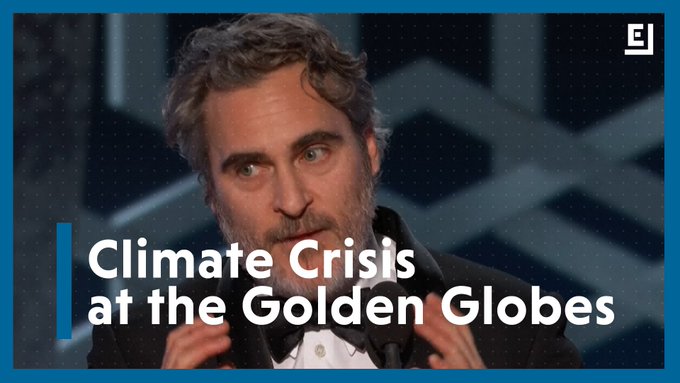
Joaquin Phoenix made a much more general statement about climate change and how Hollywood celebrities have been contributing to it when he accepted the Golden Globe for Best Actor in a Motion Picture - Drama.

Joaquin Phoenix accepts the award for Best Performance by an Actor in a Motion Picture - Drama at the 77th Annual Golden Globe Awards.
Gizmodo quoted Phoenix as well.
It’s really nice that so many people have come up and sent their well wishes to Australia, but we have to do more than that.  It’s such a beautiful gesture. Together, hopefully, we can be unified and actually make some changes. It’s great to vote, but sometimes we have to take that responsibility on ourselves and make changes and sacrifices in our own lives. I hope that we can do that. We don’t have to take private jets to Palm Springs for the awards sometimes or back.
I second this sentiment.  It's one of the main reasons why I monitor my driving so closely.  I want to be a good example.

I'm not done with the Golden Globes, as I plan on revisiting the Golden Globes to discuss the winners that dealt with politics and government as well as diversity among the individual winners.  Stay tuned.

Sunday, June 16, 2019

U.S. birth and fertility rates continue falling and setting record lows for Father's Day


Happy Father's Day!  Just as I did last year, I am "writing about the lower birth rate for Father's Day, even though that is usually considered a concern of mothers.*

Just like last year, the birth rate hit another record low, as CBS News reported last month.

America's baby bust isn't over. The nation's birth rates last year reached record lows for women in their teens and 20s, a government report shows, leading to the fewest babies in 32 years. The provisional report, released Wednesday and based on more than 99% of U.S. birth records, found 3.788 million births last year. It was the fourth year the number of births has fallen, the lowest since 1986 and a surprise to some experts given the improving economy.
Gizmodo included even more facts in its article on the subject.
[T]he national birthrate, measured as the number of births per every 1,000 women between the ages of 15 to 44, also took a drop for the fourth year in a row. Overall, the country hasn’t seen this few births since 1986.
...
There’s also been a continuing decline in the fertility rate, defined as the number of children a woman has over her lifetime. In 2018, the rate was 1.72 births per every woman, a decline from 1.76 births in 2017. Experts consider a rate of 2.1 births to be a baseline for ensuring that younger generations can continue to replace the aging population with no problems, a threshold the U.S. has consistently failed to meet for a decade.
I found the CBS News report, while good on the facts, short on analysis.  That's not the case with the following clip from KSNT News from Topeka, Kansas, Report shows U.S birth rate is declining.


In addition to the reasons for the declines among most age groups and increases among older women, the expert from the Cleveland Clinic connects the increase in premature births to the trend towards delayed childbirth.  That's decent analysis of the data.  Still, it misses some of the economic dimensions of both the causes and effects of lower birth and fertility rates.  For those, I turn to Gizmodo.
But there are likely other worrying things that are making pregnancies among women in their 20s less common, namely the lingering after-effects of the Great Recession. Research has consistently linked a struggling economy to fewer births, and in the U.S., this latest decline began in 2008, when the recession hit.

While some people’s financial fortunes (mostly the rich) have since recovered and the economy as a whole is considered healthy, it’s people in their 20s who are often still struggling to stay afloat. And this financial stranglehold is clearly affecting some young adults’ plans for parenthood. A 2018 survey commissioned by the New York Times, for instance, found that nearly two-thirds of adults cited the expenses of child care as a reason for not having children. In fact, it was the most commonly-cited reason.
I first made this point in Next Media Animation thinks low birth rates in the U.S. and China aren't all good eight years ago.  I expected that as the economy improved, birth rates would pick up.  That hasn't happened.

Gizmodo also analyzes the possible effect of lower fertility rates.
Again, as with the birth rate, this isn’t necessarily a doomsday scenario. Many similarly wealthy countries, such as Canada, have rates even lower than that. In some ways, a lower fertility rate could be viewed as a sign that an industrialized country is doing relatively well. It can mean, as mentioned above, that more women have the reproductive freedom to have (or not have) children at their choosing. The closer the birth rate becomes to that of countries like Greece and Japan, though, the more trouble that could spell in the future, with a growing aging population that can strain a country’s resources and labor shortages.
That's a concern elsewhere as well, as France 24 English reported in Drop in world fertility rates leading to 'baby bust' last year.

Women are having fewer babies in developed countries. That's the conclusion of a new global report that warns the current population in some of the world's wealthiest nations can't be maintained at the current birth rate.
I'm ambivalent about this development, as I wrote last year.
I have been in favor of zero population growth for as long as I can remember.  However, I'm not sure the U.S. economy is set up for a stable or slowly declining population, a point I made in the Hipcrime Vocab: Why Slowing Population Growth is a Problem.  We are going to have to figure how to do so.  Otherwise, I might live long enough to experience the wisdom of the saying "Be careful what you wish for; you might get it."
I repeated a similar sentiment in my comment on Going South at Kunstler's blog last month.
It always struck me as odd that, if the economy is supposedly so good with a 50-year low unemployment rate, U.S. birth and fertility rates are falling and the fertility rate is at a record low.  The answer is that, as our host pointed out, the economy isn't actually that good because it's unequally distributed.  On the one hand, it's leading us (as in the U.S.) to do our part to slow the growth of population and affluence, the P and A in I (impact) = P * A * T, where T is technology, which ideally could counteract the effects of the other two variables.  On the other, I and other advocates of zero population growth should be careful what we wish for.  We might not like how we get it.
That includes accepting more immigrants to counteract lower population growth and stagnant or shrinking economies.  I'm O.K. with that, but Trump is in office in large part because many Americans are not.

Enough finding a dark lining in a silver cloud.  It's Sunday, so it's time for an entertainment feature.  As I promised on Mother's Day, "I'm saving Star Wars names for Father's Day.  Stay tuned."

*That written, there are "Men Going Their Own Way" (MGTOW) types who are allies of the men's rights advocates (MRAs) that I criticized in Recycled comments about the men's rights movement that are cheering this development in the comments to the videos I posted because it means men are avoiding marriage, fatherhood, and child rearing and support.  They're not entirely wrong factually, although I think they are wrong morally as well as giving themselves and men in general too much credit.

Sunday, November 12, 2017

Yet another attempt at a 'Ringworld' movie/miniseries plus bonus 'Snow Crash' from Amazon


For the Sunday entertainment feature, I'm recycling what I wrote on Dreamwidth.
Four years ago, I wrote Finally, a Ringworld movie!
That's the one in which I repeated my twenty-year-old grousing about how I wrote an adventure for Chaosium's Ringworld table-top RPG, but lost all that effort because the movie rights to the book were sold and the movie production company asserted that they had the game rights, too.  To add insult to injury, there was no movie.  Apparently, that will change, as SyFy announced that they will develop the book into a four-hour miniseries.
The good news was that it became one of the two most read posts of that year.  The bad news is that no "Ringworld" movie or miniseries came of it.

Not all is lost, as io9 reported this week Amazon Is Developing a Bonanza of Genre Titles: Ringworld, Snow Crash, and Lazarus.
Amazon just announced a virtual land grab of genre titles that it’s putting into development: Larry Niven’s scifi classic Ringworld; Neal Stephenson’s cult classic Snow Crash; and Greg Rucka’s acclaimed comic Lazarus. In a perfect world, we could be seeing all three made into drama series.

As Deadline reports, the announcement comes as the streaming network is hoping to land a “big-scope genre drama series in the mold of Game Of Thrones and The Walking Dead.” There aren’t too many details yet, but the standout points include: the Ringworld project will likely draw not just from Niven’s 1970 original, but other books in the series; Rucka will be adapting Lazarus himself from page to screen; and Snow Crash will be co-produced by Joe Cornish, who at one time had the project on his own feature-directing slate.
I'm a lot more confident in Amazon pulling off "Ringworld" than I was about SyFy, so I'm looking forward to it.  The other project I want to see is "Snow Crash."  It may not be the best of Stephenson's novels, but it is the best-known and it's a lot of fun.  Here's to both of them reaching the small screen before the decade is out!
Here's to getting that "Ringworld" movie I was promised 33 years ago, even if it ends up being a series streaming on Amazon!

Saturday, March 11, 2017

Wild boars may prevent people from returning to towns near Fukushima


I know I hinted twice that I would celebrate Purim on this blog, I've decided to skip it this year because today marks the sixth anniversary of the Fukushima triple disaster.  That is an occasion much more on topic for the blog's themes, so today I observe an anniversary of DOOM instead of joy.*

After six years, conditions have managed to improve near the ruin nuclear plant, enough that people might return.  Gizmodo has the story.
In just a few weeks, the residents of a Fukushima city will finally be allowed to return to their homes. Trouble is, the place has been overrun by hundreds of belligerent and potentially radioactive wild boars, prompting public safety concerns.

At the end of March, the six-year-long evacuation order will be lifted for Namie, a city located just 2.5 miles (4 km) from the damaged nuclear power plant. Radiation levels, now measured at 0.07 microsieverts an hour, are the same as they are in other areas of Japan. Namie is the closest area to the nuclear meltdown residents have been allowed to return to since the disaster on March 11, 2011, but the continued presence of wild boars in the region is making prospective homecomers nervous.
Newsy has more in Boars overrun Fukushima.


High radiation levels drove people away from many areas of Fukushima.

I shouldn't have been surprised.  As the video noted, Chernobyl became an impromptu wildlife refuge, complete with radioactive wolves, so the evacuation zone around Fukushima becoming one as well should have been expected.

Finally, the idea of Fukushima being infested with radioactive boars evoked the image of the giant boar demon from the opening scene of "Princess Mononoke."  I wasn't the only one to think that, as Gizmodo used the following illustration for their article.


Geeky minds think alike.

*No, I won't observe it tomorrow, as that is the beginning of Daylight Saving Time.  I'll save it for next year, when it falls on the evening of February 28th -- perfect timing!

Tuesday, December 20, 2016

Gravity waves and other top science stories of 2016


I promised to return to reality today after a three day weekend devoted to entertainment.  I was planning on blogging about the Electoral College or the Flint Water Crisis, but I decided to write about something positive about the past year instead, the year in science.  Following my own adage of "if it moves, it leads," here is New Scientist's  The 12 biggest science stories of 2016.

Gravitational waves, humming gorillas, a new neighbour and more: here are New Scientist's stories of the year.
Science News, Gizmodo, and Newsweek have their own reviews of the top science stories of the year about to end.  Every one of them included the discovery of the gravitational waves predicted by Albert Einstein, so it's the top science story of the year by consensus.  Planet Nine and Proxima B showed up in three of the four.  The remaining stories that showed up in half the lists were human gene editing, a three-parent baby being born, Google's A.I. beating a human Go master, and Zika.  No single environmental story showed in more than one list, although two different climate change stories were mentioned in different articles.  Also, no one story about fighting aging made more than one list, but several different ones also were mentioned, so I'm giving climate change and anti-aging breakthroughs honorable mentions.

The New York Times had its own science, environment, and health year in review articles, but I found them next to useless.  The science summary mentioned none of the above stories, the environmental review was all about climate change, and the health one only mentioned Zika.  I suppose that reinforces my awarding climate change an honorable mention and allows me to break the tie among the third place stories in favor of Zika, but that's about it.  Still, it's enough to convince me to blog about Zika; today's entry is the first time I've mentioned the disease here.

Tomorrow is the winter (hibernal) solstice.  I have something special planned for the occasion.  Stay tuned.

Saturday, June 7, 2014

Hurricane names show that sexism harms the sexists


In yesterday's Recycled comments about the men's rights movement, I described my online encounter with a den of rabid sexists and how their "inflammatory, paranoid, rigidly doctrinaire, and downright hostile" behavior got in the way of accepting something that would help them.  Today, I present evidence that sexism harms the sexists themselves from Laci and Tara of Discovery News, who explain Why Female-Named Hurricanes Are More Deadly.

A groundbreaking new study revealed that hurricanes that are named after a women are more deadly than hurricanes with male names! What's the reasoning for this? Tara and Laci discuss how people don't take hurricanes with female names as seriously as those with male names!
Actually, I'd find Bertha more threatening than Reginald, but that's probably just me, as the former sounds tougher than the latter.

Follow over the jump for my reflections on the utility of naming storms and a meta observation on the comments to this video.

Tuesday, February 18, 2014

The practicality and esthetics of LED streetlights


One technology that I’ve been telling my students is coming is LED, which will replace fluorescent bulbs, which have themselves been taking over from incandescent lights for most of this century.  The technology’s acceptance in one application shows my prediction is already becoming reality.  As KPBS reported on Tuesday, January 28, 2014 3,000 San Diego Streetlamps Getting LED Upgrade.
The city of San Diego and General Electric announced Tuesday that a program to replace 3,000 streetlamps around the downtown area with energy-efficient LED lighting is underway.

The new lights are expected to shine brighter while saving the city $254,000 annually in utility costs.

A digital system will provide status updates on the condition of the lights, and allow the Environmental Services Department to adjust the brightness of individual lamps.
In addition to saving money, the light cast by the LED streetlamps is more balanced.  That’s generally good, but it will have unintended consequences.  Geoff Manaugh explains in Gizmodo How LED Streetlights Will Change Cinema (And Make Cities Look Awesome).
The decision by the city of Los Angeles last year to replace its high-pressure sodium streetlights—known for their distinctive yellow hue—with new, blue-tinted LEDs might have a profound effect on at least one local industry. All of those LEDs, with their new urban color scheme, will dramatically change how the city appears on camera, thus giving Los Angeles a brand new look in the age of digital filmmaking. As Dave Kendricken writes for No Film School, "Hollywood will never look the same."
Here’s one of the images he used making his point.


His essay also makes two points of mine: Everything is connected to everything else and there is no free lunch.

Friday, February 7, 2014

Giant African Snails returning to Florida


It's time for an update to Giant African Snails invading Latin America.  These animals have now returned to Florida after an earlier invasion was repelled.  Matt Simon of Wired tells the story of both invasions in Absurd Creature of the Week: Foot-Long, Sex-Crazed Snails That Pierce Tires and Devour Houses
Ah, the innocence of children. So free of corruption and cynicism, so sweet and sincere. Laughing and playing and introducing supremely destructive monster snails to Florida, where the beasts eat almost anything that’s green and then crap all over houses — quite literally laying waste to whole neighborhoods.

This actually happened in the 1960s, when a boy vacationing with his family in Hawaii had pocketed a few giant African land snails (Lissachatina fulica), a mollusk that grows to a foot long and a full pound. Hawaii had been battling the pest, and so too would Florida, where the boy returned with his new friends. Once home, he quickly grew bored of the snails and handed them over to his grandmother, who set them free in her backyard.

What ensued was an invasion by rapidly reproducing critters that have over the last century spread out of their native East Africa into tropical climes all over the world, from Asia to South America, as stowaways on ships or as pets brought home by people with a thing for snails. In Florida, eradication took seven years. Other places, like Brazil, have not been so lucky in their efforts.
At least the first invasion had a happy ending for Florida, if not for the snails.  Follow over the jump for the tale of the second invasion.