Thursday, June 10, 2021

JBS paid $11 million while the FBI recovered much of the Colonial Pipeline ransom

In a report by the Associated Press reprinted in the Detroit News, cyberattack victim JBS confirms it paid $11M ransom in cyberattack. Yikes! That's the bad news. The good news is that a few days ago, the FBI recovered $2.3 million in bitcoin paid by Colonial Pipeline after being attacked by ransomware. I'll get into the details of the latest in these related stories after I share the latest general overview of the subject from CNBC, Why The U.S. Can't Stop Cyber Attacks.

U.S. recently faced a series of ransomware attacks on critical infrastructure like the Colonial Pipeline, the city of Tulsa, and JBS, the worlds largest meat producer. Ransomware, a program that hackers use to hold digital information hostage, has become the top choice of malware for criminals. In 2020, the total amount of ransom paid by the victims reached nearly $350 million worth of cryptocurrency, most of them in bitcoin. So what led to the rise of ransomware in the U.S. and what makes it so difficult to fight?

The May 7 ransomware attack on the Colonial Pipeline “is probably the most significant ransomware attack on one of our critical infrastructures ever,” said Rep. John Katko, R-N.Y. And shortly after the pipeline was hit, the U.S. faced more ransomware attacks — targeting cities, ferries and even a meat plant.

“Although ransomware has really been around since 2013, it has not yet been seriously taken in terms of something that could impact critical infrastructure,” said Vanessa Pegueros, chief trust and security officer at OneLogin.
Like the other CNBC mini-documentaries I share, this one does a good job of explaining the issue with high production values. It also answers its own question.
These groups have become increasingly bold, showing off bundles of cash and fancy sports cars. That’s because tracking, arresting and bringing these hackers to justice is often incredibly difficult.

“A lot of these organizations are allowed to essentially operate freely within Russia or other former Soviet states as long as they don’t hit anybody within that country,” [Marc] Bleicher said. “So unless there’s a cooperation at the political level there, I don’t see this going away anytime soon.”
Putin's hackers and agents have graduated from being trolls who weaponize social media, spread disinformation, and hack into political campaigns. As 21st Century criminal gangs, they are now engaging in industrial sabotage, a threat to the nation's infrastructure and a national security issue.

Bloomberg Markets and Finance covered both the JBS and Colonial Pipeline stories in JBS Paid $11 Million in Bitcoin to Hackers.

Jun.09 -- JBS USA has confirmed it paid the equivalent of $11 million in bitcoin to hackers that targeted and crippled its business last week. Separately, U.S. regulators have slammed Colonial Pipeline Co.’s cybersecurity practices after it paid $4.4 million in bitcoin in its own ransomware attack. Bloomberg’s Kartikay Mehrotra reports on “Bloomberg Daybreak: Asia.”
Kartikay Mehrotra told pretty much the same story as CNBC, that the FBI followed the money and exploited the hackers sloppy security to retrieve most of the ransom. That's rare, but at least it's possible, which is good news.

I conclude today's entry with another ransomware story, U.S. transit agencies targeted in recent wave of cyberattacks from CBS News.

Two new cyberattacks targeted U.S. transit agencies. New York's Metropolitan Transit Authority and a Massachusetts ferry service both said their systems were recently compromised by hackers following Monday's attacks on the world's largest meat processing company, JBS SA. CBS News chief Justice and Homeland Security correspondent Jeff Pegues reports on the response from Washington, and CBSN technology reporter Dan Patterson joined Tanya Rivero to discuss.
While I'm calling these criminal gangs an outgrowth of Putin's hackers and agents, they are really independent organized crime groups acting with the Russian government's tacit approval. In addition, Russia isn't the only country hosting these criminal gangs; China is as well, although the group that attacked New York's subway system may be state associated. Those are government and industry issues. For individuals, follow the advice given by Dan Patterson to keep your data secure. Be careful and good luck!

Wednesday, June 9, 2021

Colbert and Meyers lampoon 'Italygate' and debunk Trump's backwards pants

It's been almost a full month since I featured Stephen Colbert and Seth Meyers here, so I can't resist them lampooning yet another conspiracy theory. I begin with Colbert's monologue from last night, Exactly What You Thought, But So Much Worse Than You Imagined.*

In this edition of Stephen's unfortunately ongoing segment, he looks at damning findings of law enforcement failures leading up to the Jan 6th Capitol riot, and an insane election fraud theory known as "Italygate."
After rushing through another report about the January 6 insurrection, Stephen moved on to "Italygate." That's at least as nutty as searching for bamboo fibers as part of the Arizona audit, but less racist.

Seth Meyers concentrated on that story in The GOP's Insane Election Conspiracy Theories Now Include "Italygate": A Closer Look.

Seth takes a closer look at Donald Trump reportedly believing he'll be "reinstated" in the White House as some of his allies and supporters openly call for a coup.
Before I move on to the main conspiracy theories, I have to remark about Seth mentioning Rudy Guiliani's video about UFOs. On the one hand, I feel the same about addressing the official interest in UFOs as I do about "Fauci's emails and...the Wuhan lab-leak hypothesis, two narratives that I want to give as little attention to as possible." On the other, I have described this blog as having a "science fiction slant" on its Facebook page, so writing about the topic is on brand. I have two opportunities to do so, as there are two World UFO Days coming up, June 24 and July 2. Maybe by then I'll feel up to it.

As for "Italygate," Seth found it even more ridiculous than Stephen did. He also thought the idea that Trump wore his pants backwards was silly and quoted Snopes debunking it. Progressives have their own conspiracy theories, although they are a lot less convoluted and dangerous than the ones being promoted on the right, like the Big Lie that the 2020 election was stolen.

I'm closing the circle today by returning to Colbert, whose Monday night monologue was The Zipper Was In Front - Fact-Checking No. 45's Pants Scandal, in which he also quoted Snopes debunking the idea.

After the internet delighted in the possibility that America's previous president was copying a look from the legendary rap duo Kriss Kross, people may be disappointed to hear that fact checkers have proven the president was not wearing his pants backwards at a speech in North Carolina last weekend.
While going back to the studio is more good news about the pandemic, I can tell Stephen is getting punchy from cabin fever after fifteen months of recording his show from home, but I think that made his monologues even more hilarious. Still, I will miss hearing his wife and crew laughing in the background when he returns to the studio next week. Stephen might also miss being able to do his show from home while wearing shirtsleeves and slippers.

Stephen's line about Trump "spends so much time yanking stuff out of his keister he just likes to have the zipper back there to make it easy" reminds me of one of my favorite insults of BS artists: If so-and-so ever had an intestinal blockage, he'd run out of material. After ten plus years of blogging, I finally got to use it here. Thanks, Stephen, for giving me the opening.

Stephen closed with space news. I really will have to cover both Jeff Bezos going into space and UFOs. Stay tuned for posts about those, eventually.

*I couldn't resist this shiny object. Writing about coral reefs for Coral Triangle Day and a late World Reef Awareness Day, which I wrote I might do yesterday, will just have to wait.

Tuesday, June 8, 2021

World Oceans Day 2021 celebrates 'The Ocean: Life & Livelihoods'


Happy World Oceans Day! I begin today's celebration by quoting the description for this day from National Day Calendar, something I have done for other holidays, but not this one.
World Oceans Day takes place every 8 June. It is an annual observation to honor, help protect, and conserve the world’s oceans. The ocean provides us with many resources and services including oxygen, climate regulation, food sources, medicine, and more

The sea is important because it:
  • Provides food for people
  • Makes oxygen
  • Impacts weather everywhere
  • Purifies water that runs to the ocean, evaporates and falls as rain
  • Provides the basis for a large number of medicines
...

The concept was initially proposed in 1992 by Canada’s International Centre for Ocean Development (ICOD) and the Ocean Institute of Canada.

At the first World Oceans Day in 1992, the objectives were to move the oceans from the sidelines to the center of the international discussions and to strengthen the voice of marine and coastal constituencies worldwide.

World Oceans Day events are celebrated on 8 June, the closest weekend, the week, and the month of June. The day is marked in a variety of ways, including launching new campaigns and initiatives, special events at aquariums and zoos, outdoor explorations, aquatic and beach cleanups, educational and conservation action programs, art contests, film festivals, and sustainable seafood events.
The United Nations declared this year's theme to be "The Ocean: Life & Livelihoods." Follow over the jump for three videos from the UN Environment Programme (UNEP) and UNESCO about World Ocean Day in general and this theme in particular.

Monday, June 7, 2021

More good news than bad as NBC reports 600,000 dead in U.S. from COVID-19, a pandemic update

I foreshadowed today's topic in the conclusion of WOOD-TV provides a Michigan perspective on the JBS cyberattack.
I expect I will have a pandemic update first, as the prediction of 600,000 dead in the U.S. from COVID-19 by June 1, 2021 will likely be only a few days off. I expect the country will pass that grim milestone by the end of today.
That happened as NBC News reported Covid has claimed more than 600,000 lives in United States on the night of June 3.
More than 600,000 people have died from Covid-19 in the United States, a grim reminder that even though cases are down as more people are vaccinated, the pandemic is not over.

As of Thursday evening, the country had seen at least 600,040 Covid-19 deaths, according to a count of reports by NBC News. More than 33.4 million cases have been recorded in the U.S.
That's the bad news. NBC News also reported the good news.
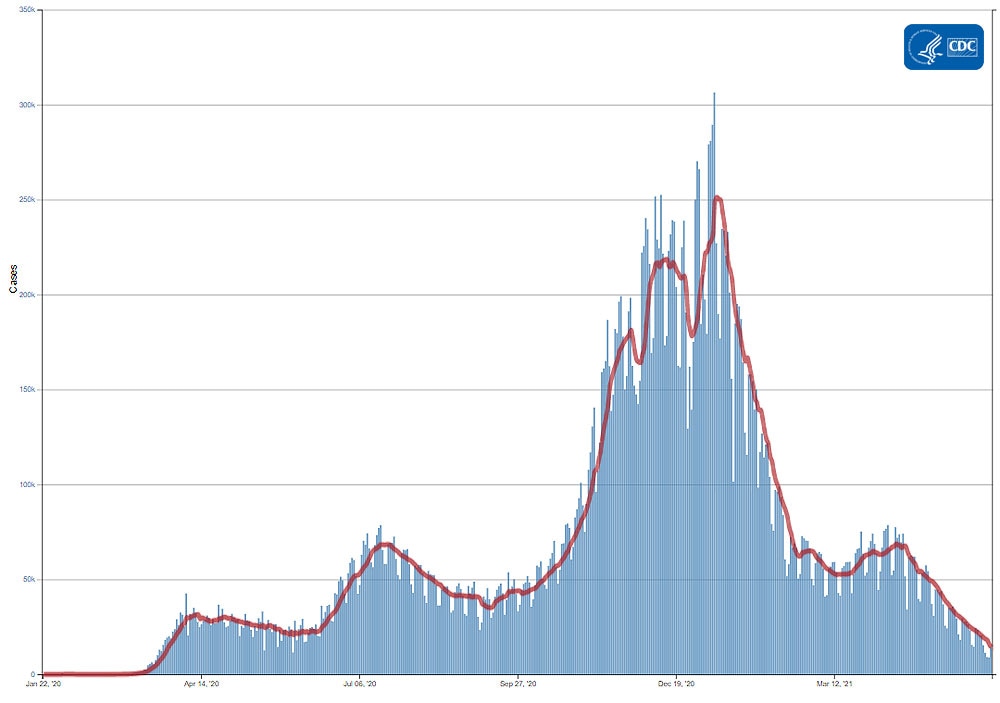
The Centers for Disease Control and Prevention said in a summary late last week that the numbers of cases and deaths had dropped to their lowest levels in almost a year.

The agency said at the time that the number of tests that came back positive for the disease over the previous seven days was below 3 percent, one of the lowest rates since widespread testing began.
The CDC's latest graph of new cases shows that drop.


The good news continued with vaccinations.
More than 136 million people in the U.S. — around 41 percent of the population — have been fully vaccinated, according to the CDC.

Just more than 51 percent of the total population has received at least one dose, and around 63 percent of people 18 or older have gotten at least one dose, according to the CDC.
That good news opened MSNBC's Dr. Fauci: The Covid-19 Pandemic ‘Isn’t Over Yet’ the night before.

Dr. Anthony Fauci urges all Americans to get their Covid-19 vaccine to stop the spread of potential variants and to allow the country to fully reopen. He also reacts to the publication of his emails during the early months of the coronavirus crisis.
I second all of Fauci's answers. Working from the end to the beginning, I think he gave the right response to criticism of his emails, that science is a self-correcting process to get to the truth and that as the state of knowledge improves, so will the advice based on it. This includes getting vaccinated as the vaccines are effective against the current variants. Finally, the pandemic may be receding, but it's far from over. CNBC got that answer when it asked Is it too soon to declare the Covid pandemic over? Follow over the jump to watch that video and others where CNBC interviews Former FDA Commissioner Dr. Scott Gottlieb.

Sunday, June 6, 2021

FiveThirtyEight asks 'Will We See More Celebrities Run For Office In 2022?'


For today's Sunday entertainment feature, I'm sharing FiveThirtyEight asking Will We See More Celebrities Run For Office In 2022?

It’s another episode of Confidence Interval, where we make a persuasive case for a hot take we’ve been hearing … and then reveal how confident we really feel about the idea. This time, we talk about celebrity politicians. FiveThirtyEight politics reporter Alex Samuels explains the rise in the number of celebrities running for political office and argues whether or not they will be successful.
As one of the commenters snarked, I'd bet $20 on the confidence interval response being "I'd bet $20 on this," as it has probably been a more common response than "it makes sense" or "meh." More seriously, celebrities running for office happens often enough to be worth noting. As Alex Samuels mentioned, Caitlyn Jenner is running for Governor of California in the upcoming recall election and Andrew Yang, arguably a celebrity, is running for Mayor of New York City. On the other hand, some candidacies end up being mere publicity stunts, such as Kid Rock for U.S. Senate. That's what I think Dwayne "The Rock" Johnson is doing. Matthew McConaughey seems to be more serious, but I don't think he'll get very far if Beto O'Rourke runs for Texas Governor.


The former Texas congressman says he hasn't ruled anything out.

I think Beto will push McConaughey out of the Democratic primary should he run, leaving McConaughey to try to win the Republican primary (good luck with that), mount an independent bid, or drop out and enjoy the free publicity. I'd bet $20 on the last option.

For more on this subject, read Samuel's article Why Americans Can’t Resist A Celebrity Political Candidate on FiveThirtyEight's website. In the meantime, enjoy your Sunday!

Saturday, June 5, 2021

Ecosystem restoration is the theme of World Environment Day 2021

Happy World Environment Day!
June 5, every year is celebrated as World Environment Day or WED. The day is set aside to encourage awareness and action to protect the natural environment. It draws attention to environmental issues such as marine pollution, air pollution, deforestation, and wildlife crime such as poaching.

Each year, WED has a new theme that major corporations, communities, governments, and celebrities adopt to advocate environmental causes.
While I mentioned last year's theme, biodiversity, and its slogan "time for nature," I focused on the effect of the pandemic on the environment. This year, I'm following more closely with the theme of ecosystem restoration. The United Nations Environment Programme (UNEP) began promoting the theme last September, when it uploaded UN Decade on Ecosystem Restoration: 10 years to heal the planet.

On 15 September 2020, UNEP and FAO launched the strategy guiding implementation of the UN Decade on Ecosystem Restoration. The UN Decade on Ecosystem Restoration 2021-2030, led by the United Nations Environment Programme, the Food and Agriculture Organisation of the United Nations and partners covers terrestrial as well as coastal and marine ecosystems. A global call to action, it will draw together political support, scientific research and financial muscle to massively scale up restoration.
That's literally the global overview. What does that look like on the ground? The United Nations Environment Programme uploaded several videos on that topic this week, including Restoration in California showing efforts in my former home state.

The United Nations Environment Programme (UNEP)’s North America Office and the government of California showcase California’s commitment to restoration in this new video which aims to show what restoration looks like in North America - emphasising how local solutions can have a big global impact.
This clip reminds me of topics I've blogged about before. Loren Poncia, co-owner of the Stemple Creek Ranch, resembles Joel Salatin in his belief that sustainable agriculture can help heal the planet. That's a good thing. Dos Rios Ranch at the confluence of the Tuolumne and San Joaquin Rivers reminds me that I blogged about the San Joaquin, America's most endangered river seven years ago. I don't know about the rest of its course, but it looks like this portion is being better cared for.

Switching to the other coast, UNEP uploaded The Living Shoreline - Building a resilient waterfront in Manhattan last month as part of its observance for today.

Restoring a park and wetlands in Northern Manhattan. New York Restoration Project believes that access to nature is a fundamental right. Since its founding in 1995 by Bette Midler, NYRP has planted trees, renovated gardens, restored parks, and transformed open space for communities throughout New York City’s five boroughs.

As New York’s only citywide nature conservancy, it brings private resources to spaces that lack adequate municipal support, fortifying the City’s ageing infrastructure and creating a healthier environment for those who live in the most densely populated and least green neighbourhoods.

The 25-year-old non-profit nature conservancy oversees 80+ acres of parkland and 52 community gardens throughout New York City.
...
The work comes on the eve of the UN Decade on Ecosystem Restoration 2021-2030, a 10-year push to revive the natural world that launches on 5 June 2021, World Environment Day. Led by the United Nations Environment Programme and the Food and Agriculture Organization, the UN Decade is designed to prevent, halt and reverse the degradation of ecosystems worldwide. It will draw together political support, scientific research and financial muscle to scale up restoration and revive millions of hectares of land and marine ecosystems.
First, I didn't know that Bette Midler was also an environmental activist, which means that I learned something new, making today a good day. Second, while I haven't written about restoring oyster reefs before, I did include a video about restoring blue mussel beds in New York Harbor in PBS NewsHour on Hurricane Sandy one year later. As a malacologist, a biologist who studies mollusks, I couldn't resist that story or this one.

I'll return with more about the environment on World Oceans Day. Until then, stay tuned for the Sunday entertainment feature.

Friday, June 4, 2021

Legend and history for National Donut Day 2021


Happy National Donut Day! I skipped celebrating the holiday last year because it was also World Environment Day, but I'm not skipping it today.* I begin this year's observance by recycling my family connection to the donut, which is more legendary than historical.

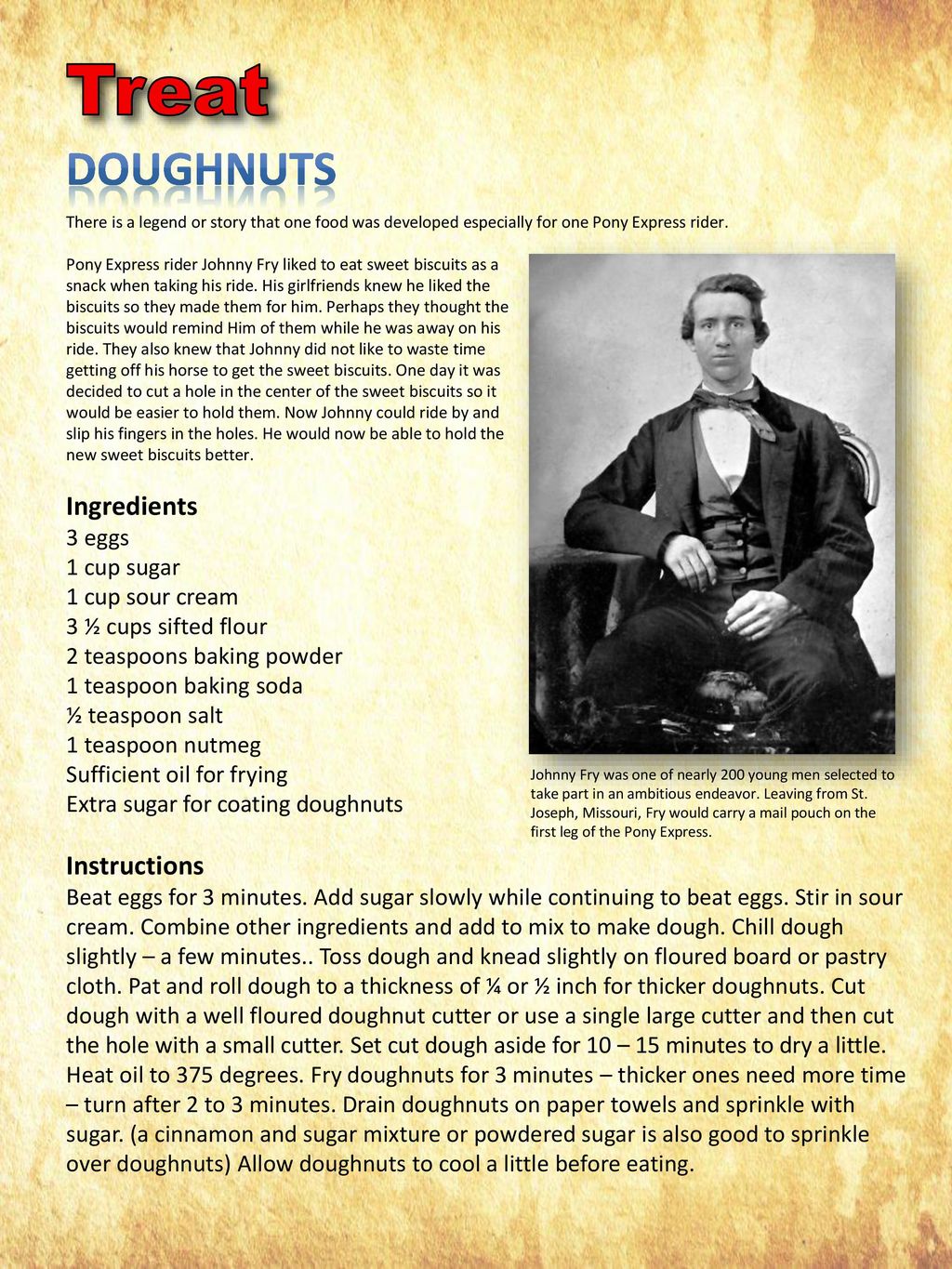
I'm descended from the brother of Johnny Fry, the first Pony Express rider out of St. Joseph, Missouri. He's connected to the origin of donuts.
Fry quickly gained a reputation for never failing to deliver the mail, regardless of weather or danger, and was a fast rider, averaging a speed of 12.5 miles per hour, including all stops. Local lore says that the donut was invented as a cake for Fry to eat while speeding by young girls homes near Troy, Kansas.
This is also family lore. My father told me that the girls would try to give him cakes and cookies, but he rode so fast that when they tried to give them to him, they would just crumble. The solution was a fried cake with a hole in the middle, which he could hook like a ring on a carousel. Thus the donut was invented.

That's a really cool story. Unfortunately, it's not the accepted one. Smithsonian Magazine gives credit to someone else a couple of decades earlier in The history of the doughnut...Johnny Fry and his female admirers are not mentioned at all, not even to debunk the legend. Darn. Just the same, Happy National Donut Day!
That's a legend about the creation of the donut. Now for some actual history about National Donut Day from its creators, the Salvation Army.

“Today is my favorite day of the year because it’s National Donut Day. The Salvation Army has a connection with the donut that you might not know about…”
As I wrote two years ago, "That's right, the Salvation Army created this holiday, not the donut shops, although they are quite content to tag along." WTOL in Toledo, Ohio exemplified this when the morning show hosts started off talking about the Salvation Army founding the holiday, then describing all the donut chains giving out deals in The morning team celebrates National Donut Day!

Today is National Donut Day, one of the morning team's favorite days!
All of my readers who feel like eating a donut, go right ahead. I'll have to beg off because of my diabetes.

*I'll write about World Environment Day tomorrow, entertainment on Sunday, and probably a pandemic update Monday. I'm in an "I can't be all DOOM all the time" mood and I plan on easing out of it over the weekend.

Thursday, June 3, 2021

WOOD-TV provides a Michigan perspective on the JBS cyberattack

I concluded Cyberattack on meat processor JBS shows how the food supply is a national security issue by telling my readers "One of those plants is in Michigan, which means I might look at this story from a Michigan perspective next. Stay tuned." WOOD-TV in Grand Rapids has been covering this story closely, so I'm sharing the reports the station uploaded to its YouTube channel beginning with Cyberattack affects JBS meat processing in US, Australia.

Meat processing giant JBS has stopped production at at least one U.S. plant after it announced it was the target of an organized cybersecurity attack. (June 1, 2021)
As the videos I uploaded yesterday reported, six plants closed. The Plainwell, Michigan, plant was not one of them, as WOOD-TV reported in Meat producer JBS says expects most plants working Wednesday.


June 2, 2021

The temporarily closed Green Bay, Wisconsin, plant was among those closed and its sign provided the preview image for Expert: Ag industry not prepared to tackle cyberthreats even though none of the reporting was from there.


Raquel Martin reports from Washington, D.C, on June 2, 2021.

I agree with Susan Duncan of Virginia Tech that the federal government and food processors need to coordinate to protect the food supply. As she said, it's bad enough that there may be food shortages in 30 years because of increased population; we don't need corruption of the technologies used in distribution to make those worse.

President Biden and Press Secretary Jen Psaki weren't the only political figures to comment on the incident. WOOD-TV reported Sen. Peters reacts to recent cyber attacks while the senator was visiting Grand Rapids.


As I pointed out yesterday, this attack shows that the U.S. food system has become a 21st Century crime scene, a national security issue, and part of the nation's infrastructure. It always was, but now it's obvious. Criminals overseas and the governments of the countries they operate in recognize this, so it's time we do, too.

I might have more about this story, but I expect I will have a pandemic update first, as the prediction of 600,000 dead in the U.S. from COVID-19 by June 1, 2021 will likely be only a few days off. I expect the country will pass that grim milestone by the end of today. Stay tuned.

Wednesday, June 2, 2021

Cyberattack on meat processor JBS shows how the food supply is a national security issue

It's bad enough when the pandemic and market responses create supply chain disruptions as I documented for the microchip supply chain for autos and appliances. It's worse when criminals disrupt supply chains as Russian hackers using ransomware shut down the Colonial Pipeline did last month. That happened again, this time to the food supply, which CNBC reported yesterday in Cyber attack hits world’s largest meat processor in North America and Australia.

CNBC's Eamon Javers reports on the latest details from the cyberattack on JBS, the world's largest meat supplier.
The food supply has now become a 21st Century crime scene and a national security issue. Lovely.

Follow over the jump for coverage of this story on the morning news shows.

Tuesday, June 1, 2021

Stories of 'Black Wall Streets' to remember the 100th anniversary of the Tulsa Massacre

Today is the 100th anniversary of the Tulsa Massacre, which both "Watchmen" and "Lovecraft Country" used as pivotal events in their stories. Those were fiction, so I'm turning to historical fact for today's observance, beginning with Time Magazine's The Overlooked Stories of America's Black Wall Streets | The History You Didn't Learn.

It's been 100 years since the Tulsa race massacre, when an angry white mob destroyed a prosperous black neighborhood in Tulsa Oklahoma. But Tulsa's story is part of a larger history of Black Wall Streets that existed in many American cities.
I like Time Magazine's suggestions about how to rebuild African-American wealth. They are positive ideas I might return to in a future entry.

Time looked at history and legacy of "Black Wall Streets" in general. Bloomberg Quick Takes focused on how Black Wall Street's Greenwood Tragedy Didn't End in 1921 in particular.

On May 31, 1921, the entire Greenwood neighborhood of Tulsa, Oklahoma, was destroyed and hundreds of its Black residents were murdered by a White mob. The massacre and the destruction of the prosperous enclave, dubbed “Black Wall Street,” was the single largest incident of racial violence in American history. While the neighborhood was razed, the survivors weren't deterred as they rebuilt Greenwood over the coming decades. But what demolished the neighborhood a second time four decades later was much less overt, but no less racist.
In his interview, Hannibal B. Johnson made a depressing observation followed by a cynical saying and an expression of hope. The depressing observation was that attempting to become respectable backfired; it made white Americans envious (not jealous, although I think I'm fighting a losing battle maintaining the distinction) and resentful. That's the fault of the white folks; I think Americans should celebrate success no matter which of our citizens achieves it.* The cynical saying was that "if you're not at the table, you're on the menu." Cynical or not, I agree with it. The expression of hope that that there are more white allies now. I hope so, too.

Both videos document the rise and fall of African-American wealth, including not only the race riots of 1919-1921, but also the straightforward effects of urban renewal and the paradoxical effects of integration in the 1960s, and the erasure of that history afterwards. Now that Americans are being made aware of it, may we not forget it again.

*This includes rich people like Elon Musk and Jeff Bezos, but that doesn't preclude taxing them more so they pay their fair share back to the country that helped them succeed.