A blog about societal, cultural, and civilizational collapse, and how to stave it off or survive it. Named after the legendary character "Crazy Eddie" in Larry Niven and Jerry Pournelle's "The Mote in God's Eye." Expect news and views about culture, politics, economics, technology, and science fiction.
The marching bands from Michigan and Michigan State teamed up for a Halloween-themed show during halftime of the football game between the schools on October 30, 2021 at Spartan Stadium in East Lansing.
He uploaded another Halloween recipe today, but I'm saving it for next year. After all, I'm an environmentalist; I conserve my resources.
That's it for Halloween and October 2021. Stay tuned for November's first post tomorrow, when I might extend spooky season one more day by writing about Day of the Dead.
For today's treat, I'm continuing my tradition for the past twoyears of blogging about monsters on Candy Corn Day. This year, Dr. Emily Zarka of PBS Digital's Storied explored the history of werewolves for Halloween, just as she exhumed the history of zombies last year. At least her werewolf history spanned only two episodes in contrast to three for zombies. Watch The Killer Origins of the Werewolf to see the first part.
Long before a full moon could transform a human into a beast, the werewolf was present across the literature, lore, and mythologies of ancient Europe. Whether a punishment for the wicked, a cure for the unlucky, or a blessing for the strong, the human to wolf shapeshifter is almost always violent. Real wolves posed a real threat to humans and their livestock, but how did these predators come to be associated with cannibalism, sorcery, and mental illness? The first in a two-part series, featuring werewolf expert and Gothic scholar Dr. Kaja Franck, this episode tackles the rise of the werewolf in its myriad of forms, looking at what happened when Christianity interceded and turned the werewolf into the embodiment of evil—a change that reached its devastating climax with the persecution and execution of accused werewolves.
While I appreciated both the history and the science used to explain it, I agree with Dr. Zarka's final question, "but why?" For the answer, watch part two, The Werewolf’s Modern Metamorphosis.
Modern interpretations of werewolves include grotesque transformations, bloodied muzzles, and loyal packs. Many of these tropes first appeared on film but how did the modern world integrate older fears of lupine shapeshifters into haunting depictions of modern anxieties? The second installment in Monstrum’s werewolf series looks at the evolution of the werewolf through Gothic fantasy, horror films, literature, and video games, exploring the monster’s evolution into one of popular culture’s most malleable metaphors. With insights from werewolf expert Dr. Kaja Franck, horror critic Meagan Navarro, and werewolf graphic novelist Olivia Stephens, this episode will help you understand why the popularity of the werewolf only continues to grow.
Werewolf of London is a classic horror film. This cocktail has nothing to do with that film, and draws flimsy inspiration from Warren Zevon's 1977 novelty song. This episode, we're bringing you a Piña Colada twist on the Trader Vic's classic that'll have you howling for another round!
THE RECIPE:
1 oz Pusser's British Navy Rum
1 oz J. Wray Overproof Rum
3 oz Pineapple Juice
1/2 oz Lime Juice
1/2 oz Cream of Coconut
2 dashes Angostura Bitters
Haha! I enjoyed this video enough that I left the following comment: "Your channel needs more subscribers, so I subscribed, and this video needs more viewers, so I'm embedding it on my blog for an entry about werewolves. Happy Halloween!" I hope my actions encourage the creators to make more videos. Since Spirits of Horror is a Canadian channel, it also has a recipe for "Ginger Snaps." I'll save that for a future post about lycanthropes, just in case Dr. Zarka and her guests are right about the rising popularity of werewolves in literature and media. After all, I'm an environmentalist; I conserve my resources in addition to recycling my comments.
Stay tuned for one final Halloween post for this year. Trick or treat!
The irony is that neither of the Haunted Mansions at Disneyland nor the Magic Kingdom in Disney World is a Victorian Mansion. The former is an antebellum plantation house and the latter is a Gothic Revival. On the other hand, Phantom Manor in Disneyland Paris is. Maybe I'll write about it next.
Our final look at The Haunted Mansion takes us all the way out to Paris, Disneyland Paris that is. To a unique version of the attraction called "The Phantom Manor". The manor presents an entirely new storyline throughout it. One that we'll be diving into with this video...
Since this video came out three years ago, Vincent Price's narration has returned to Phantom Manor. It's almost enough to convince me to put Disneyland Paris on my bucket list just so I can hear it and experience what is probably the best version of the ride — almost.
This is a Haunted Mansion cocktail. Inspired by the attraction at Disneyland and Walt Disney World, this cocktail calls in the spirits wherever they're at. It has tequila, rum, vodka, and gin among other delicious mixers.
Drink responsibly and stay tuned for more Halloween posts through the end of the month. Trick or treat!
The Gilded Age left a legacy of decay on the American landscape.
...
Haunted houses are often depicted with similar features: decaying woodwork, steep angles, and Gothic-looking towers and turrets. The model for this trope is the Victorian mansion, once a symbol of affluence and taste during the Gilded Age - a period of American history marked by political corruption and severe income inequality.
After World War I, these houses were seen as extravagant and antiquated, and were abandoned. Their sinister relationship to the troubling end of the Victorian Era in America eventually led to their depiction as haunted and ghostly in both fine art and pop culture, and is now an unspoken symbol of dread.
Why write about a copy when I can go to the original?*
INGREDIENTS
2 oz. scotch
½ oz. simple syrup (infused with cigar smoke)
1 dash orange bitters
INSTRUCTIONS
Add a lit cigar to a decanter and fill with smoke.
Mix ingredients in a cocktail shaker.
Strain into decanter and shake.
Strain over ice.
MORTICIA
INGREDIENTS
1 ½ oz. gin
¾ oz. lemon juice
½ oz. simple syrup
1 oz. raspberry liqueur
2 oz. champagne
INSTRUCTIONS
In a cocktail shaker, combine gin, lemon juice, simple syrup, and raspberry liqueur. Shake vigorously.
Strain into a chilled champagne flute and top with champagne.
Drink responsibly and stay tuned for more Halloween posts through the end of the month. Trick or treat!
*The irony is that neither of the Haunted Mansions at Disneyland nor the Magic Kingdom in Disney World is a Victorian Mansion. The former is an antebellum plantation house and the latter is a Gothic Revival. On the other hand, Phantom Manor in Disneyland Paris is. Maybe I'll write about it next.
I can use the concept for this entry next year, as Santa Clara Vanguard played "The Phantom of the Opera" in 1988 as well and The Phantom of the Opera has at least two more drink recipes. Works for me, as I'm an environmentalist who likes to recycle.
Learn how to make the perfect #PhantomHalloween drink with our spooky #SweetIntoxication cocktail!
Drink responsibly and stay tuned for more Halloween posts through the end of the month. Trick or treat!
*Courtney also has a reaction video to The Academy's "Drum Corpse Bride" show. If it's still up next year and none of the 2021 or 2022 shows inspire me, I might use it.
"Tainted Love" is a song composed by Ed Cobb, formerly of American group The Four Preps, which was originally recorded by Gloria Jones in 1964. It attained worldwide fame after being covered and reworked by British synthpop duo Soft Cell in 1981 and has since been covered by numerous groups and artists.
National Farmers Union President Rob Larew made a point that Food, Inc. makes about industrial agriculture; food processing has become too centralized and concentrated for the good of farmers, workers, and consumers and a more diverse food system would serve them better. To get students to think about that, I ask them "In 1970, how much of the beef market was controlled by the top beef packers? In 2010?" The answers show how much meat packing has consolidated during those 40 years.
In 1970, the top five meat packers controlled 25% of the beef supply. In 2010, the top four controlled 80%.
"Food, Inc." focused on how this concentration of power led to abuses of workers and outbreaks of food-borne diseases and could lead to disruptions of the food supply from market forces.
Corporate consolidation is making it impossible for cattle ranchers to stay afloat.
...
Cattle auctions happen every day throughout the US; they serve a crucial purpose for the cattle markets. Inside one of these auctions, like the one we profile in St. Onge, South Dakota, you can see how a competitive market functions. There are multiple producers and buyers competing for a commodity, which results in a value, or price, for that commodity.
But over the past 40 years, the meatpacking sector — made up of the companies that buy and slaughter cattle for consumption — has undergone a dramatic degree of corporate consolidation. In the 1980s, the US relaxed its approach to antitrust enforcement, one tool the government uses to rein in market concentration. Today, only four companies process 85 percent of all the cattle produced in the US.
Cattle ranchers say this is affecting their ability to compete for good prices and make a living. This is one way industrialized agriculture is making it difficult for independent farmers and ranchers to stay in business in America.
This is approaching the state of chicken farming, where the processors have total control over the animals and near total control over the farmers. That may be good for consumers in the short run, but it will likely drive independent farmers out of business, setting up the chicken model for beef. I don't know if that will be good for anyone but the meatpackers in the long run.
That's it for this year's exploration of "Food, Inc." for FoodDay. Stay tuned as I go all Halloween from now to the end of the month.
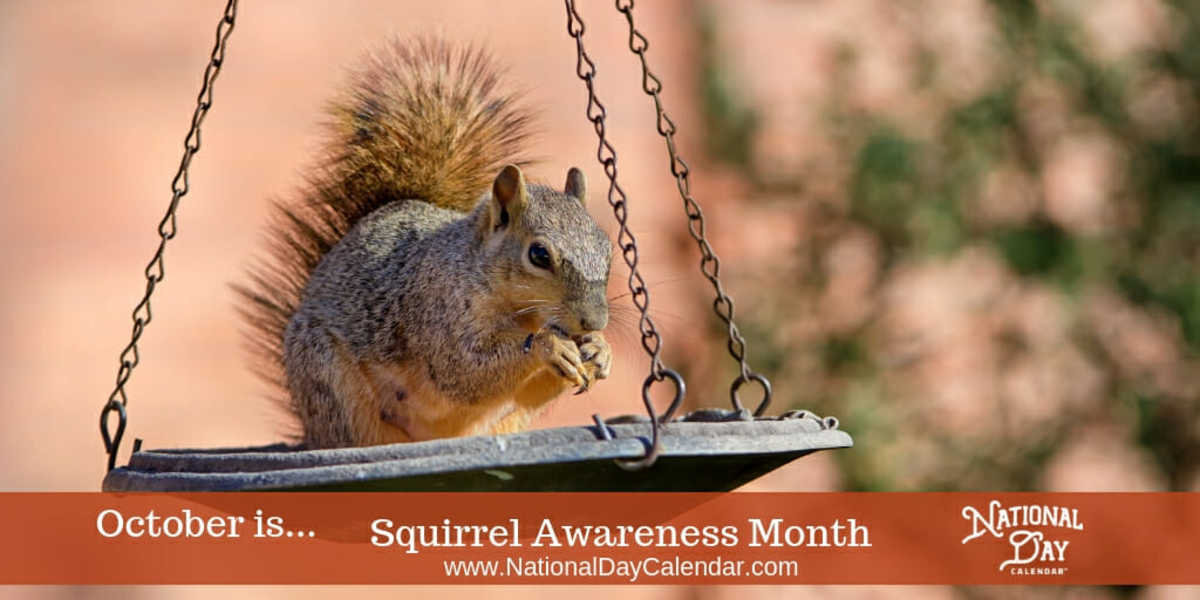
Squirrel Awareness Month is an annual designation observed in October. Yes, you read that right. A whole month dedicated to giving those furry, quirky little creatures a little appreciation. It’s a time to look around at a local park, or even right outside your window, and giggle at the silly mannerisms of squirrels.
They may come off as a little mischievous and troublesome when they get into the bird feeders or even your attic, but you may not realize why they do what they do. Squirrels spend most of the warmer months gearing up for winter. Here’s the craziest part: experts estimate that squirrels find and bury three years of food during the warm months! They don’t hibernate during the winter, but they do like to stay cozy in their dens so they can sleep and snack until it warms up again.
SciShow describes how Eastern Gray Squirrels use their mischievousness to defend their food caches in 7 Animals That Can't Be Trusted.
Almost every human has told a lie at some point or another - but did you know that we are not the only species to do this? From dogs to cuttlefish to thornbills, these 7 animals also lie!
For years, I have closed these entries by writing "May the Wester Squirrel not steal anything from you and hide it!" I didn't realize that the squirrels may be thinking the same thing about us!
*Today is also NationalFoodDay. I'm postponing my post about that until tomorrow. Stay tuned.
Happy National TVTalkShowHostDay! Since tomorrow is both NationalFoodDay and Wester, I'm going to blog about entertainment today instead of tomorrow for the Sunday entertainment feature. I'm not avoiding politics, just current real-world politics, as the subject of today's entry is "Dune," which features a lot of futuristic politics and political allegory in its science fiction. I should know, as I have read the book and watched both the 1984 David Lynch movie and the current Denis Villneuve release.
Stephen Colbert is a known "Dune" superfan so he delights in picking the brain of director Denis Villeneuve, who explains the delicate process of adapting such a far-reaching novel into a film and expresses his admiration for its star Chalamet.
My wife and I watched "Dune" at home on HBO Max, but I can imagine what the experience would have been like in a theater. Because of the pandemic, we're passing on that.
Follow over the jump for Stephen's interviews with the stars of "Dune."
Michigan drivers were overcharged more than $1 billion in auto premiums in 2020, according to a study by a national consumer advocacy group.
This report repeats what I wrote about last month; driving decreased, but fatalities increased. Also, it's a good thing that Michigan drivers received rebates last year, but could have received more, as the follow graphic shows.
At least our rates are lower now.
Follow over the jump for the details of my driving the past month-and-one-half.