A blog about societal, cultural, and civilizational collapse, and how to stave it off or survive it. Named after the legendary character "Crazy Eddie" in Larry Niven and Jerry Pournelle's "The Mote in God's Eye." Expect news and views about culture, politics, economics, technology, and science fiction.
Showing posts with label Gretchen Whitmer. Show all posts
Showing posts with label Gretchen Whitmer. Show all posts
Seth takes a closer look at Trump backing out of a 60 Minutes interview while JD Vance brazenly lied about everything from health care to abortion to January 6.
As I wrote yesterday, "Vance saying Trump saved Obamacare didn't pass the smell test. Really? Even if it were true, most people wouldn't believe it." Seth certainly didn't.
Tonight was the Vice Presidential debate between JD Vance and Tim Walz, Fox News is desperate to exploit any kind of oddness that they can conjure up about Tim Walz, the two candidates were pretty polite to each other, CBS opted to not fact check live but to have a QR code on the screen instead so we created our own – just go to MattDamonSucks.com, Trump did a play by play of the debate on Truth Social, he was in Wisconsin today where we was in full babble mode, and JD Vance (Haley Joel Osment) has released a new ad making his donut shopping a top priority.
Jimmy remarked about how polite the debaters were, but I'm reminding my readers that "the civility of the debate, the 'Midwestern nice,' masked two political movements at total odds with each other." Still are, as evidenced by convictedcriminalDonald Trump's (un)truths. Histrionic him couldn't help but make it all about himself.
The Vance-Walz debate was universally hailed as “normal,” the former president looked tired and confused at recent speeches, and Stephen’s favorite Alaskan forest animal has returned in time to defend his Fat Bear Week title.
Stephen didn't buy Vance saying Trump saved Obamacare, either.
Michael Kosta tackles last night's VP debate between JD Vance and Tim Walz and the cable news pundits who have been hard at work spinning who won. Plus, Troy Iwata is in the post-debate spin room with a definitive, scientific debate-scoring system.
I agree that Vance was slick. If he won, and the polling was a statistical dead heat, it was on style, not substance. He lied more smoothly than Walz told the truth. That's not a good thing.
Governor Whitmer talks about all the artists on the “True Gretch” playlist from her book, her friendship with Tim Walz, her response to tonight’s VP debate between Walz and JD Vance, being 30 minutes late to her first debate, being described as a “Happy Warrior,” her grandmother teaching her to look for the best in everyone, something nice she could say about Donald Trump, her parents being in a mixed marriage politically, and whether or not Americans will ever be able to find unity.
That was an insightful take on both Walz and debating. I'm glad I included it in today's post.
That's a wrap for today. Stay tuned to see what I blog about tomorrow.
I promised that I'd cover the results of Tuesday's primaries in Michigan and maybe Kansas and Missouri. Stay tuned for that tomorrow if I don't get distracted by a shinier object. The way the news has been lately, that's always a possibility.
Vice President Kamala Harris and Minnesota Gov. Tim Walz made a campaign stop in Michigan on Wednesday, a day after the Democratic nominee announced her running mate.
On the one hand, this was fun rally and both Harris and Walz were inspiring — joyful warriors, heckling aside, indeed! On the other, it must have been a little too warm for some of the attendees, several of whom needed medical attention. I'm glad the candidates cared and directed the medics to the people who needed them. I'm not sure convictedcriminalHoover Cleveland or his running mate JD Vance would have been so considerate. Hoover Cleveland would probably be annoyed that someone distracted from him. I'll show my readers Vance's reaction to the press over the jump.
Unlike Tuesday, when Walz was the star and Harris cut her remarks short to concentrate on introducing him, she was the star yesterday and gave her full stump speech yesterday, including her working the eye of Project 2025. It was worth listening to. I want to hear what it sounds like in October and November.
Speaking at Kamala Harris's rally in metro Detroit was Michigan Gov. Gretchen Whitmer, who praised the Harris-Walz ticket while calling out the contrasts between the Democrats and Republican ticket featuring Donald Trump and JD Vance.
Go Big Gretch! As my wife and I were watching this part of the rally, my wife turned to me and said "I like this Democratic Party!" So do I!
Follow over the jump for JD Vance's appearance in Michigan and the promised recap of Tuesday's primary elections.
Michigan Gov. Gretchen Whitmer signed legislation Wednesday repealing Michigan's abortion ban from 1931 that made it a crime to assist in an abortion.
Governor Whitmer is right to call this a "zombie law." It had been dead since Roe v. Wade 50 years ago and could have risen from the grave after the Supreme Court overturned Roe v. Wade. While Proposal 3's passage should have kept it there, the Democrats running Michigan wanted to take no chances, so they repealed the law. Good. I like my zombies in entertainment, not in real life.
Local 4's Paula Tutman had a chance to sit down with Governor Gretchen Whitmer for an exclusive interview just before she repealed Michigan’s 1931 abortion ban. They talked about how the battle over abortion rights is still playing out across the country and how that could impact here in Michigan.
Local 4 spoke with two women with different views on the abortion battle. In Birmingham, the repeal of the 1931 law that bans abortion in Michigan with the stroke of the pen, the law is off the books. In an exclusive sit-down interview before striking down that law, Gov. Gretchen Whitmer says she believes the moment is on the side of reproductive rights, as evidenced by what's happening around the country.
On August 25, 2018, the Democratic National Committee (DNC) members passed reforms to the Democratic Party's primary process in order to increase participation[25] and ensure transparency.[26] State parties are encouraged to use a government-run primary whenever available and increase the accessibility of their primary through same-day or automatic registration and same-day party switching. Caucuses are required to have absentee voting, or to otherwise allow those who cannot participate in person to be included.[25]
Independent of the results of the primaries and caucuses, the Democratic Party, from its group of party leaders and elected officials, also appointed 771[a] unpledged delegates (superdelegates) to participate in its national convention.
In contrast to all previous election cycles since superdelegates were introduced in 1984, superdelegates will no longer have the right to cast decisive votes on the convention's first ballot for the presidential nomination. They will be allowed to cast non-decisive votes if a candidate has clinched the nomination before the first ballot, or decisive votes on subsequent ballots in a contested convention.[27][28] In that case, the number of votes required shall increase to a majority of pledged and superdelegates combined. Superdelegates are not precluded from publicly endorsing a candidate before the convention.
There were also a number of changes to the process of nomination at the state level. A decline in the number of caucuses occurred after 2016, with Democrats in Colorado, Hawaii, Idaho, Kansas, Maine, Minnesota, Nebraska, North Dakota, and Washington all switching from various forms of caucuses to primaries (with Hawaii, Kansas, and North Dakota switching to party-run "firehouse primaries"). This has resulted in the lowest number of caucuses in the Democratic Party's recent history, with only three states (Iowa, Nevada, and Wyoming) and four territories (American Samoa, Guam, Northern Marianas, and U.S. Virgin Islands) using them. In addition, six states were approved in 2019 by the DNC to use ranked-choice voting in the primaries: Alaska, Hawaii, Kansas, and Wyoming for all voters; Iowa and Nevada for absentee voters.[29] Rather than eliminating candidates until a single winner is chosen, voters' choices would be reallocated until all remaining candidates have at least 15%, the threshold to receive delegates to the convention.[30]
Several states which did not use paper ballots widely in 2016 and 2018, adopted them for the 2020 primary and general elections,[31] to minimize potential interference in vote tallies, a concern raised by intelligence officials,[32] election officials[33] and the public.[34] The move to paper ballots enabled audits to start where they had not been possible before, and in 2020 about half the states audit samples of primary ballots to measure accuracy of the reported results.[35] Audits of caucus results depend on party rules, and the Iowa Democratic party investigated inaccuracies in precinct reports, resolved enough to be sure the delegate allocations were correct, and decided it did not have authority or time to correct all errors.
Worse yet, neither of them earned the Democratic nomination for President, despite them essentially tying in the NewHampshirePrimary. That distinction went to Joe Biden.
Despite his un[der]performance, Biden would go on to win the nomination, becoming the first candidate to do so without winning Iowa since Bill Clinton in 1992. Additionally, with Biden defeating incumbent president Donald Trump in the general election, he became the first candidate to do so without finishing in the top 3 in Iowa since the conception of the caucuses in 1972.
On top of which, Biden showed that he didn't need New Hampshire, either.
Biden became the first Democratic candidate since Bill Clinton, and the third ever Democratic candidate,[c] to win the nomination without carrying either Iowa or New Hampshire, the first two states on the primary/caucus calendar.
On top of which, many in the Democratic Party have pointed out how unrepresentative both Iowa and New Hampshire are of the current Democratic electorate, so the party is trying to rearrange its primary calendar to reflect its voters. PBS NewsHour reported on that process in Democratic Party battles over rearranging its presidential primary calendar, uploaded, appropriately enough, on Groundhog Day.
Democrats will soon vote to rearrange their calendar for the presidential primaries in 2024 and beyond and it could have major ramifications for the party. The plan moves South Carolina to the top of the calendar and would be the first time in more than 50 years that Iowa and New Hampshire won’t be the first caucuses and primary. Lisa Desjardins reports.
Both guests agreed that the Democratic primary calendar should be rearranged to make it reflect the party's voters. They just disagree that the first state should be South Carolina, which has a history of voting more for moderates than progressives. FiveThirtyEight examined that possibility in What Would It Mean If SC Voted First In The Democratic Primary.
In Part 2 of this week’s FiveThirtyEight Politics Podcast, the crew looks at how the Democratic Party's effort to rearrange its presidential primary calendar is going and discusses the impact this reassortment could have on candidate selection.
I agree with the general sense of the panel; neither New Hampshire nor Georgia will comply with the proposed changes. New Hampshire has the first primary of the Presidential country by state law and I think the Granite State won't move it. Also, these are changes that benefit the Democratic Party but not the Republican Party. The calendar in place up to 2020 suits them just fine, especially since Iowa and New Hampshire do reflect their voters. They have no motivation to go along with this reform.
Michigan House Democrats voted Tuesday to move the state's presidential primary to the fourth week of February and become a part of a new group of states slated to lead off the Democratic party's presidential primary starting next year.
Governor Gretchen Whitmer signed a new law Wednesday that would bump Michigan up in the presidential primary process. Whitmer said the law would give the state’s voters a stronger voice in choosing the president, by counting their votes earlier.
But Republican leaders said their party’s rules mean that it could actually disenfranchise their primary voters. And, in either case, it’s still not clear if the law will take effect in time for the 2024 election.
...
The bill to move up the primary passed the state Legislature on a partisan vote, with Republicans objecting because they said it would hurt voters in their own primary. The Republican National Committee rules say most states cannot hold primary votes before March 1.
...
Under the state’s constitution, in order for a law to take immediate effect, it has to pass with a two-thirds majority in the Legislature. Because Republicans held out, SB 13 didn’t cross the threshold. That means it will now take effect 90 days after the end of this year’s legislative session.
To meet that deadline, Democratic leaders would have to adjourn the legislature no later than November 29. Currently, legislators are scheduled to be in session through the first few weeks of December.
I begin my promised posts about the election results with news from my adopted home state of Michigan and start at the top of the ballot with Governor Gretchen Whitmer winning re-election. WOOD-TV used the graphic announcing that news as the preview image for Michigan's Election Day 2022 results.
In addition, Hillary Scholten won Peter Meijer's current seat. That's a relief, as I worried about the tactic used to get her a more favorable opponent after the primary.
Not only did TFG go after Meijer, the DCCC did as well, running ads "attacking" Gibbs as too extreme in the hopes that doing so would make him more attractive to the right-wing of the Republican Party so they would vote for him. On the one hand, that's smart politics, as it makes the seat easier for Hillary Scholten to win in November. On the other, it's punishing a holdout for decency and democracy in the GOP by removing him from Congress. Sigh. It worked last night, but I hope it doesn't backfire in November.
Gov. Gretchen Whitmer is delivering remarks after being the projected winner of the gubernatorial race.
Whitmer was first elected in 2018 after years in the Legislature and has since become a leading voice in the Democratic Party, delivering the party’s response to former President Donald Trump’s State of the Union address in 2020. She has said in interviews that she will not run for president in 2024 even if President Joe Biden doesn’t seek reelection.
Congratulations and go Big Gretch!
Follow over the jump for the rest of the election news from Michigan.
Election Day is next Tuesday, so it's time for me to return my attention to the candidates and issues on Americans' ballots. One of those issues is abortion rights. FiveThirtyEight examined this issue in my adopted home state in Voters Will Decide The Future Of Abortion Rights In Michigan.
On Election Day, Michigan voters will vote on an amendment that could enshrine the right to abortion in the state’s constitution. This comes after an abortion law from 1931 was ruled enforceable following the overturning of Roe v. Wade in June. Abortion is currently legal in the state, because of the ruling against the 1931 law. However, without the amendment, that law could end up banning abortion in most cases.
That's a good summary of the issue and how it ties into the Governor's contest between Gretchen Whitmer and Tudor Dixon, as well as the state of the race right now. I'm confident Big Gretch will win, although the FiveThirtyEight forecast is no guarantee. That's why my wife and I voted for her and Proposal 3.
Just 11% of Americans who are voting this year say abortion is the number one issue deciding their vote, according to the latest PBS NewsHour/NPR/Marist poll. But abortion is on the ballot in some states after the Supreme Court overturned Roe v. Wade. Zoe Clark of Michigan Radio and Ryland Barton of Kentucky Public Radio joined Amna Nawaz to discuss the debates taking place at the state level.
I hadn't heard of the ballot measure in Kentucky, which really looks like a funhouse mirror version of Michigan's. The two made for an interesting contrast while still pointing out the valid comparisons between the two. Here's to hoping Kentucky's ballot measure fails like the one in Kansas.
“How sick does a patient have to get before we can provide her evidence-based, life-saving care without risking arrest?” That’s the kind of dystopian question that medical professionals have to ask themselves when treating pregnant people in post-Roe America, says Dr. Gregory Goyert, an OB-GYN based in Detroit. “We’re going backwards for our girls,” says Warren [sic — Wayne] County Prosecution [sic — Prosecuting] Attorney Kym Worthy. It’s why the passage of Proposal 3, a ballot measure that would enshrine abortion rights in Michigan’s constitution, is so important. Yet as Election Day nears, Worthy notes that disinformation about it has become rampant. “That’s what happens when people know on the opposing side that the majority of Michiganders want Prop 3 to pass.”
I enjoyed that segment, especially listening to Kym Worthy. She pointed out the real crimes she wants to focus on, not prosecuting doctors for actions that should not be illegal.
Michigan recorded its first two cases of coronavirus on March 10, 2020. This timeline shows how the pandemic played out over the last year in Michigan, along with measures taken by the state government and Governor Gretchen Whitmer to slow the spread of the virus.
The numbers lined up next to the government actions tell quite a story, one of restrictions being imposed and coronavirus infections falling and then being relaxed and the disease returning. I hope people in the state learn from that.
Wednesday marks one year since Michigan's first reported COVID-19 cases, and a year ago, Gov. Gretchen Whitmer declared a state of emergency, which was followed by a slew of executive orders aimed at stopping the spread.
I'll return over the jump with WXYZ's look at the future of the pandemic in Michigan. That's after WDIV/Click on Detroit's retrospective, which examines what Americans in general and Michiganders in particular have already learned about the pandemic and our response in Coronavirus pandemic 1 year later: What we wish we'd known.
Dr. Frank McGeorge discusses the past year of the coronavirus pandemic.
I agree with Dr. McGeorge about the significance of asymptomatic people being infectious and masks preventing spread of the disease. If mask wearing had been recommended earlier and mask production had been ramped up sooner to match the need, millions fewer would likely have avoided infection and many thousands would still be alive.
Follow over the jump for what the present and future might hold in store, even though Dr. Arnold Monto of the University of Michigan reminded WDIV's viewers that the past year was worse than predicted, which means that my readers should take the prognostications with a grain of salt.
COVID-19 is surging across the country, with the U.S. recording another one million new confirmed cases in just the past week. As the virus shows no signs of slowing down and the economic toll deepens, President Trump spent Sunday playing golf for the second straight weekend. CBS News White House correspondent Weijia Jiang joined “CBSN AM” with the latest.
Also, 9,000 more Americans have died from the disease during the past week and 250,000 total deaths could happen in few days. Yikes! That's the bad news. CBS News also reported good news, Moderna's coronavirus vaccine shows success in testing.
Moderna says preliminary results show its coronavirus vaccine is over 94% effective. CBS News correspondent Carter Evans reports on the latest developments, and emergency care physician Dr. Ron Elfenbein joined CBSN to discuss progress towards a vaccine and the challenges involved in distributing it to millions of people nationwide.
That's even better than the Pfizer vaccine news I shared last week. I see a second light down the tunnel that isn't an oncoming train. Unfortunately, the first light definitely is a locomotive bearing down on us. We have to do our best to dodge it until the vaccines become available in the spring.
Michigan Gov. Gretchen Whitmer is asking Michiganders to take the recent pandemic order seriously, warning that if we continue at this rate, tens of thousands of people could die by mid-winter.
Impeach Whitmer for these emergency orders? Wow, talk about no good deed goes unpunished! I hope that idea doesn't get past the talking stage. In the meantime, I agree with her statement in response. Go Big Gretch!
In its most recent episode, "Saturday Night Live" debuted a new Weekend Update segment, Aidy In America, which mocked both undecided voters and the reporters trying to find and interview them. Today, CBS This Morning offered an example of the kind of reporting SNL was making fun of, Tony Dokoupil travels to Michigan to get the pulse of voters.
"CBS This Morning" co-host Tony Dokoupil travels to three crucial battleground states to talk to voters about the issues that matter most to them, less than three weeks before Election Day. Monday, he visited Macomb County, Michigan, which voted twice for President Obama, before electing President Trump in 2016.
That's a good summary both of how important Michigan was in the 2016 election and the potential importance of Michigan to the 2020 election. I also think Tony Dokoupil and his news crew went to the right place to check the pulses of Michigan voters, Macomb County. It was Macomb County that swung Michigan to Donald Trump and will be one of the crucial parts of the state in this year's election, along with Detroit proper.
Follow over the jump for the rest of the clips from "CBS This Morning."
In Michigan, the FBI and local police say they’ve disrupted a plot to kidnap the state’s governor, Gretchen Whitmer. At least six people have been arrested, and Whitmer is pointing a finger at President Trump, saying he is complicit. NBC justice correspondent Pete Williams reports for TODAY.
First, yikes! Second, "Today" was being a bit euphemistic. The participants were charged with being gang members, not militia members, although I don't think that's a bad thing. Engaging in criminal activity is what gangs do.
The FBI says it has foiled a militia plot to kidnap Governor Gretchen Whitmer, target law enforcement, and instigate a Civil War. Michigan Attorney General Dana Nessel joins Katy Tur to discuss. Aired on 10/08/2020.
"The tip of the iceberg" — again, yikes! On a more intellectual level, Nessel made an important point about the apparent contradiction of militias both targeting and supporting law enforcement. It depends on which level of government the law enforcement officers and agents are working for. Federal and state law enforcement would be the targets, while municipal law enforcement agencies such as county sheriffs and police departments in rural areas would provide some of the supporters. That resolves the contradiction on a practical level, if not a conceptual one.
Nessel also made a good point about supporting safe voting and protecting the count being the best defense against unrest during what should bea peaceful transfer of power. I hope she succeeds in Michigan. She can't help what happens elsewhere.
Follow over the jump for more videos and views about the case.
The day after the postmaster general said he would hit pause on massive changes within the U.S. Postal Service, News 8 learned a sorting machine was being dismantled in the downtown Grand Rapids post office. (Aug. 19, 2020)
I watched this story blow up on Twitter yesterday, which the WOOD-TV anchor noted. In particular, he mentioned both Michigan's Attorney General and one of Michigan's U.S. Senators retweeting the story. Both elected officials play a part in the next two videos, one off-camera and the other on-camera, from MSNBC. Follow over the jump for the reactions.
Cilizza listed Susan Rice, Keisha Lance Bottoms, Michelle Lujan Grisham, and Gina Raimondo as the other possibilities. McClatchy and Politico added Stacey Abrams and Gretchen Whitmer to their lists while leaving off Raimondo. None of them have served in Congress, so they don't have Voteview scores. They do have analyses at On The Issues, so if the announcement isn't made Monday, I might be able to create and post a Vice-Presidential version of OnTheIssues.org's take on the Democratic presidential candidates from left to center. Stay tuned.
It's Thursday and as of this morning, Joe Biden still hasn't announced his running mate, so I'm examining all of the dozen candidates mentioned as top possibilities at the start of the month, including Elizabeth Warren, Kamala Harris, Karen Bass, Tammy Baldwin, Val Demings, and Tammy Duckworth, who I already listed from left to center according to their Voteview scores.
Before I list the possibilities from left to center, I'm sharing my methods.
Mine was to rank the candidates by economic score from low (left) to high (right, or in this case center) to make it comparable to the liberal-moderate (there are no true conservatives running for the Democratic nomination) ranking I used last week which was based on the economic dimension. I then used the social score to break ties in the economic score with high scores being considered more liberal and low scores being considered more conservative.
Follow over the jump to see the contenders from left to center.
A look at the a week many mid-Michigan residents will not soon forget after heavy rain and dam failures resulted in massive flooding across the region.
...
How did the dam fail? What happens next? When the Edenville Dam failed on May 19th, 2020, it started a chain of events that would devastate thousands of lives, homes, and property. So much so that President Donald Trump has approved an emergency declaration throughout mid-Michigan hit with catastrophic flooding.
In addition, this month's flood resulted from the second highest single-day rainfall in Detroit history. Welcome to four precipitation records in four years.
The third-biggest snowstorm in metro Detroit's recorded history has plows humming among tall snow piles on roadways across southeastern Michigan this morning.
...
With 16.7 inches of snow since the storm arrived early Sunday, it's the most to fall since Dec. 1 and 2 in 1974, when 19.3 inches fell, as recorded at Detroit Metro Airport. The snowiest was April 6, 1886, when 24.5 inches were reported...
Add the snowiest month in Detroit history and that's now six precipitation records in four years. As I wrote in the first entry I wrote about the storm, welcome to weather weirding in the 400 ppm world.
I haven't been keeping as close track of Michigan precipitation records since then, as this blog has become more national and international in its focus, but it wouldn't surprise me if the state has racked up more in the past five years.
President Trump is heading to Michigan today after threatening the state and making false claims about voter fraud as flooding devastates the state. Congresswoman Debbie Dingell joins Stephanie Ruhle to react.
At least he's not threatening to withhold disaster relief now, as the caption for the MLive video reported.
Michigan Gov. Gretchen Whitmer extended Michigan’s stay-at-home order until June 12 and the state of emergency until June 19.
The pandemic response even overwhelmed what would have been the focus of the clip in normal times, Aquaman and Game of Thrones star Jason Momoa visiting metro Detroit. Even he wore a mask on the way out. Welcome to celebrity in a time of plague.
President Donald Trump on [Twitter] lashed out at officials in two swing states, Michigan and Nevada, over their moves to make it easier for more voters to cast their ballots by mail ahead of the November election, highlighting his growing anger over mail-in voting changes that he contends will hurt his chances of reelection.
The President's harsh and often baseless criticism of vote-by-mail is significantly ratcheting up as more and more states loosen their vote-by-mail restrictions proactively or on court orders.
CNN describing Trump's comments as "harsh and often baseless criticism of vote-by-mail" is certainly mincing no words. I also happen to agree with it.
Since this is a Michigan-based blog, I think this story needs a local reaction in addition to CNN's national reaction. WOOD-TV returns with one in Benson responds after Trump threatens funding.
Michigan Secretary of State Jocelyn Benson is responding to criticism after moving to send absentee applications out to registered voters for the August and November elections.
Good for you, Secretary Benson! Just the same, this looks like a fight that will be fought all the way to the November general election. Sigh.
Dr. Anthony Fauci (Brad Pitt) addresses the public to decipher the coronavirus misinformation President Trump has been spreading.
It's not every Saturday an Oscar-winning actor delivers the cold open for SNL. I think he did a great job, particularly after he took off the wig and glasses and delivered a sincere thanks to the people keeping society going during the lockdown.
Weekend Update anchors Colin Jost and Michael Che tackle the week's biggest news, like Trump’s comments about potential COVID-19 treatments and stay-at-home order protests.
#DontDrinkBleach is more direct than #TidePodPresident, but I got a kick out of calling what Trump suggested the Tide Pod challenge.
Michigan governor Gretchen Whitmer (Cecily Strong) has some safety tips for people protesting stay-at-home orders.
Strong could have used a fuller wig, but otherwise her performance was perfect. Governor Whitmer should be flattered that she is important enough to be lampooned on SNL.
That's it for the Sunday entertainment feature, which makes me feel better at the news by making me laugh at it. I hope it has the same effect on my readers. Stay safe at home, everyone!
Wednesday around noon, numerous cars caused traffic jams near the capitol building in Lansing as people took part in a protest against Gov. Gretchen Whitmer's recent executive orders.
The main order people are taking issue with is the extension of the stay at home order and what businesses are considered essential and non-essential. On Thursday, April 9, Whitmer extended that order through the end of the month and also introduced new restrictions on garden centers and stores selling furniture and paint.
As far as I could tell, there were notaxmarches on Tax Day. Instead, several states saw protests like this.
That was Wednesday. Yesterday, President Trump tweeted "Liberate Minnesota," "Liberate Michigan," and "Liberate Virginia," apparently to encourage more protests like this in swing states. CBS This Morning reported on those tweets and the protests they supported in "Trump goads protesters to defy stay-at-home orders."
President Trump took to Twitter to back right wing protests in several states, staged against the stay-at-home orders of the Democratic governors of those states. Mr. Trump's expressive "LIBERATION" tweets were met with swift replies from the governors of Minnesota and Michigan, asking what he thought the states could do better and expressing hope that he is not encouraging more protests. Nikole Killion reports on the back-and-forth as well as Mr. Trump's ongoing feud with New York Governor Cuomo.
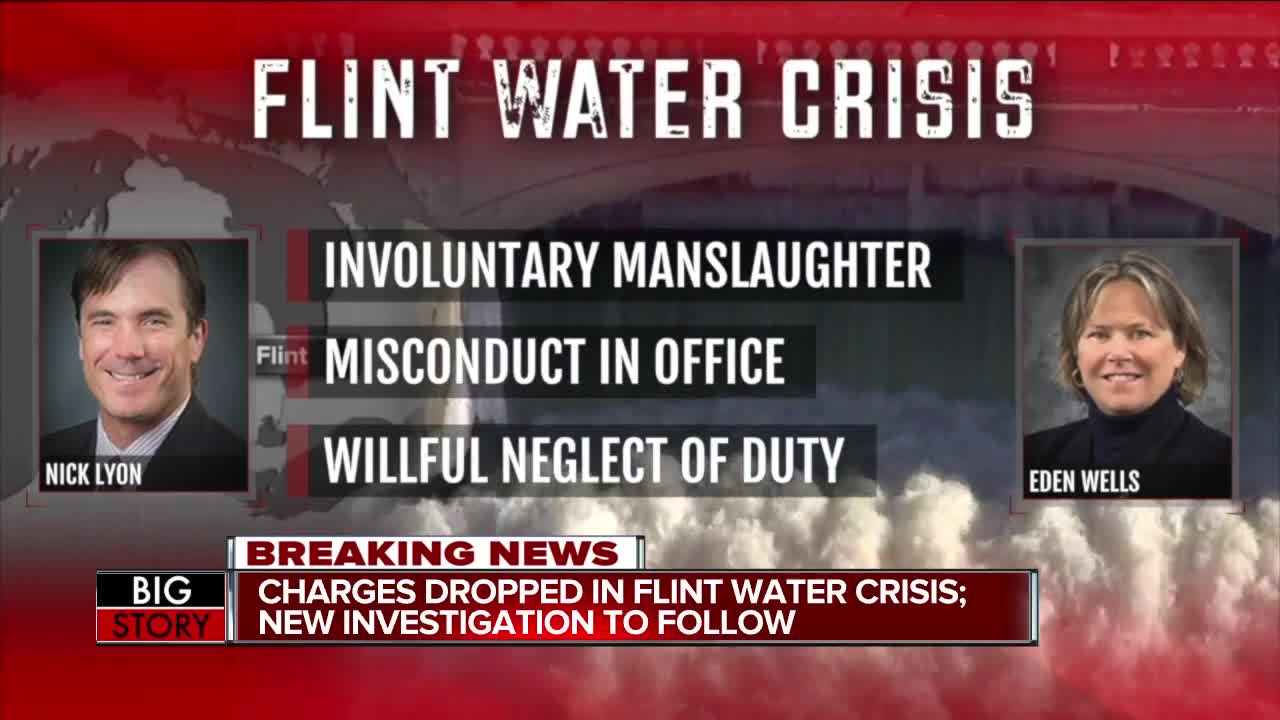
Eight remaining Flint water prosecutions have been dismissed by the Department of Attorney General, officials said Thursday, June 13, 2019. Solicitor General Fadwa Hammoud and Wayne County Prosecutor Kym L. Worthy issued a statement saying the cases are being dismissed without prejudice -- meaning they could be refiled -- in order to conduct a full and complete investigation, a shocking conclusion to the high-profile criminal prosecutions.
This video presented the headlines and facts, although I think its interpretation that this is the conclusion of the case is premature. WXYZ had the reactions from officials and people on the street in its two videos, beginning with last night's Flint Water Crisis: Charges Dropped.
WXYZ captured the desire for justice from both expert observers and the people affected, which included the possibility that charges will likely be refiled and the resulting cases will be stronger.
The Michigan Attorney General's office announced Thursday that they have dismissed all pending criminal cases connected to the Flint Water Crisis that were brought by the former Office of Special Counsel.
The quote from Former Attorney General Bill Schuette reminds me that Iwasverycynical about how he handled this case and still think Dana Nessel's more direct approach is a necessary improvement.
The attorney general says her office will not respond further on the investigation until prosecutors speak directly to the people of Flint.
I'm looking forward to hearing and reading more on this investigation at the end of the month. Until then, this news just reinforces my observation that "The wheels of justice are grinding slowly in this case, but I expect they will indeed grind exceedingly fine." If anything, they're grinding even slower than I expected, but also much finer.
Former Democratic legislative leader Gretchen Whitmer and Republican state Attorney General Bill Schuette won the nominations for Michigan governor on Tuesday, besting five other candidates who were also vying to succeed term-limited GOP Gov. Rick Snyder.
I'm glad to see El-Sayed being a team player for the Democrats. I'm looking forward to seeing more of him in Michigan politics and government in the future.
As for the Libertarians, Bill Gelineau
beat John Tatar to win the nomination for Governor.
Happy InternationalWomen'sDay! To celebrate this year, I'm expanding on something I reported last year, record numbers of women running for office. Last year, it was CNN. This year, it's CBS Evening News.
A record number of women are running for office this year, including nearly 500 who have their sights set on the nation's capital. CBS News' Meg Oliver tells us about two female candidates who are hoping for big wins in Texas, which holds its primary elections Tuesday.
ABC News' "Nightline" met with three women, who were first time candidates and could make history if they won.
That's what the picture looks like in tight focus. What about the entire picture? NPR lists the total numbers of women running for the Senate, House of Representatives, and Governor across the country.
At latest count, 431 women were running for or were likely to run for the House nationwide — 339 Democrats and 92 Republicans. At this point in 2016, there were fewer than half that: 212. Likewise, 50 women are running for or likely to run for Senate, compared with 25 at this point in 2016. Many have not officially filed for office yet — filing deadlines have not occurred in many states. But thus far, this year is on track to break records.
Democratic Nominee for Governor, Gretchen Whitmer stopped by WBKB to discuss her campaign and the bright future of Michigan.
I'm already planning on voting for her in the August primary so she can get the nomination. I also plan on voting for other women running for office, so I'll be doing my part to make the political leadership here in Michigan more equal.